
Disrupting the Borg is expensive and time consuming!

Google Search
-
Recent Posts
- Analyzing The Western Water Crisis
- Gaslighting 1924
- “Why Do You Resist?”
- Climate Attribution Model
- Fact Checking NASA
- Fact Checking Grok
- Fact Checking The New York Times
- New Visitech Features
- Ice-Free Arctic By 2014
- Debt-Free US Treasury Forecast
- Analyzing Big City Crime (Part 2)
- Analyzing Big City Crime
- UK Migration Caused By Global Warming
- Climate Attribution In Greece
- “Brown: ’50 days to save world'”
- The Catastrophic Influence of Bovine Methane Emissions on Extraterrestrial Climate Patterns
- Posting On X
- Seventeen Years Of Fun
- The Importance Of Good Tools
- Temperature Shifts At Blue Hill, MA
- CO2²
- Time Of Observation Bias
- Climate Scamming For Profit
- Climate Scamming For Profit
- Back To The Future
Recent Comments
- Bob G on Analyzing The Western Water Crisis
- arn on Analyzing The Western Water Crisis
- Bob G on Analyzing The Western Water Crisis
- Bob G on Analyzing The Western Water Crisis
- Bob G on Analyzing The Western Water Crisis
- Hank Phillips on Analyzing The Western Water Crisis
- Hank Phillips on Analyzing The Western Water Crisis
- Hank Phillips on Analyzing The Western Water Crisis
- Hank Phillips on Analyzing The Western Water Crisis
- Bob G on Analyzing The Western Water Crisis
If Hansen said it never happened til now, then damn it, that’s good enough for Mr Duncan. Unless he did not say it, then it is still OK with Mr Duncan.
Are there any satellite photos to show that condition? 😉
Steve,
Again, I suggest you read the actual article.
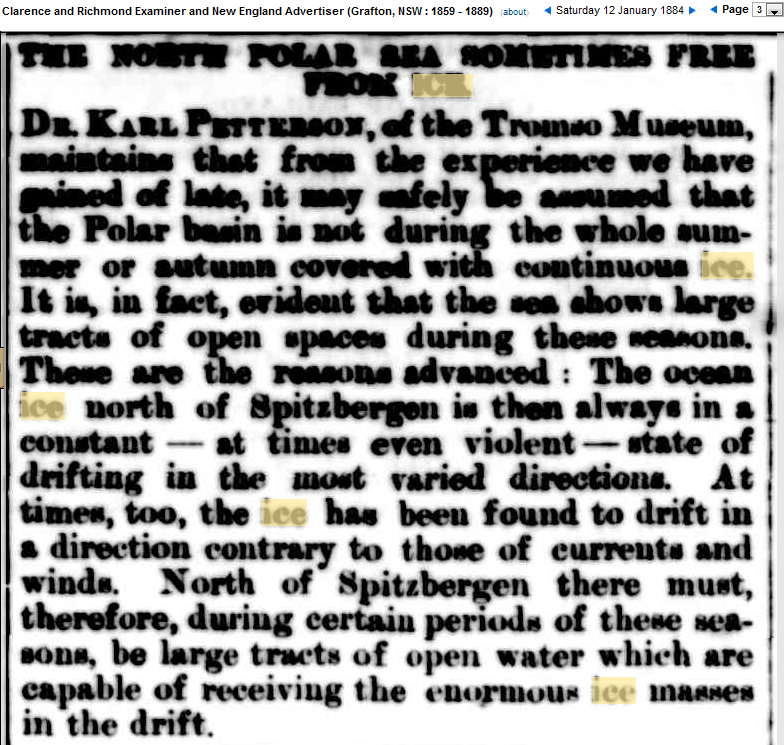
” it may safely be assumed that the Polar basin is not during the whole summer or autumn covered with CONTINUOUS ice
It is, in fact, evident that the sea shows large tracts of open spaces during these seasons.”
That does not sound like an ice free arctic either. Of course if Hansen or others have been saying that until the 1880’s the arctic was covered with continuous ice, you have totally exposed them.
Prior to 1989, the Arctic was covered with 10 metre ice. Everyone knows that.
And Polar Bears were vegans, who dined on lichens and sedges.