In reviewing the time series temperature data from Wichita, KS, which is continuous from 1889 CE through the Great Depression to the present, it looks like the 2008 prediction of temperature in 2013 is quite good. I have not had time to update this local “mini-model” but one key variable in the model is a solar activity proxy, ie sunspots. Extending this observation to published GCM models, I suspect that failure to include a solar activity proxy may have seriously impaired the predictive accuracy of those models.
In reviewing the time series temperature data from Wichita, KS, which is continuous from 1889 CE through the Great Depression to the present, it looks like the 2008 prediction of temperature in 2013 is quite good. I have not had time to update this local “mini-model” but one key variable in the model is a solar activity proxy, ie sunspots. Extending this observation to published GCM models, I suspect that failure to include a solar activity proxy may have seriously impaired the predictive accuracy of those models.

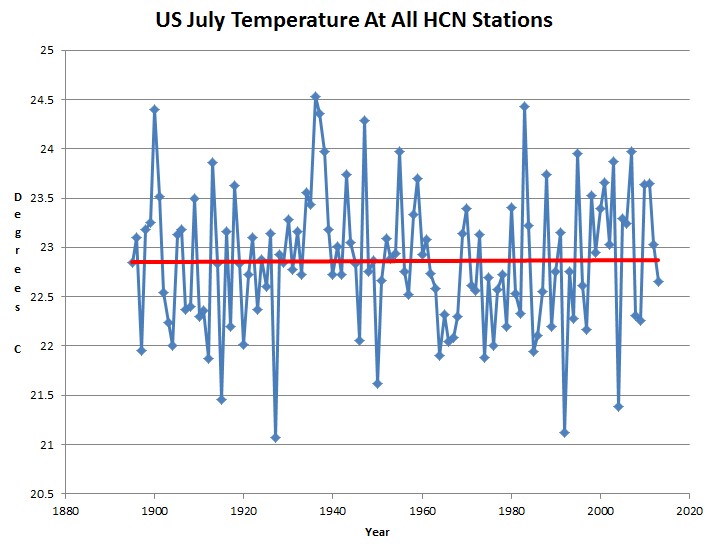


Unprecedented July Cold – Arctic Sees Shortest Summer On Record:
http://iceagenow.info/2013/08/unprecedented-july-cold-arctic-sees-shortest-summer-record/
UAH v5.6 Global Temperature Update for July, 2013: +0.17 deg. C
http://www.drroyspencer.com/2013/08/uah-v5-6-global-temperature-update-for-july-2013-0-17-deg-c/
In reviewing the time series temperature data from Wichita, KS, which is continuous from 1889 CE through the Great Depression to the present, it looks like the 2008 prediction of temperature in 2013 is quite good. I have not had time to update this local “mini-model” but one key variable in the model is a solar activity proxy, ie sunspots. Extending this observation to published GCM models, I suspect that failure to include a solar activity proxy may have seriously impaired the predictive accuracy of those models.
http:/www.well.com/~pdeep/pages/warm07/stat02/stat02.shtml
In reviewing the time series temperature data from Wichita, KS, which is continuous from 1889 CE through the Great Depression to the present, it looks like the 2008 prediction of temperature in 2013 is quite good. I have not had time to update this local “mini-model” but one key variable in the model is a solar activity proxy, ie sunspots. Extending this observation to published GCM models, I suspect that failure to include a solar activity proxy may have seriously impaired the predictive accuracy of those models.
http://www.well.com/~pdeep/pages/warm07/stat02/stat02.shtml
[corrected URL link]
Of course, NOAA’s “Climate at a glance” plots out a whopping +0.12degree/F trend per decade.