
Arizona has been getting drier for the past 110 years.
Lake Powell filled up during the unusually wet decade of the 1980s, leading to unrealistic expectations about water availability. The state has been in drought for almost 30 years.
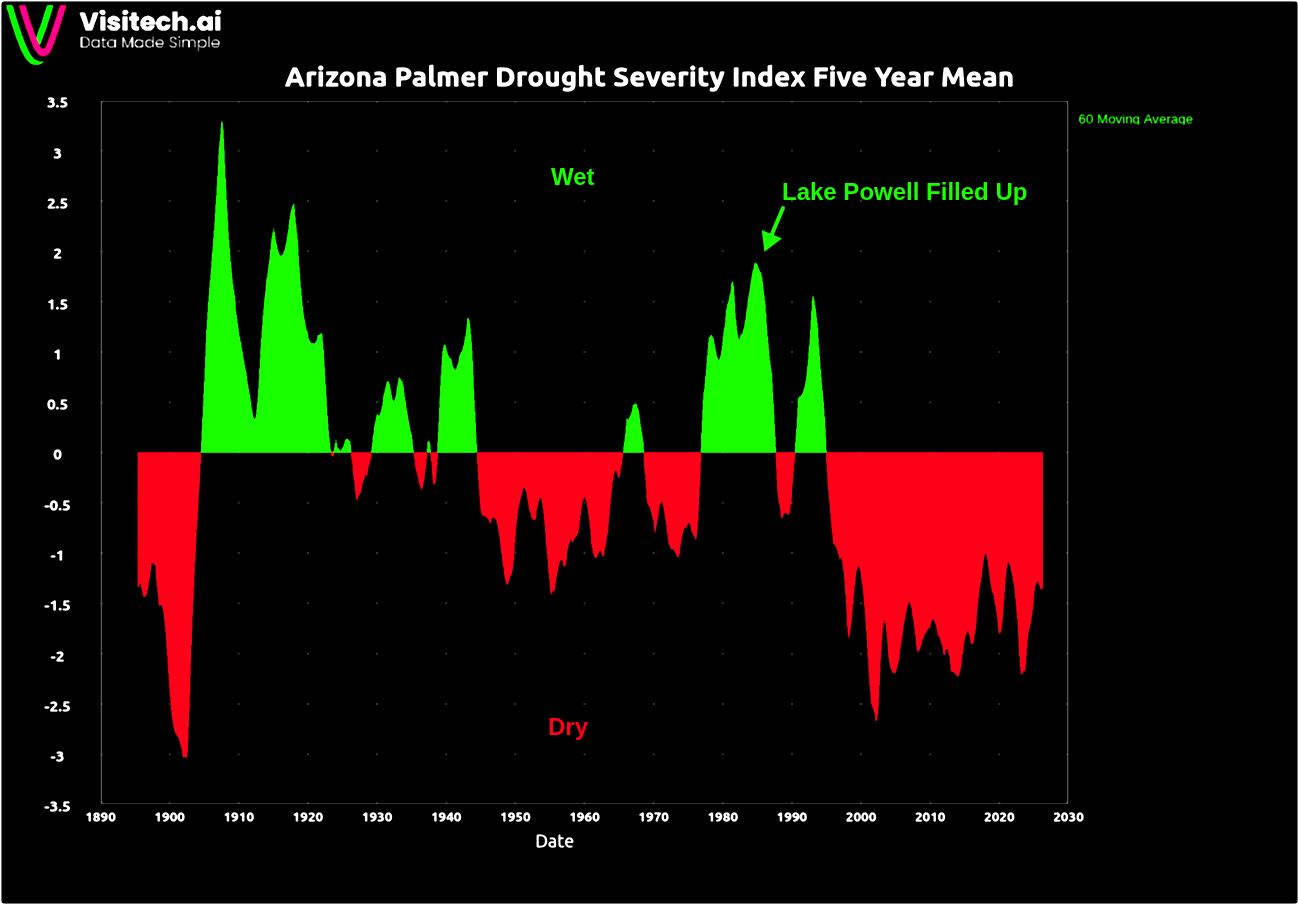
https://www.ncei.noaa.gov/pub/data/cirs/climdiv/climdiv-pdsidv-v1.0.0-20240606
Thirteen years ago I wrote this editorial in the Santa Fe paper explaining the problem of unrealistic expectations about water.
Mary Wolf of the Collected Works Bookstore recently made some valid observations describing how the climate has changed in New Mexico since her store opened in 1978 (My View, “Climate change effects: Real and local,” Aug. 4). I remember the opening of her store, a valuable asset to the community.
To understand New Mexico climate, though, we need to look much further than 1978 — which, according to the National Oceanic and Atmospheric Administration, was the coldest and snowiest winter in U.S. history. Looking back to the 13th century, the Anasazi of Chaco Canyon were wiped out primarily because of a multi-decade drought, much more severe than anything seen in modern times.
More recently, according to NOAA, New Mexico was in near continuous drought from 1946 to 1972, and that drought was more intense than the current four-year drought. And from 1900 to 1912, New Mexico was in near-continuous severe drought.
The giant aspen groves extending from Aspen Vista up to Colorado are here because of massive forest fires that burned in the 1890s. The Spokane Daily Falls Chronicle reported June 25, 1890: “It would seem that a great portion of the Sangre de Cristo range in Colorado and New Mexico is in flames.” On Sept. 30, 1898, The New York Times reported that “most of the northwest part of Colorado” was on fire. America’s worst fire occurred in 1871, when 3.5 million acres and 2,000 people perished around Peshtigo, Wis. — on the same day as the Great Chicago Fire. The worst fire in Western U.S. history occurred in 1910.
Now, let’s fast-forward to the opening of Collected Works in 1978. According to NOAA, the period from 1978 to 1996 was the wettest in New Mexico history. The 1980s were marked by spectacular snowfalls and skiing, a far cry from the normally marginal ski conditions in the 1960s and early 1970s, when nearly every ski trip ended with ski repairs.
The owner of this paper, Robin Martin, took me on my first cross-country ski trip to Wheeler Peak on May 18, 1980, which was also Mount St. Helens Day. The snow was spectacular. It was still 10 feet to 15 feet deep in many places. Many people moved to Santa Fe during the 1980s and 1990s, and came to believe that wet was the normal climate. In fact, the “normal” climate in New Mexico is drought, according to NOAA records. Over the past decade, New Mexico has seen a return to more historically normal weather.
To plan for the future, we need to be aware that drought is cyclical and is a regular feature of the New Mexico climate. There is nothing anyone can do about the weather, but New Mexicans can control how they use the limited water supply.
Tony Heller is currently living in northern Colorado. He grew up in Los Alamos and worked as a geologist at Los Alamos National Laboratory for several years. One of his hobbies is studying climate history. Heller plans to do some cycling this autumn through the beautiful new aspen groves appearing in the burn areas around Los Alamos.
Reader View: Drought is normal for New Mexico | My View | santafenewmexican.com


My family moved tothe Texas – New Mexico border between Las Cruces and El Paso in 1957. I finished grade school thru highschool at Gadsden School District in the following years. About 2017 or so I went back to a class reunion and stayed with a friend. We went up on the “mesa” west of the Rio Grande Valley and I was surprised to see grasslands. When I was a living there, the same area was rolling sand dunes with one mesquite bush poking out of the top of each big dune. The difference was a couple of years of heavy rain. Where the grass seeds came from or how they survived the long periods of drought, I have no idea. Certainly, to someone who had never been there before, they might think that grasslands were normal, which they might be, every 50 years or so.
Good work Tony, the drought, like the global temperature, has little to do with human activity, I still maintain that atmospheric injection will interfere with the water cycle. The past six months have been particularly soggy this side of the pond.,
I read a book on the I Ho Tuan or Boxer revolt in China, where Bert Hoover was holed up during hostilities. The gist of the story was that there was a drought in China, crops failed, unrest followed and foreigners blamed. Yet while China was mired in decades of controversy over poppies and opium, the subject was not acknowledged to exist. Naturally, if there is a climate record for 1900, I never saw it. But there were English-language papers and weather reports. What I wish is that someone would data-mine Google news archives and extract weather reports. That dataset, like the old clippings you have reproduced to debunk hoaxes, would doubtless shed light on conundrums. Just a thought.