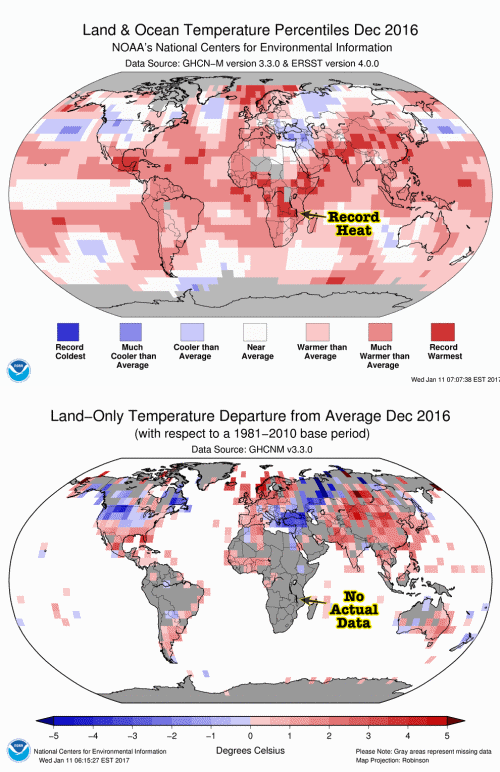
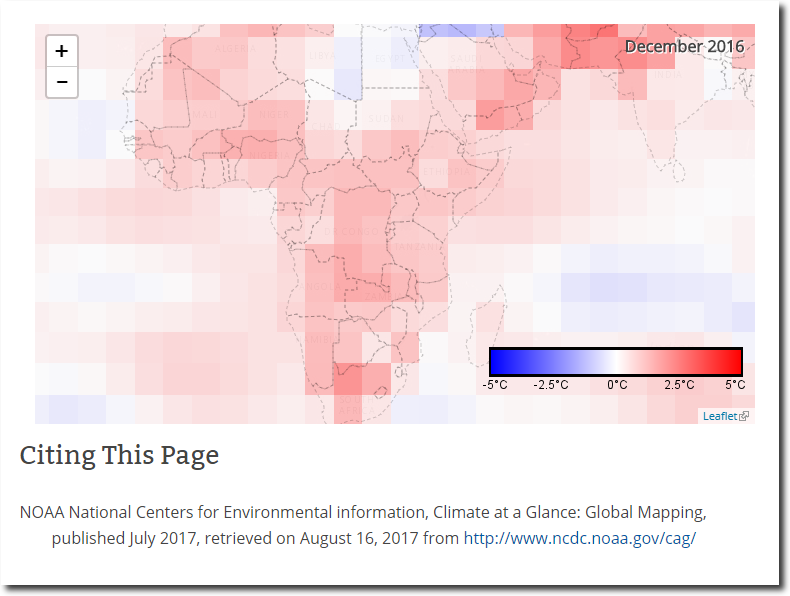
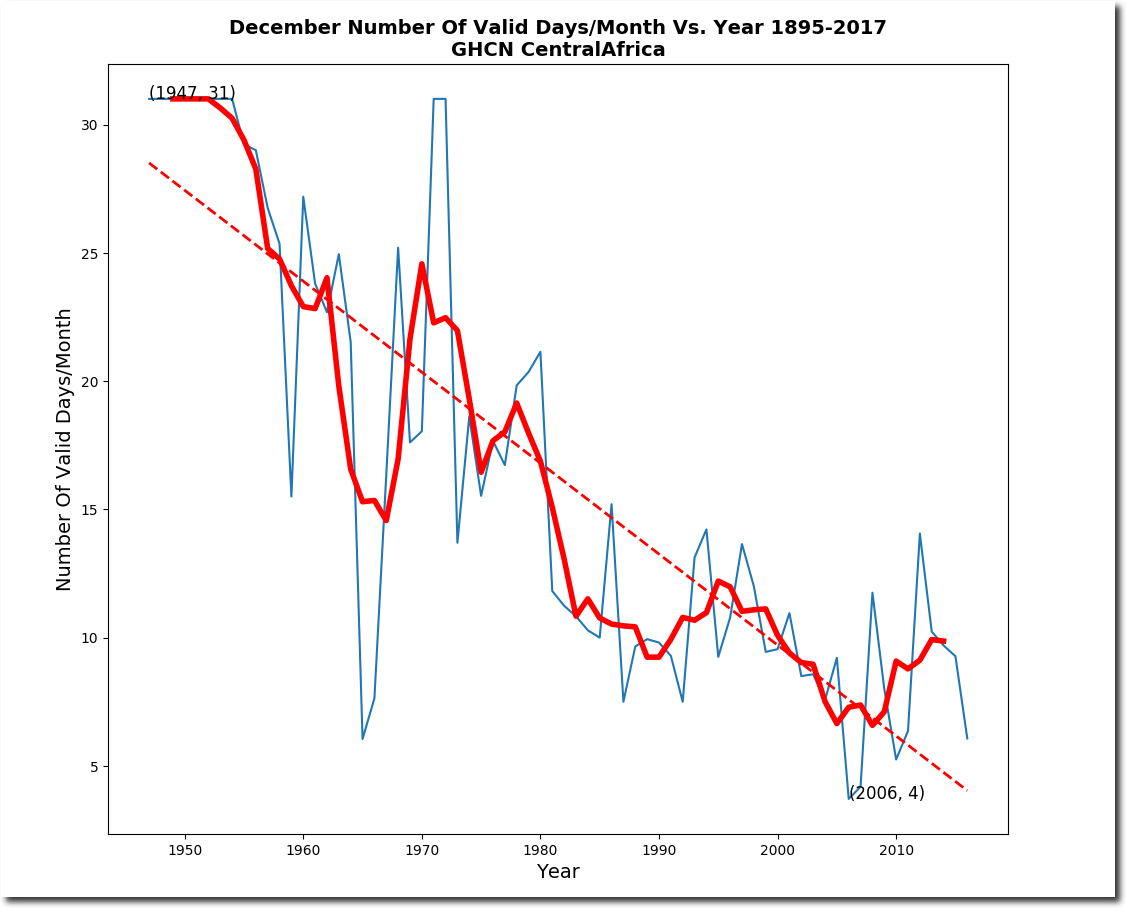
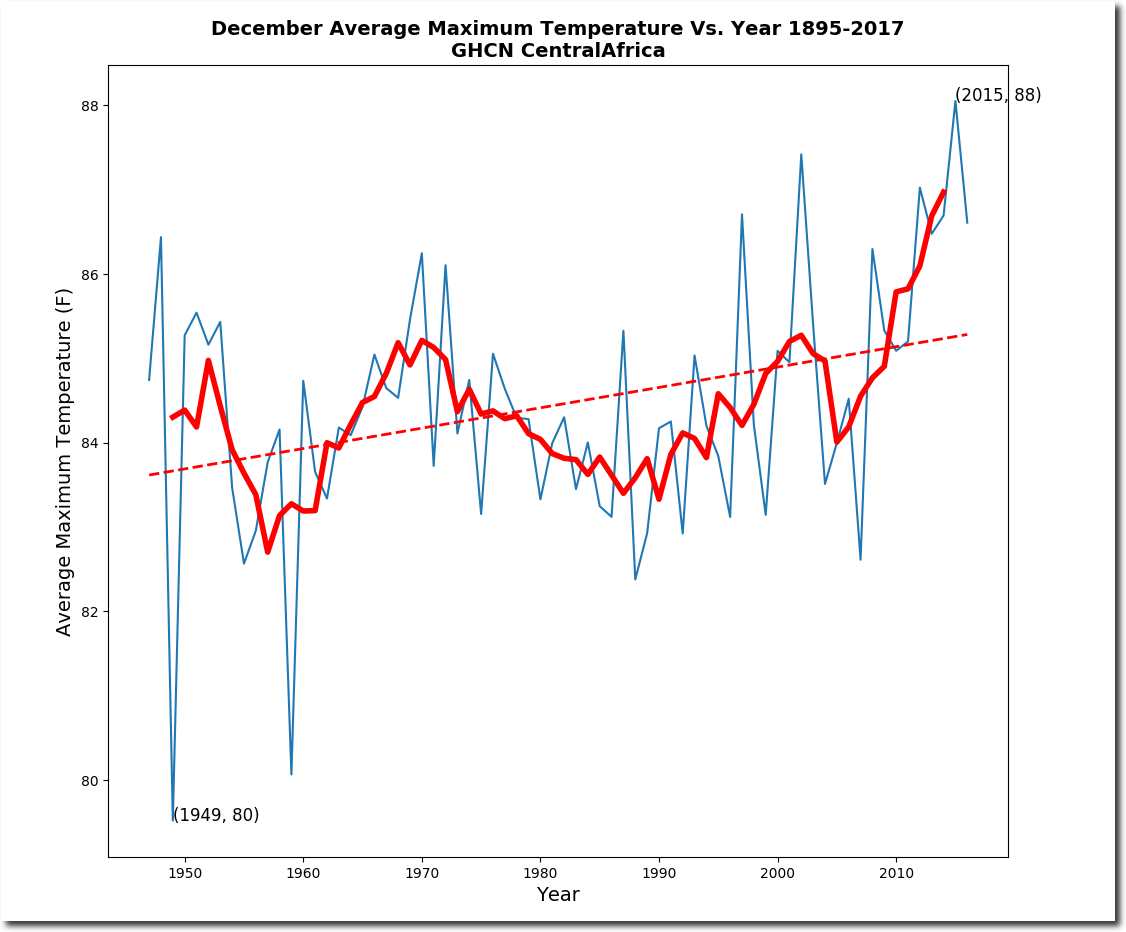
Extortion

I just moved the UNHIDING link over to Google Drive.

Posted in Uncategorized | Leave a comment

Windows Version Of UNHIDING THE DECLINE

  1. Download HIDING.zip to a directory where you have at least 400MB disk space. It contains the entire US temperature record. The python source code is here.
  2. Unzip it
  3. cd to the HIDING\release directory in a command prompt window.
  4. Run it :     ghcn.exe US.txt date=0814

(The latest ghcn.exe executable is here. Replace the one in the HIDING\release directory with that.)

It will look like nothing is happening, but after a few minutes when the temperature data set is processed, this window will pop up.

You can generate hundreds of different graph types very quickly by simply clicking on an X-axis option (left column) and Y-axis option (right column) .  Click on the “Save Image” button to create a .png file, which is in the same directory you ran ghcn.exe  from. It also generates a csv file in that directory with all of the stats.

Other command line options include :

  • spring
  • fall
  • month=[1-12]
  • date=[mmdd]
  • first_year=[yyyy]
  • last_year=[yyyy]
  • target_type=[MIN/MAX/BOTH]
  • target_min=[temperature F]      (used for stats)
  • target_max=[temperature F] .   (used for stats)
  • state=[AZ/AK/CO…..]
  • required_range=[YYYY:YYYY] . ( station must have been active in both years)

The algorithm is very simple.

  1. Average all daily temperature records for one station for one month (that is how NOAA organizes them)
  2. Average all of the 1200 station averages for that month
  3. Repeat for all 12 months, and all years from 1895 to the present.

That is it. The algorithm is an improvement over my previous software, which lumped all daily data from all stations together per month. That unfairly weighted stations which reported more days relative to stations which reported fewer days.

If you find any bugs, let me know! There may well be some. I just started this project last weekend.

To get the latest US.txt from NOAA, you can run this script from a Mac/Linux/Cygwin/Mingw command prompt. That is why I included the US.txt in the zip file.

Posted in Uncategorized | Leave a comment

Global Temperature Record Is Complete Garbage

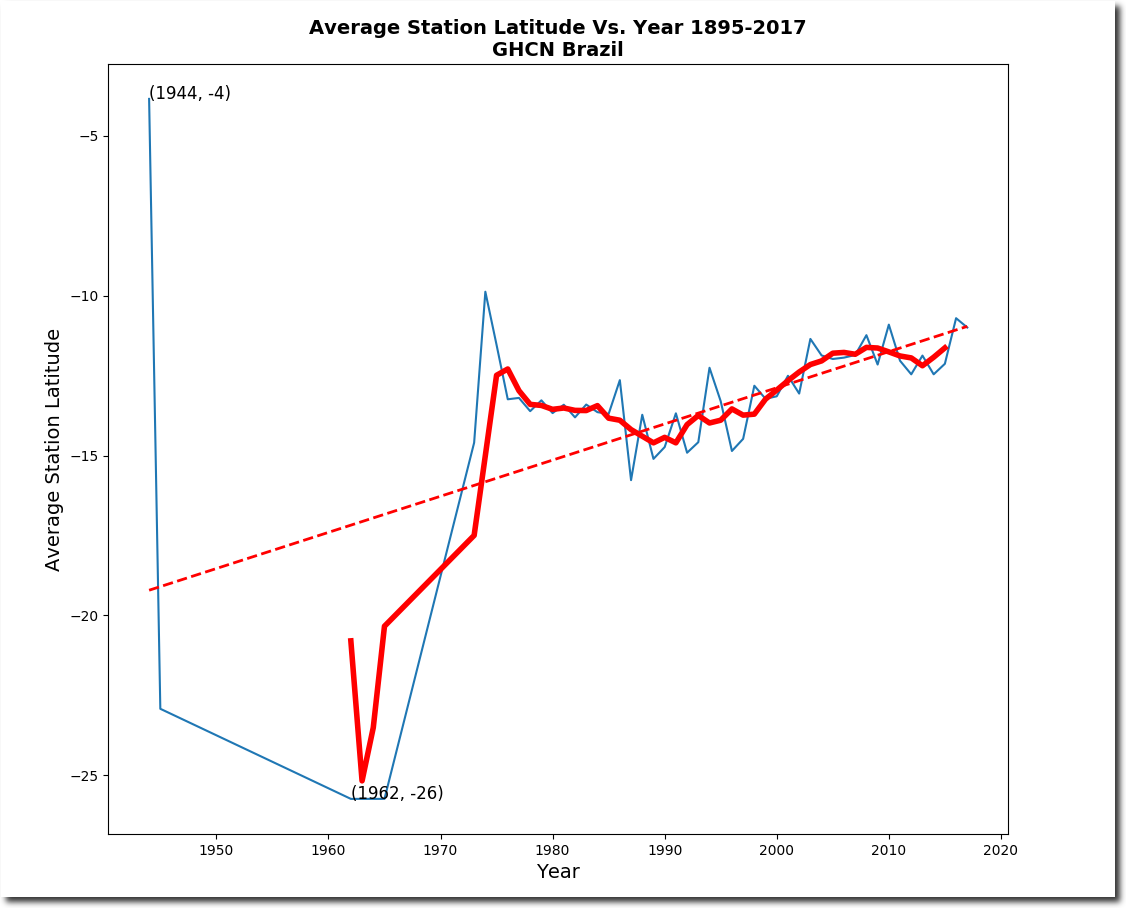
Argentina looks like it is warming – fast.

No, Argentina looks like it is cooling fast.

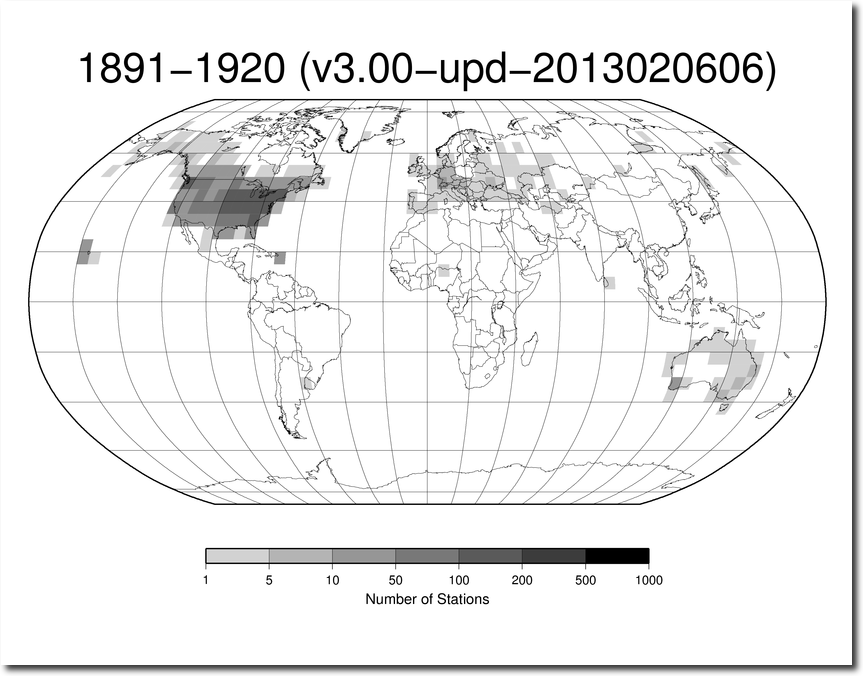
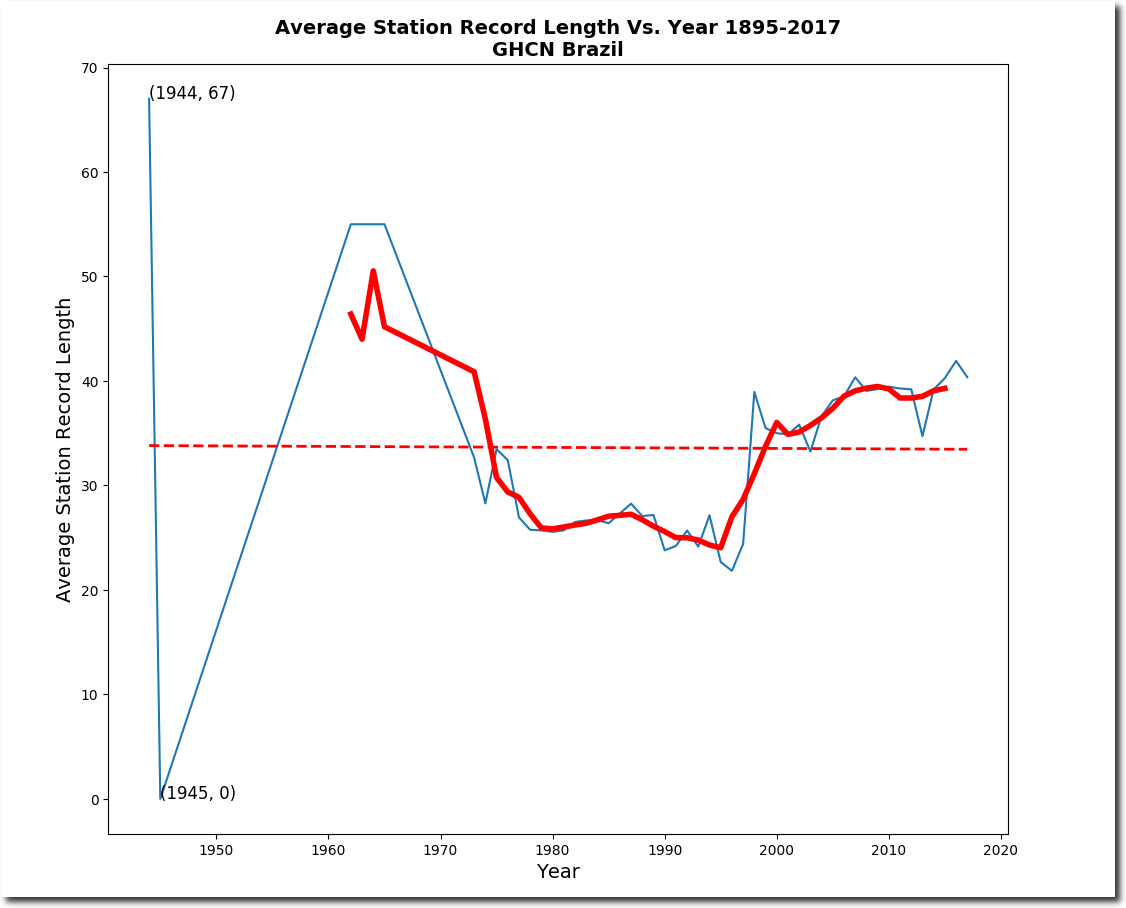
Oh wait, only one station in Argentina before 1960. In Buenos, Aires – a massive Urban Heat Island.

Argentina is typical of the global temperature record – incoherent garbage. Yet magically, all of the players (NOAA/NASA/CRU/BEST)  come up with the same graph. It couldn’t possibly be due to fraud and collusion.

Posted in Uncategorized | Leave a comment

Eclipse Of The Spotless Sun

Posted in Uncategorized | Leave a comment

2017 – One Of The Least Hot Years On Record

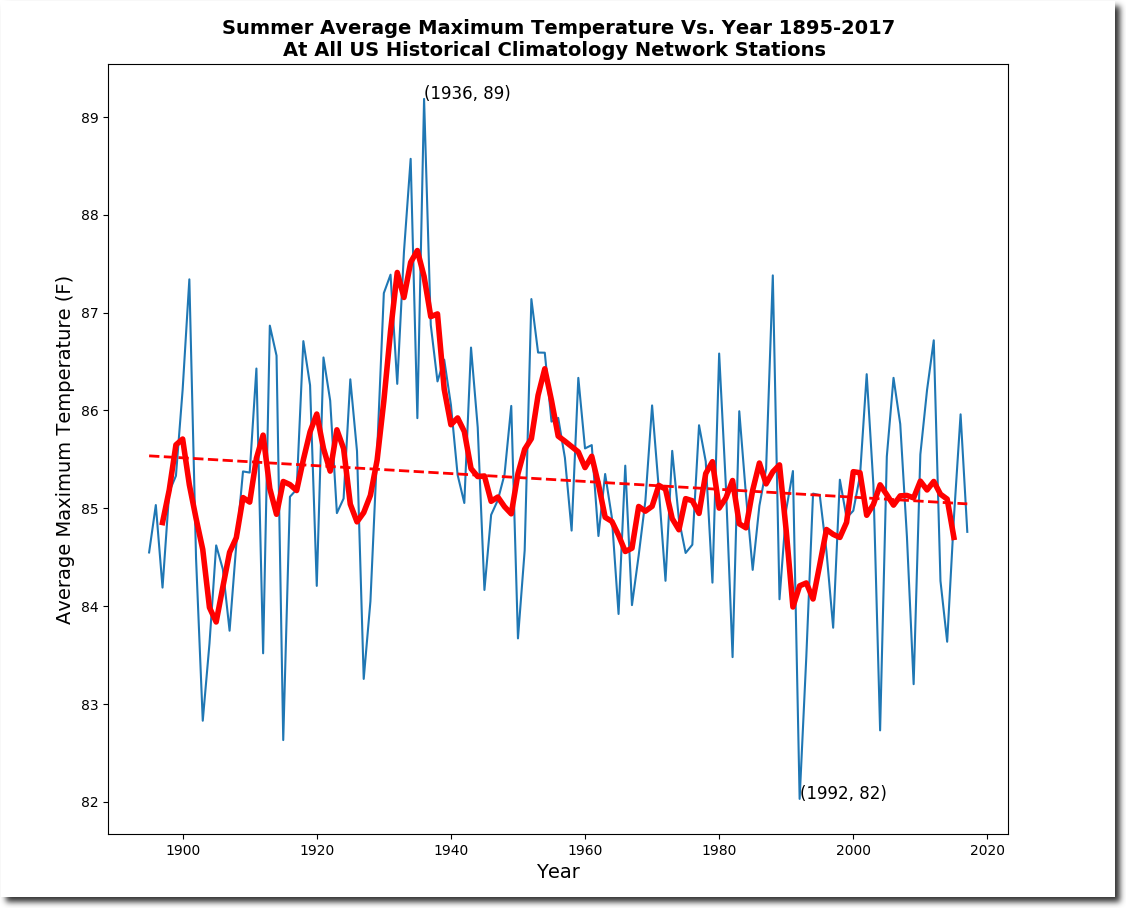
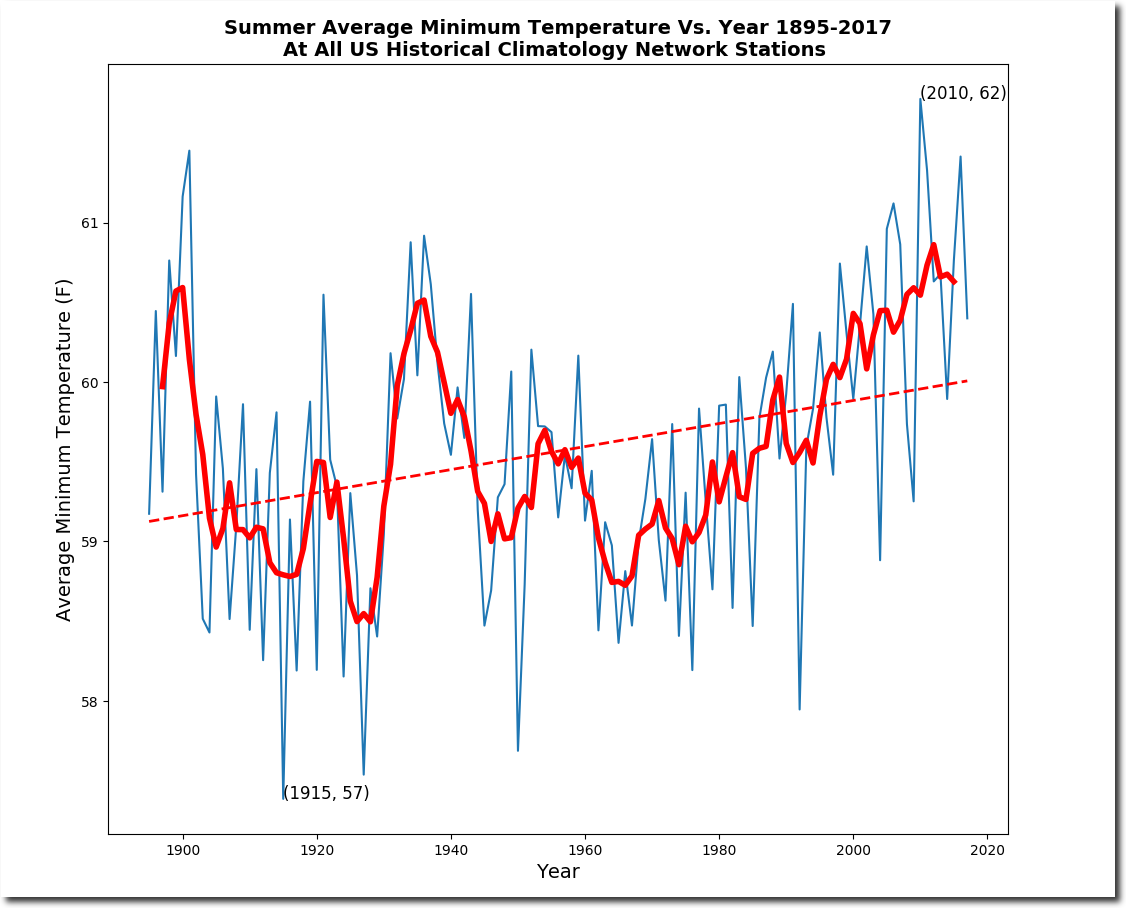
Contrary to the endless lies from climate experts and the press, 2017 has been one of the least hot years on record in the US.

Posted in Uncategorized | Leave a comment

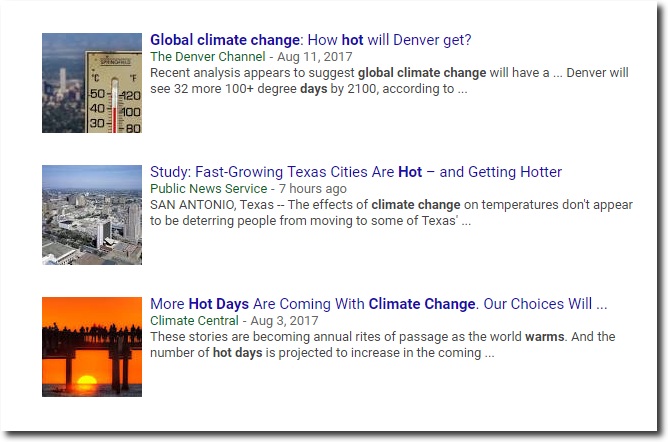
Just How Stupid Are These People?

Posted in Uncategorized | Leave a comment

Smoking Gun? Or Software Bug?

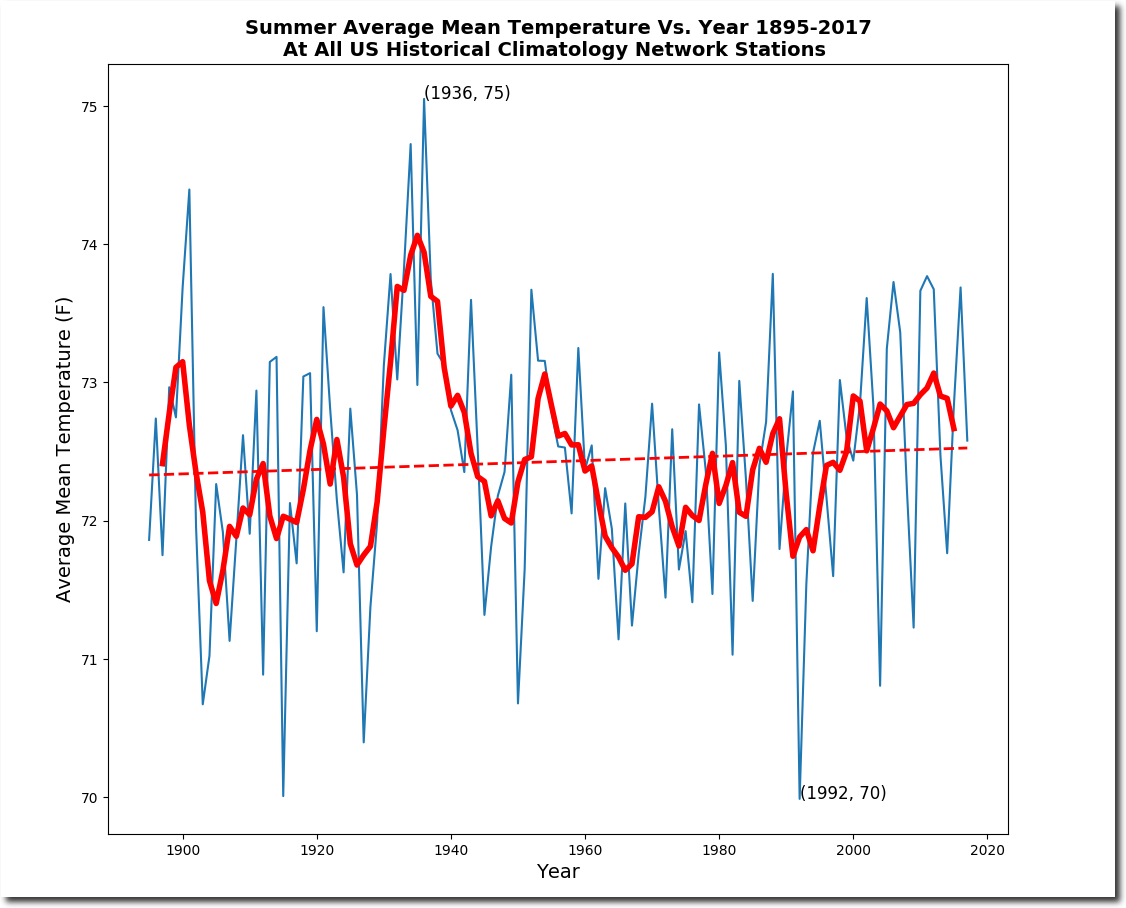
My new UNHIDING THE DECLINE software shows that US summer temperatures never recovered after the fall following the eruption of Mt. Pinatubo in 1991. I’m using a new, fairer algorithm for calculating this which weights all stations equally, regardless of how many days they report in a month. It also shows a 120 year cooling trend. My previous software showed 1992 cooler than 2004. I believe the new algorithm is more accurate.

NOAA’s fake graph shows the exact opposite. It shows an immediate recovery from the eruption, and a long term warming trend.


Climate at a Glance | National Centers for Environmental Information (NCEI)

The next graph plots both sets of data. Note the massive divergence after Pinatubo.

This graph shows the massive data tampering NOAA is engaged in. Nearly three degrees, and a hockey stick after 1990.

Since 1990, NOAA has gone from 6% fabricated temperatures to almost 50% fake data in 2017.

Note that since 1990 they have had a huge decrease in the number of temperature readings per month listed in their database. Between missing stations and missing days, adjusted data is almost half fake.

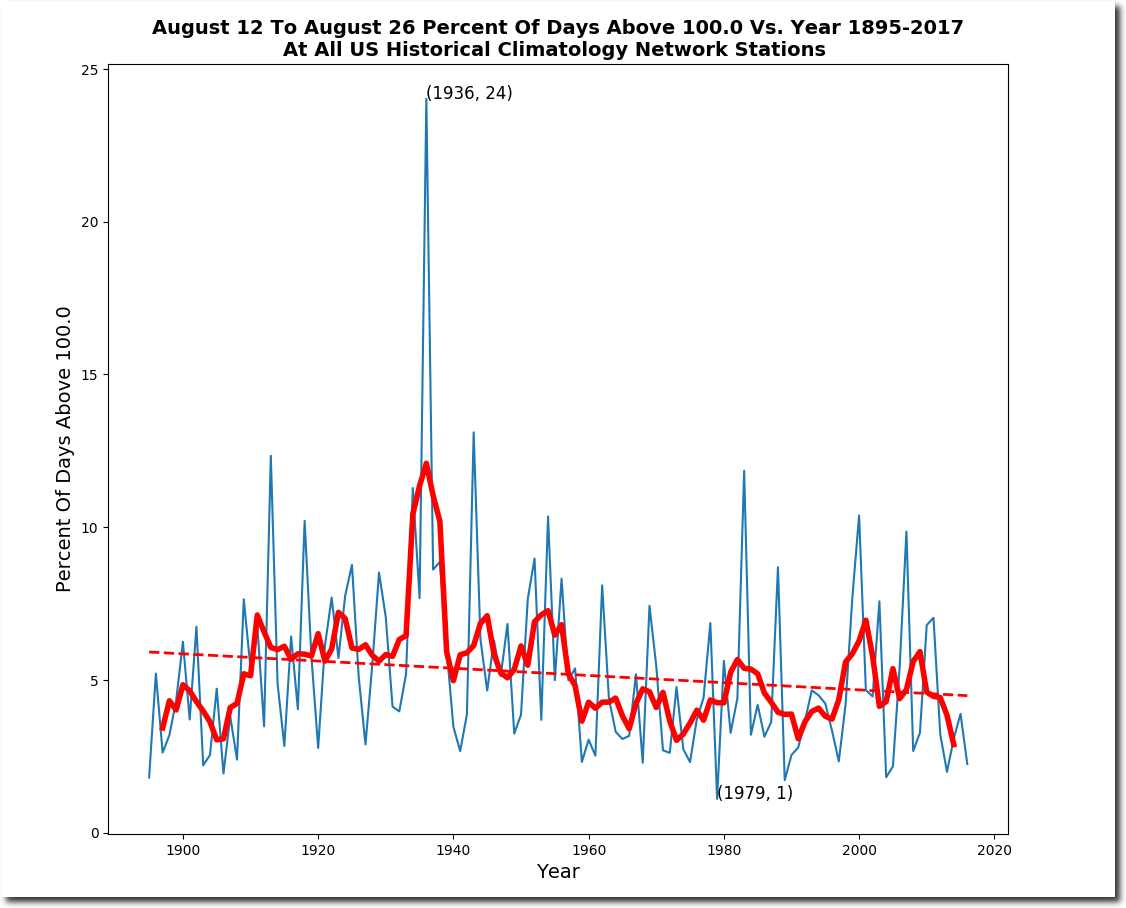
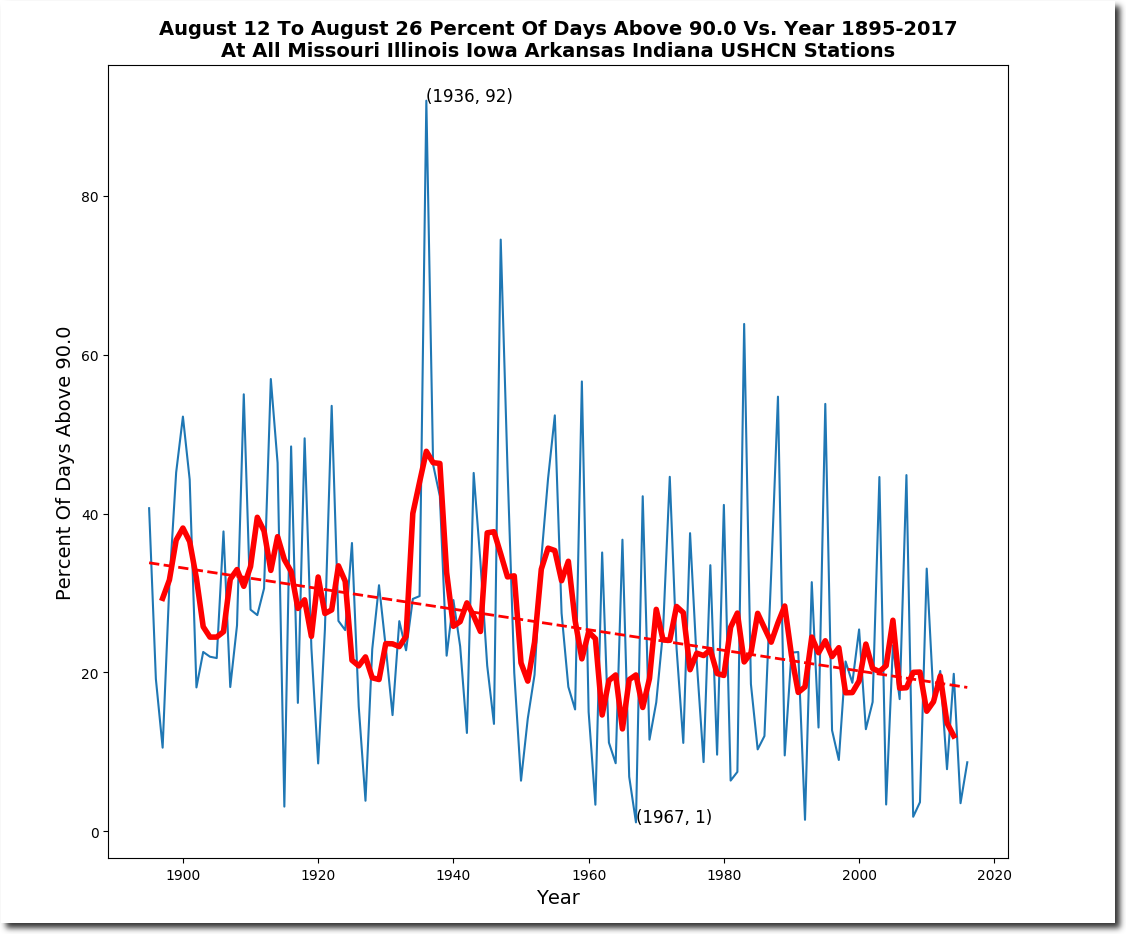
Other evidence is the frequency of hot days, which shows the same pattern as the raw averages.

It is possible that I have a bug in my new software. It is also possible that I am closing in on nailing down how their temperature data racketeering works. It appears that they are replacing cold readings with fake hot ones.

Posted in Uncategorized | Leave a comment

Plummeting August 13 Temperatures In The US

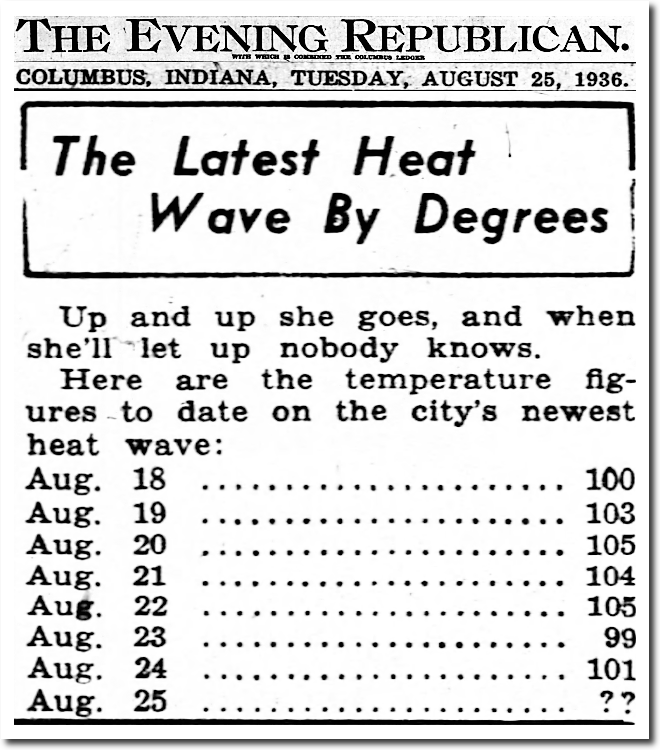
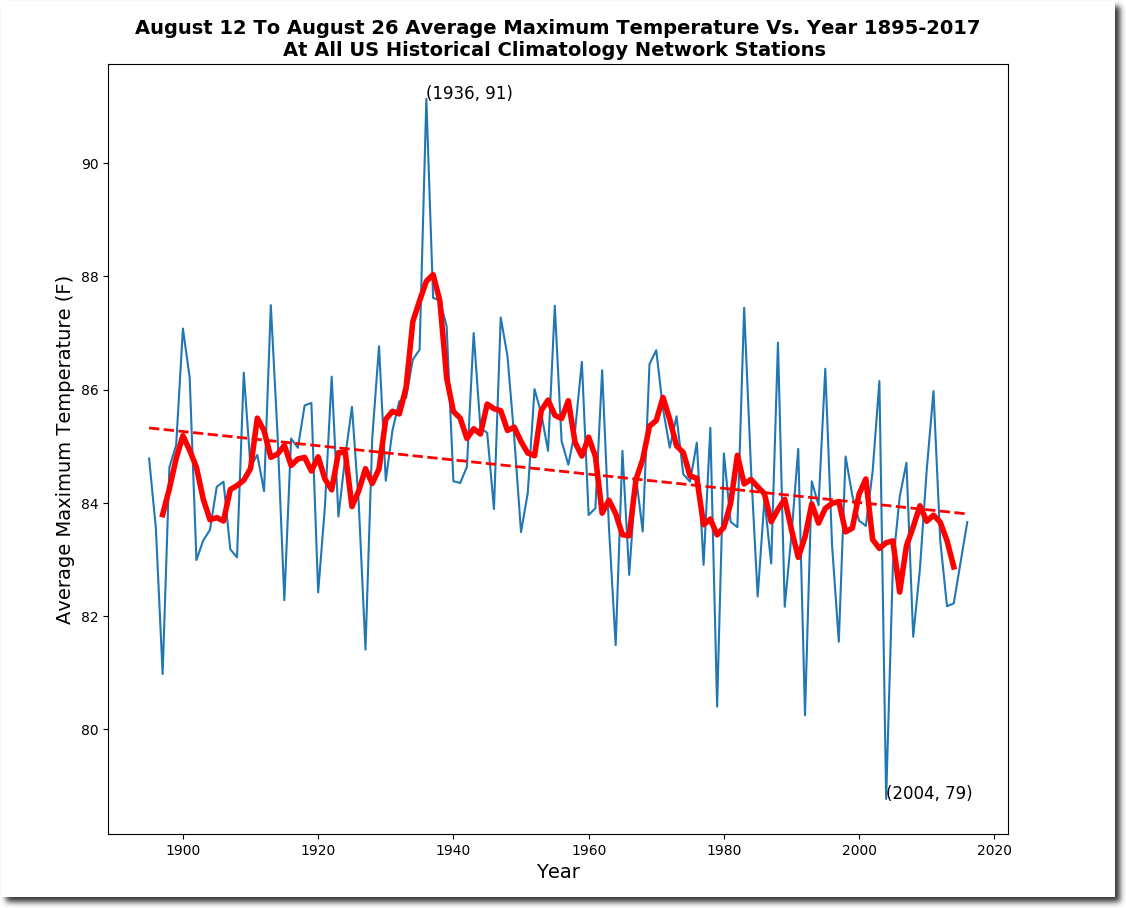
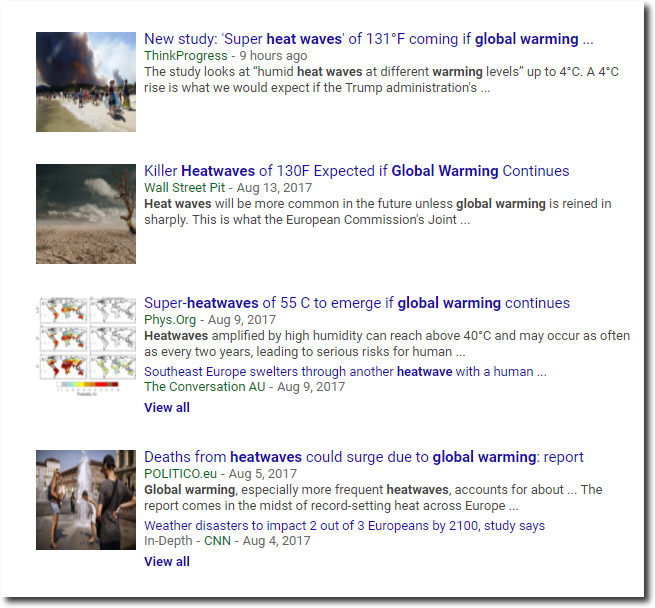
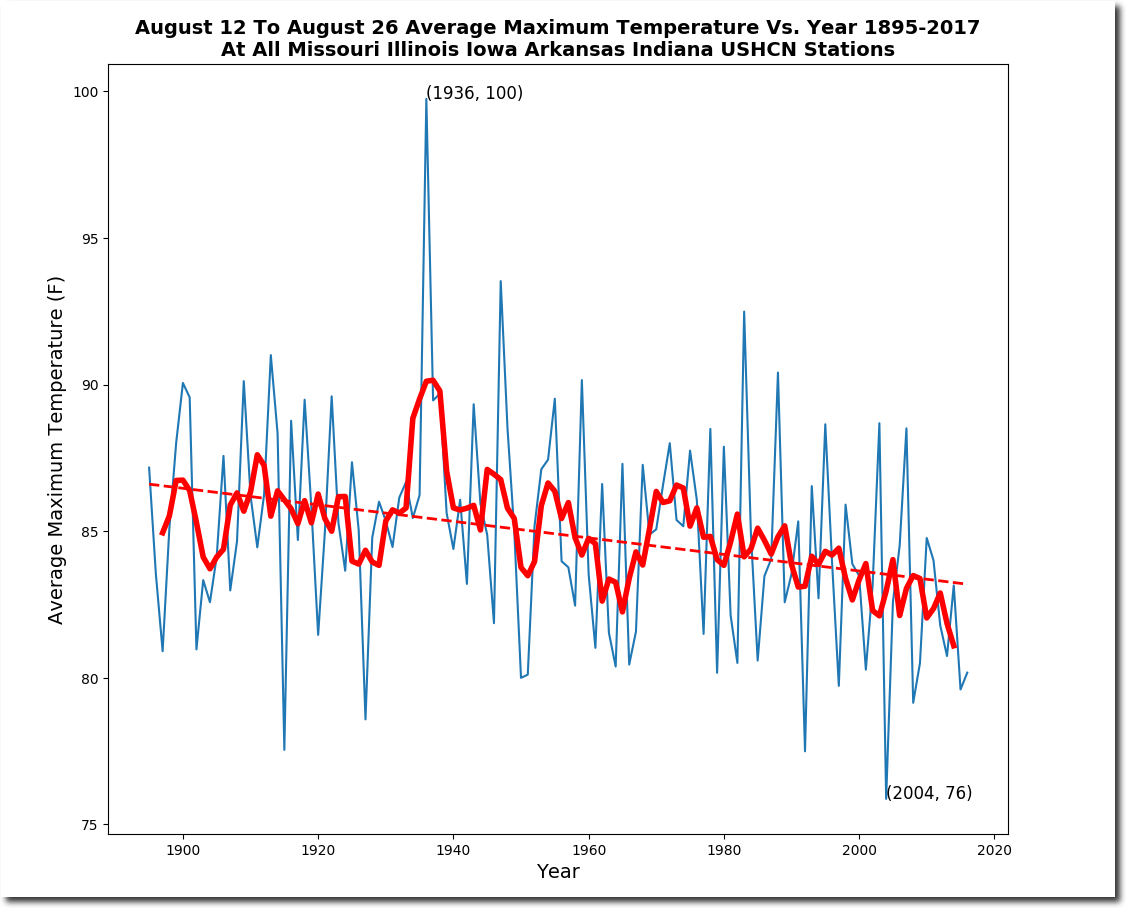
On this date in 1936, the US was incredibly hot. Minneapolis, Kansas was 119 degrees, 32 degrees warmer than their forecast maximum today of 87 degrees. Experts say this is the hottest year ever, and temperature extremes are getting much larger.

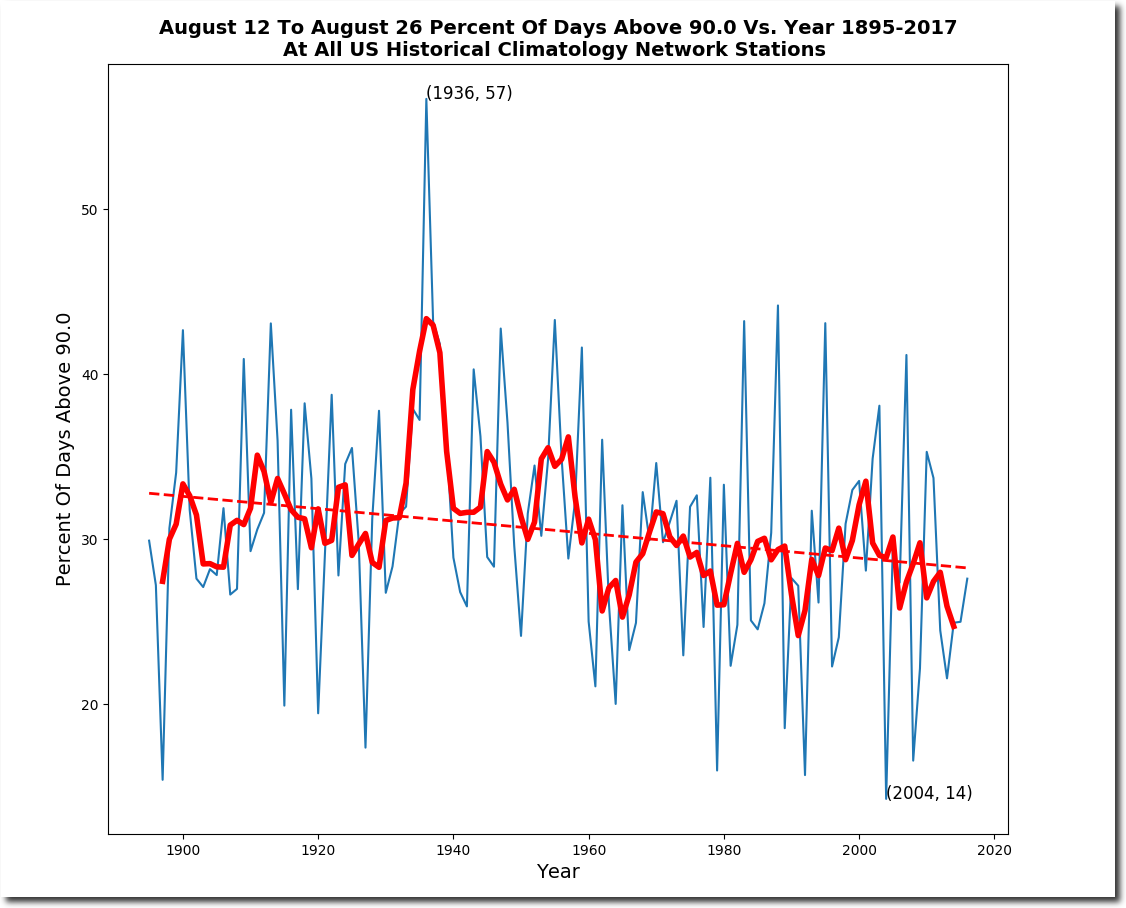
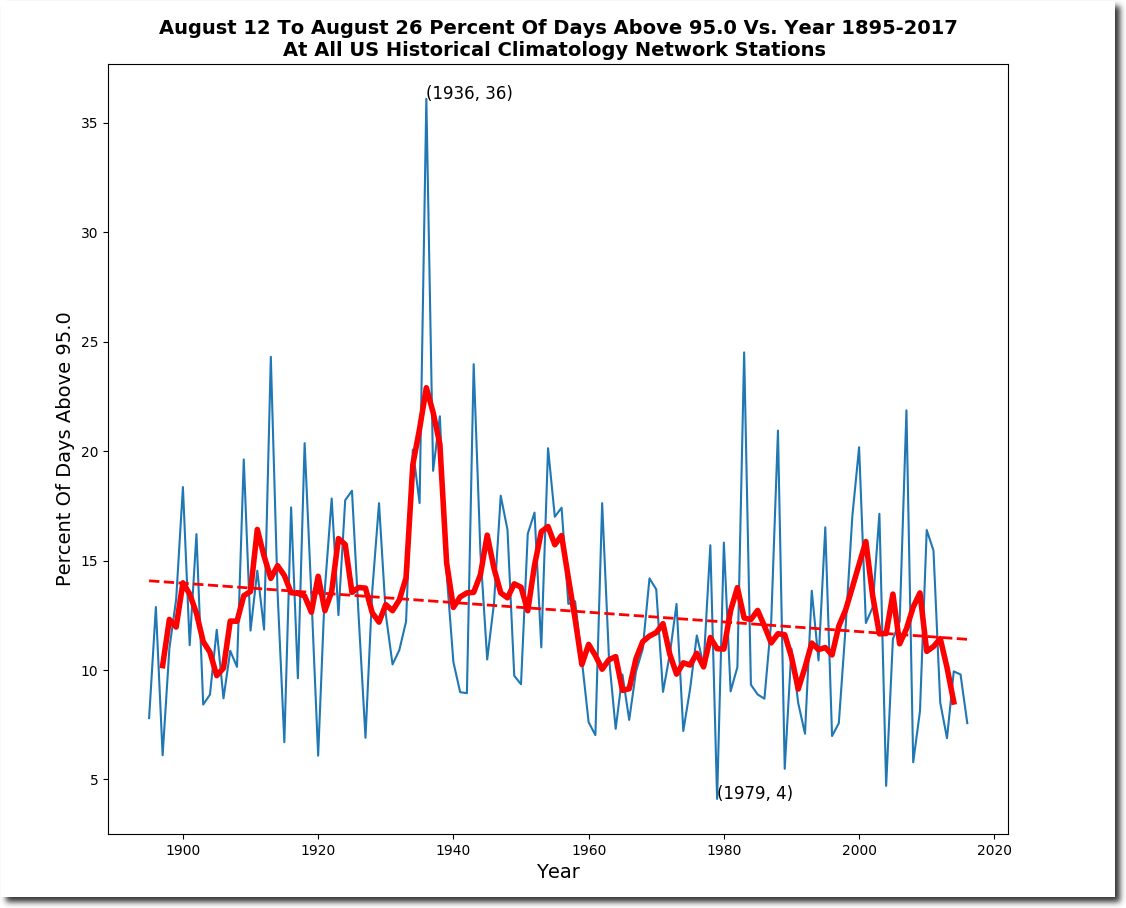
The data shows the exact opposite of expert claims. The range of daily temperatures is plummeting – indicating that the climate is becoming much milder.

Government climate experts are criminals – not scientists.

Posted in Uncategorized | Leave a comment

UNHIDING THE DECLINE

Update : There were some errors in the initial release. Please try again.

This is the initial release of my new GHCN software, titled UNHIDING THE DECLINE. It is designed to allow you to process large GHCN databases on a small computer with little memory, and make graphs very quickly.

The initial release is just for people who have python available. This includes any Mac or Linux user, and any Windows user who is willing to make the effort to install python3 and a gnu environment like cygwin or mingw. I will release a Windows exe file soon.

Open a terminal window

python3 -m pip install matplotlib
python3 -m pip uninstall numpy
python3 -m pip install numpy==1.12.1

Download these two files from dropbox :  GHCNPY.tgz  get
tar xzvf GHCNPY.tgz
cd GHCNPY

Try this command to reproduce the plot above. It will take several minutes to bring the screen up, as it has to process the data

python3 ghcn.py US.txt summer text=”USHCN”

You can generate hundreds of different graph types very quickly by simply clicking on an X-axis option (left column) and Y-axis option (right column) .  Click on the “Save Image” button to create a .png file, which is in the same directory you ran the ghcn.py script from. It also generates a csv file in that directory with all of the stats.

Other command line options include

  • spring
  • fall
  • month=[1-12]
  • date=[mmdd]
  • first_year=[yyyy]
  • last_year=[yyyy]
  • target_type=[MIN/MAX/BOTH]
  • target_min=[temperature F]      (used for stats)
  • target_max=[temperature F] .   (used for stats)
  • state=[AZ/AK/CO…..]
  • required_range=[YYYY:YYYY] . ( station must have been active in both years)

The algorithm is very simple.

  1. Average all daily temperature records for one station for one month (that is how NOAA organizes them)
  2. Average all of the 1200 station averages for that month
  3. Repeat for all 12 months, and all years from 1895 to the present.

That is it. The algorithm is an improvement over my previous software, which lumped all daily data from all stations together per month. That unfairly weighted stations which reported more days relative to stations which reported fewer days.

To update the USHCN database, change the permissions on the bash get script, and run it “./get” . That will create a new US.txt file.

If you find any bugs, let me know! There may well be some. I just started this project last weekend. I’ve been at this for 12 straight hours and need to get out on my bike!

Posted in Uncategorized | Leave a comment

About To Go Nuclear Against The Climate Scam

I plan to release my new GHCN 2.0 code today. I just generated all of these plots in less than one minute. The code is easy to understand, and unlike Mosher’s thought process – is fully reproducible.

Posted in Uncategorized | Leave a comment