
By Joe Romm on Sep 22, 2010 at 6:26 pm
Serreze: “I stand by my previous statements that the Arctic summer sea ice cover is in a death spiral. It’s not going to recover.”
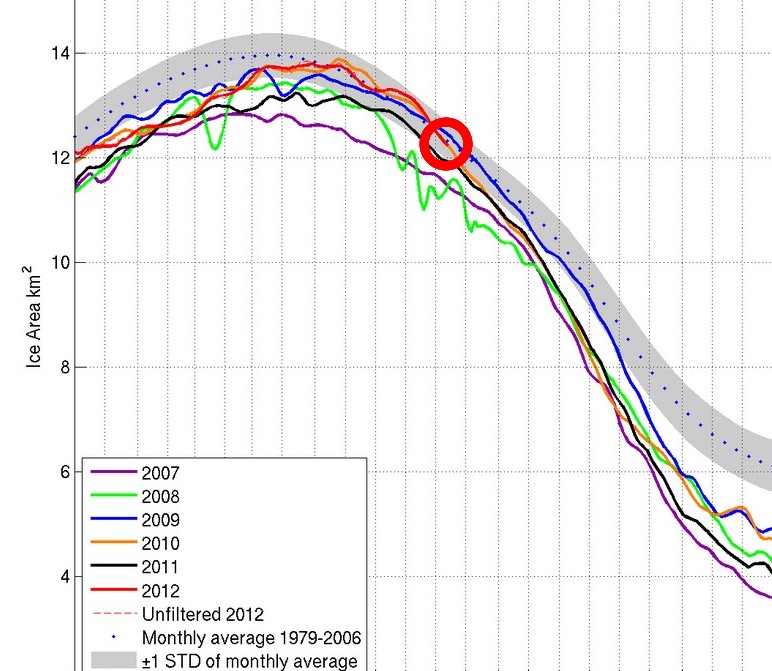
By Joe Romm on Sep 22, 2010 at 6:26 pm
Serreze: “I stand by my previous statements that the Arctic summer sea ice cover is in a death spiral. It’s not going to recover.”


….because the frozen, lifeless arctic is the “living” arctic, and a thawed, greening arctic is dead.
I beg to differ with Mr. Serreze, I think that, there’s life in the old Arctic sea ice yet, it bounds back like a dawg dude. And it sure is still colder than a witches t*t up in them there parts, yessiree.
Extract from the book (2009) „How Spitsbergen heat the world“ :
“But Mark Serreze says: the Arctic is screaming. Is it impossible to find out? It should not be impossible, as the present arctic warming since 1980 is not the only one. There was another
warming period for the region north of 62o North since 1920 until 1945, for which the high-latitude temperature increase was stronger in the late 1930s early 1940s than in recent decades (Polyakov, 2002). The first Arctic warming started 90 years ago, from about 1920 to 1940. In winter 1918-19 the air temperatures exploded at the remote archipelagos Spitsbergen, which the Norwegian call: Svalbard. In 1930 the Norwegian scientist .B. J. Birkeland regarded the rise as maybe the biggest ever observed in one place. Birkeland could presumably repeat the claim today with justification. But would he or his colleagues come up with the exclamation the Arctic is screaming today? Definitely not, although he and his colleagues might wish to scream: How could it be that you know so little about “our arctic warming” to understand “your arctic warming”. Read more: http://www.arctic-heats-up.com/chapter_1.html
I believe the “death spiral” he refers to, that can be done on ice, is this one –
http://en.wikipedia.org/wiki/Death_spiral_(figure_skating)
My question is why not?
Is it because of the ‘hot’ air temperatures?
Sea currents?
Wind?
Soot?
[……fill in any reason……]
I for one stand by my assertion that the Arctic will recover as long as man-made soot is reduced. My computer model tells me so.
It sounds like this clown is in bed with Tim Flannery and full of –it
North Pole Could Be Ice Free in 2008
“The set-up for this summer is disturbing,” says Mark Serreze, of the US National Snow and Ice Data Center (NSIDC).
A number of factors have this year led to most of the Arctic ice being thin and vulnerable as it enters its summer melting season.
http://abcnews.go.com/Technology/story?id=4728737&page=1#.T6cSUu2EYqY
I have been following the Alaskan area temperatures every day. I don’t know where all this ice melt in the Bering Sea is coming from, as temps in that area have remained consistently below freezing. Maybe a warm current? I am skeptical. Stilll subzero F in northern Alaska.
Probably being blown out by wind and shifted by currents. The current doesn’t even need to be abnormally warm. It just needs to move the ice into naturally warmer waters. (Although a warmer current would accelerate the process of course.)