You can’t make up junk science like this
Scientists Find Direct Evidence That Atmospheric CO2 Heats Earth’s Crust
Heats flows up through the Earth’s crust, not down. Nobel Laureate Al Gore says the Earth’s crust is “millions of degrees.”
March 1, 2015 | by Lisa Winter
The study, funded in part by the U.S. Department of Energy’s Office of Science, utilized data from the NOAA CarbonTracker between 2000 and 2010. Measurements from the Atmospheric Radiation Measurement Climate Research Facility in Oklahoma were taken almost every day, with 8,300 readings altogether. A second research facility in Alaska provided 3,300 measurements during this time span. Despite the sites being very different in terms of climate and industrial development, they both confirmed that CO2 levels are increasing due to human activity, and that it’s heating up the Earth’s crust.
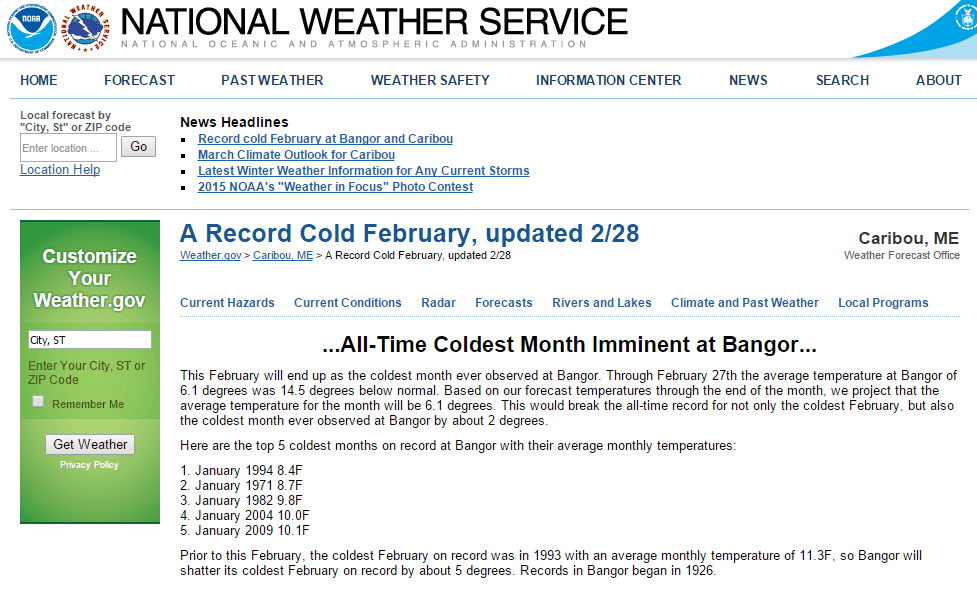
They started during the cold 2000 La Nina, and ended during the warm El Nino in 2010. Troposphere temperatures were 0.5C higher in 2010, than 2000 – so of course there was more emissions from CO2. The air temperature was higher, which means more heat is emitted.
“We see, for the first time in the field, the amplification of the greenhouse effect because there’s more CO2 in the atmosphere to absorb what the Earth emits in response to incoming solar radiation,” lead author Daniel Feldman of University of California, Berkeley said in a press release. “Numerous studies show rising atmospheric CO2 concentrations, but our study provides the critical link between those concentrations and the addition of energy to the system, or the greenhouse effect.”
It has nothing to do with absorption. There was more CO2 in the atmosphere in 2010 than in 2000, and the air temperature was higher – so of course there were more emissions in CO2 spectral bands. The authors are jumping to conclusions based on what they want to find, rather than any rational thought process.
The researchers measured the crust’s radiative force, which is the ratio of infrared energy released by the crust as thermal radiation compared to how much energy it receives from the sun. After correcting for potential confounders such as cloud cover and humidity, they discovered that the radiative force had indeed increased during that decade-long observation period by 0.2 Watts per square meter per decade. Though that number might sound small, it’s actually a 10% increase. The researchers were able to connect this to the 22 parts per million increase of atmospheric carbon that occurred during the same time span.
Scientists Find Direct Evidence That Atmospheric CO2 Heats Earth’s Crust | IFLScience
The first sentence sounds like mindless gibberish from a confused journalist, so I will ignore that. More CO2 at a higher temperature will emit more IR. Every scientist working with radiative transfer models has known this for decades. The authors’ assumption that it is due to increased absorption of LW radiation by CO2 molecules doesn’t have any basis other than conformation bias. Even it is was pitch black (i.e. no greenhouse effect) more CO2 at higher temperatures will emit more LW.
The authors are conflating emission and absorption. Junk science at its worst.