8 October 2014, 8.02pm BST
An independent inquiry into the Bureau of Meteorology? Bring it on
Maurice Newman, chair of the Prime Minister’s Business Advisory Council, has called for an independent review of the Bureau of Meteorology’s climate data, following a stream of recent articles in The Australian newspaper attacking the Bureau’s methods.
I support his call for an open and public inquiry into the Bureau’s climate data and the techniques that the Bureau’s scientists have used to reduce the influence of changes in instrumentation, exposure, and weather station location on its climate records.
I support it because I don’t think the Bureau gets enough opportunities to demonstrate to the public its scientific integrity, hard work, and valuable results.
An independent inquiry into the Bureau of Meteorology? Bring it on
I’m happy to bring it on.
Nicholls used the graph below, purporting to show that BOM surface data closely matches UAH satellite data. But he did a little nature trick – he expanded the scale of the satellite data (right side) to make it appear to match,the surface data! A realistic adjustment would be to do the opposite and shrink the satellite scale, because the troposphere should warm faster than the surface
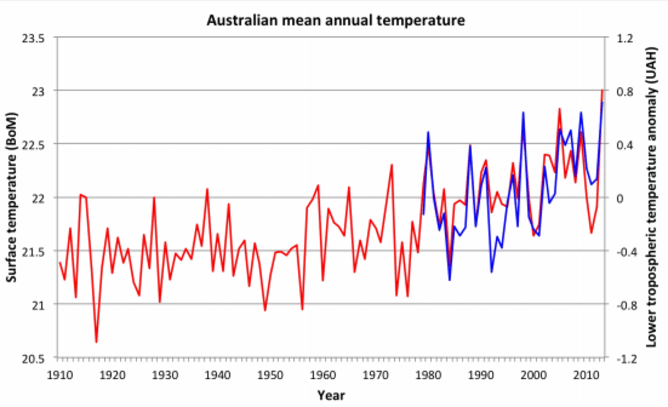
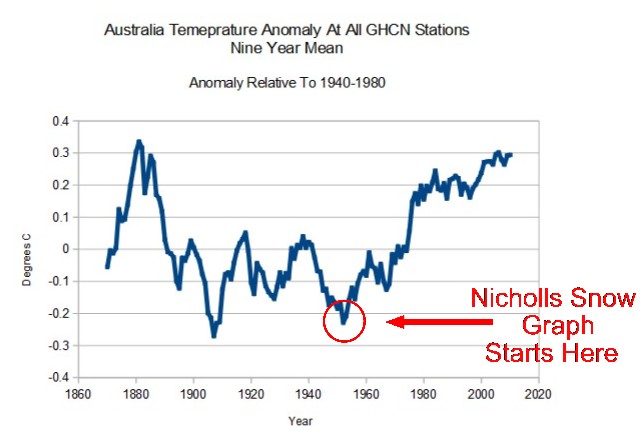
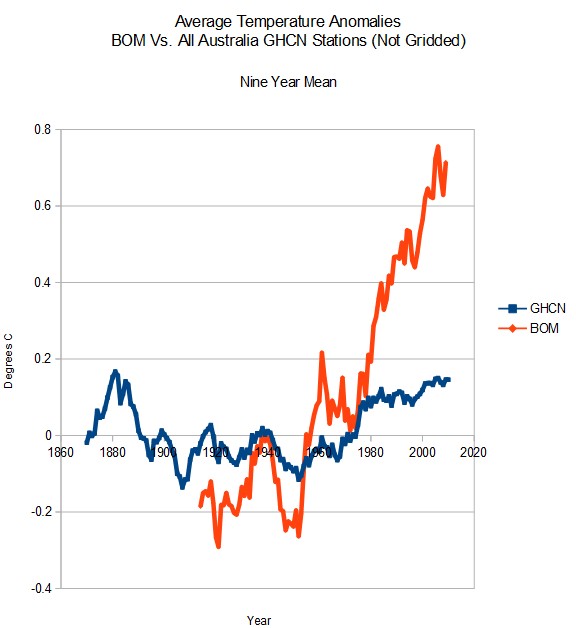
Next, let’s compare the BOM data from Nicholls graph above to all 1,655 GHCN (Global Climatology Historical Network) stations in Australia. The GHCN data shows no net warming since 1880, but the BOM (Bureau of Meteorology) data shows a hockey stick since 1950, and hides all temperatures before 1910.
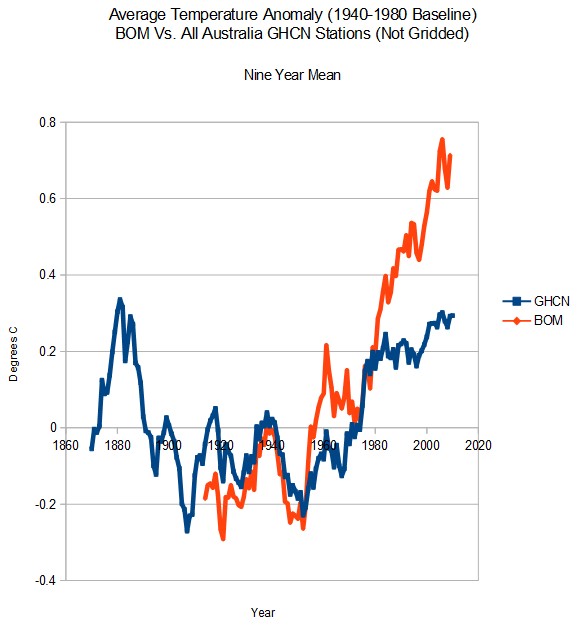
This is not a perfect comparison, because the ungridded GHCN data skews towards temperatures in the populated areas near the coasts, and under counts temperatures in the interior. But at a minimum, it shows that there has been little or no net warming over a large swath of Australia, and a strong disagreement with the BOM data.
The BOM anomalies were calculated relative to a 1940-1980 baseline, and the GHCN anomalies were calculated as the differences of each monthly average from the 1940-1980 baseline for that month.
Below is the list of GHCN stations used.
Continue reading →