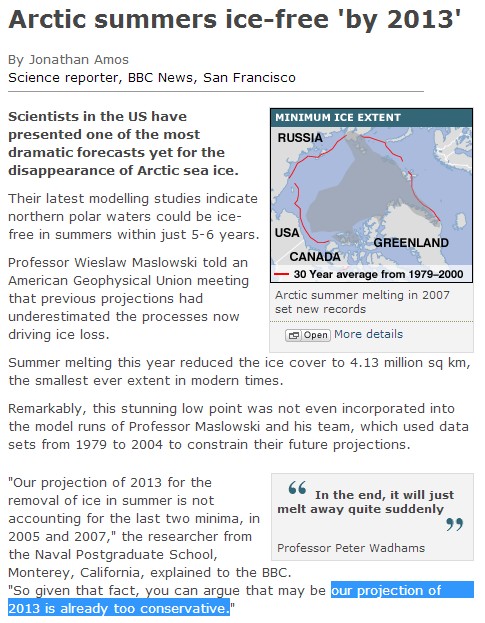
Steve, well first off you have to define what is meant by ice-free. We often refer to ice-free as less than 1 million sq-km since even with most of the Arctic Ocean ice-free, it is likely that some ice will remain north of Greenland and in the Canadian archipelago.
Also you have to consider if you define ice-free the first time the extent is 0 or below 1 million sq-km, or if it stays that way for consecutive summers.
There are some climate model simulations that show the September extent dropping below 1 million sq-km before 2020, but not necessarily staying below that value until later in the century.
Then you have to consider that even though the ice cover continues to shrink and thin, weather still plays an important role in the summer ice cover. So I think it’s impossible to say that the arctic ocean will be ice-free in september in 2015 without being able to predict the weather.
I think it’s important to remember that while the ice cover is in a period of long term decline (at least since the 1950s for which we have good data to assess the changes) that doesn’t mean the decline is linear and there will be ups and downs.
Even as we look to this coming September, we cannot say with any certainty that this summer will have less sea ice than last summer.
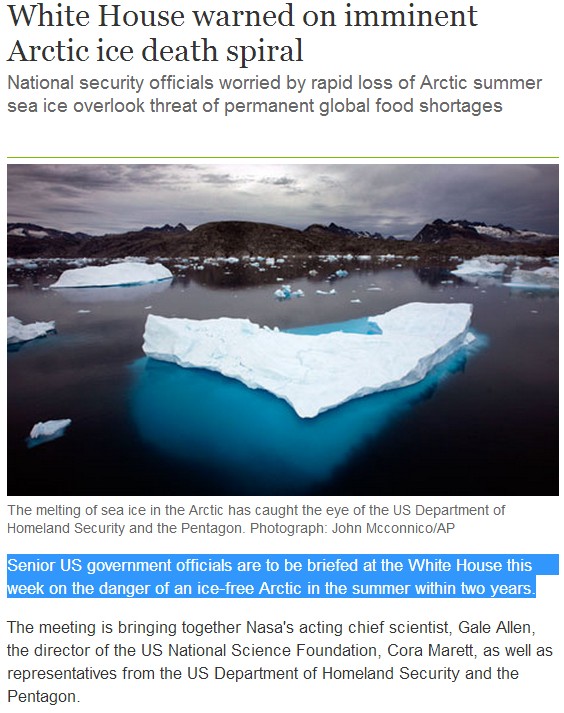
I personally would be very surprised if the Arctic Ocean was ice free in 2 years, but I do think it is likely to happen in the next couple decades.
~Julienne