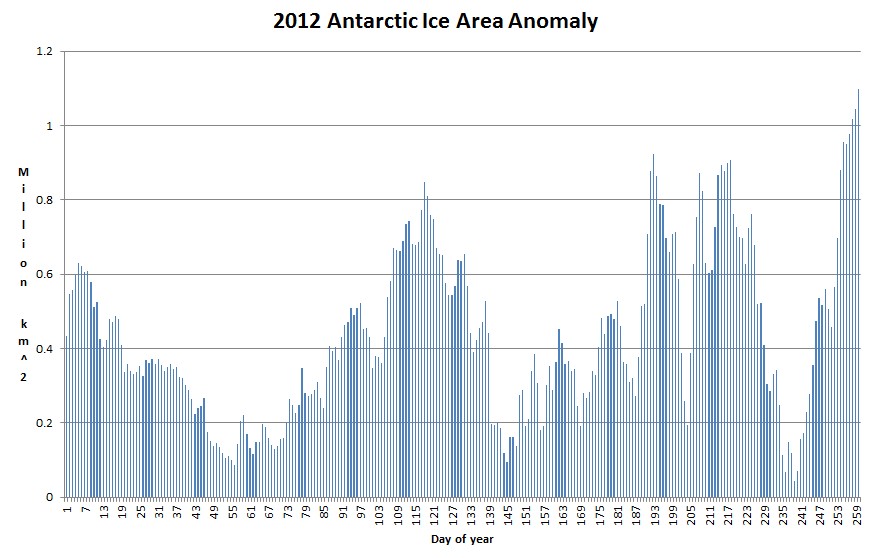
Not only has NSIDC lost track of the South Pole, but Real Climate has too
Polar Amplification
Filed under: Arctic and Antarctic Climate modelling Climate Science Greenhouse gases — group @ 2 January 2006
Guest commentary by Cecilia Bitz, University of Washington
“Polar amplification” usually refers to greater climate change near the pole compared to the rest of the hemisphere or globe in response to a change in global climate forcing, such as the concentration of greenhouse gases (GHGs) or solar output (see e.g. Moritz et al 2002). Polar amplification is thought to result primarily from positive feedbacks from the retreat of ice and snow. There are a host of other lesser reasons that are associated with the atmospheric temperature profile at the poles, temperature dependence of global feedbacks, moisture transport, etc. Observations and models indicate that the equilibrium temperature change poleward of 70N or 70S can be a factor of two or more greater than the global average.
RealClimate: Polar Amplification
Antarctica is cooling and ice is increasing. The theory is fatally flawed.