Sea ice in the Arctic is disappearing at a far greater rate than previously expected, according to data from the first purpose-built satellite launched to study the thickness of the Earth’s polar caps.
Preliminary results from the European Space Agency’s CryoSat-2 probe indicate that 900 cubic kilometres of summer sea ice has disappeared from the Arctic ocean over the past year.
This rate of loss is 50% higher than most scenarios outlined by polar scientists and suggests that global warming, triggered by rising greenhouse gas emissions, is beginning to have a major impact on the region. In a few years the Arctic ocean could be free of ice in summer, triggering a rush to exploit its fish stocks, oil, minerals and sea routes.
Using instruments on earlier satellites, scientists could see that the area covered by summer sea ice in the Arctic has been dwindling rapidly. But the new measurements indicate that this ice has been thinning dramatically at the same time. For example, in regions north of Canada and Greenland, where ice thickness regularly stayed at around five to six metres in summer a decade ago, levels have dropped to one to three metres.
Rate of arctic summer sea ice loss is 50% higher than predicted | Environment | The Observer
Scary stuff – exactly the same as what happened between between 1900 and 1940
February 23, 1940
it was concluded that near Polar temperatures are on an average six degrees higher than those registered by Nansen 40 years ago. Ice measurements were on an average only 6½ feet against from 9¼ to 13 feet.
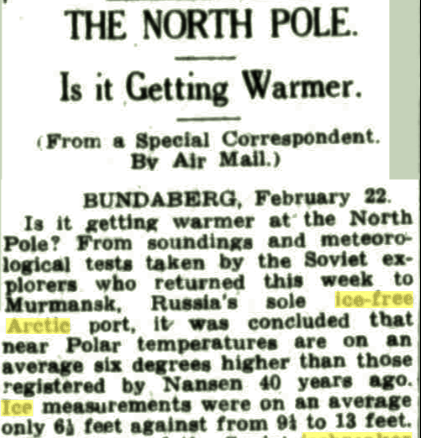
23 Feb 1940 – THE NORTH POLE. Is it Getting Warmer. | BUNDABER…<
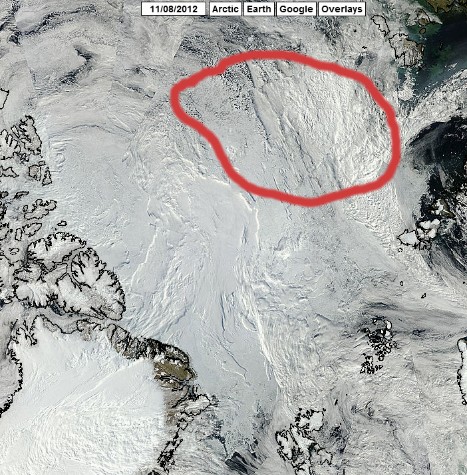
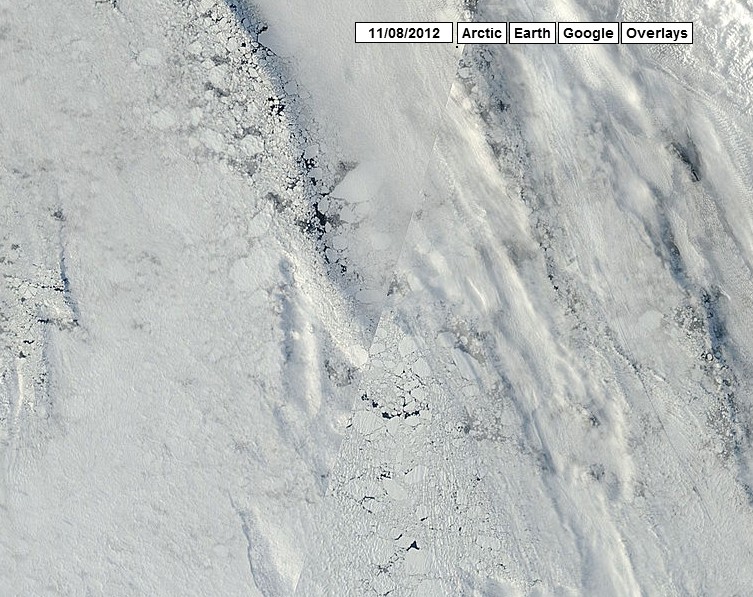
A couple of years ago David Barber said that all the multiyear ice was gone, so it seems that conditions have improved considerably over the last two years.
Navy PIPS also shows considerable thickening over the last two years along the Canadian coast to about five metres. Do we expect The Guardian to ever tell the truth about anything?

h/t to Steven Mosher