How Does A Diesel Engine Work?

They don’t have spark plugs, but they do have pistons.

A diesel engine (also known as a compression-ignition engine and sometimes capitalized as Diesel engine) is an internal combustion engine that uses the heat of compression to initiate ignition to burn the fuel, which is injected into the combustion chamber during the final stage of compression. This is in contrast to spark-ignition engines such as a petrol engine (gasoline engine) or gas engine (using a gaseous fuel as opposed to gasoline), which uses a spark plug to ignite an air-fuel mixture. The diesel engine is modeled on the Diesel cycle. The engine and thermodynamic cycle were both developed by Rudolf Diesel in 1897.

http://en.wikipedia.org/wiki/Diesel_engine

Posted in Uncategorized | 5 Comments

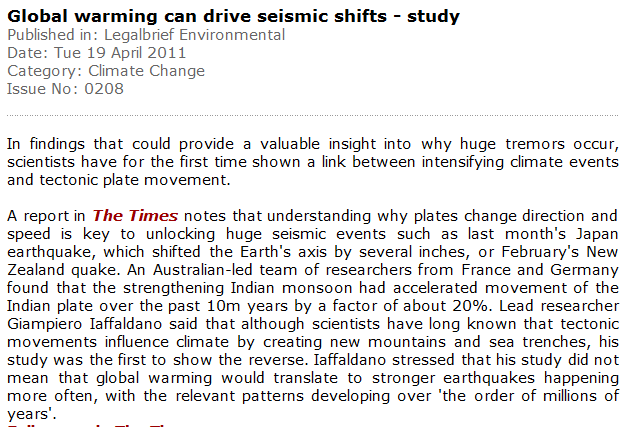
Lawyers : Global Warming Might Have Caused The Japanese Tsunami

Let’s sue everybody! Your SUV caused a tsunami in japan.

http://www.legalbrief.co.za/article.php?story=20110419090714151

Posted in Uncategorized | 9 Comments

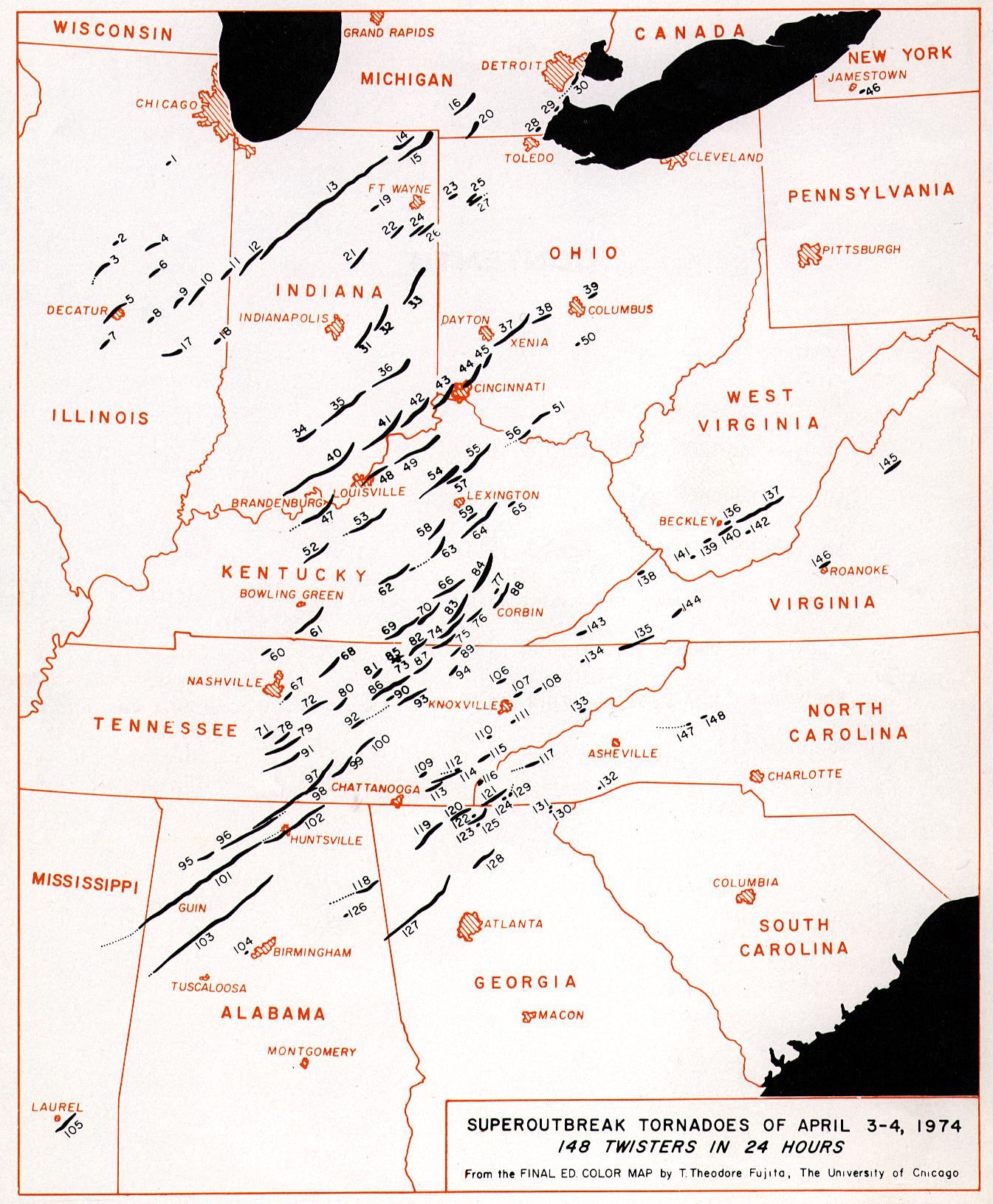
April 1974 : Largest Tornado Outbreak In History – Blamed On Global Cooling

But now we know that tornadoes are actually caused by global warming. Actually, the 1974 tornadoes probably never happened – because CO2 was well below Hansen’s safe 350 ppm.

http://www.april31974.com/images/outbreakmaplarge.jpg

Posted in Uncategorized | 8 Comments

“The longer the planners delay, the more difficult will they find it to cope with climatic change once the results become grim reality.”

Scary warnings from climatologists. Take heed. Take action quickly before it is too late.

Climatologists are pessimistic that political leaders will take any positive action to compensate for the climatic change, or even to allay its effects.

There are ominous signs that the Earth’s weather patterns have begun to change dramatically and that these changes may portend a drastic decline in food production – with serious political implications for just about every nation on Earth. The drop in food output could begin quite soon, perhaps only 10 years from now. The regions destined to feel its impact are the great wheat-producing lands of Canada and the U.S.S.R. in the North, along with a number of marginally self-sufficient tropical areas – parts of India, Pakistan, Bangladesh, Indochina and Indonesia – where the growing season is dependent upon the rains brought by the monsoon.

Last April, in the most devastating outbreak of tornadoes ever recorded, 148 twisters killed more than 300 people and caused half a billion dollars’ worth of damage in 13 U.S. states.

To scientists, these seemingly disparate incidents represent the advance signs of fundamental changes in the world’s weather. The central fact is that after three quarters of a century of extraordinarily mild conditions, the earth’s climate seems to be cooling down.

Climatologists are pessimistic that political leaders will take any positive action to compensate for the climatic change, or even to allay its effects. They concede that some of the more spectacular solutions proposed, such as melting the Arctic ice cap by covering it with black soot or diverting arctic rivers, might create problems far greater than those they solve.

The Cooling World

Newsweek, April 28, 1975

Save the planet. Melt the polar ice caps. Drown a Polar Bear. Take a climatologist seriously.

Posted in Uncategorized | 9 Comments

Shellfish Can’t Survive An Extra 100 ppm CO2

But they are fine with an extra 10,000 ppm.

Posted in Uncategorized | 3 Comments

Alarmist Scientists As gods

 if she were a scientist, she’d know what she believed about climate change – because scientists make it their business to know the facts. I’m not a scientist either, but I know enough about science to follow the issue, and I would like to assure Ms. Varley that there is no longer any scientific dispute either on the magnitude of the climate crisis, or the fact that it’s caused by human activity. That many Americans don’t recognize the problem’s urgency or severity is a demonstration of the influence of corporate power on our news media. It’s also a terrible shame.

http://www.milforddailynews.com/

Posted in Uncategorized | 2 Comments

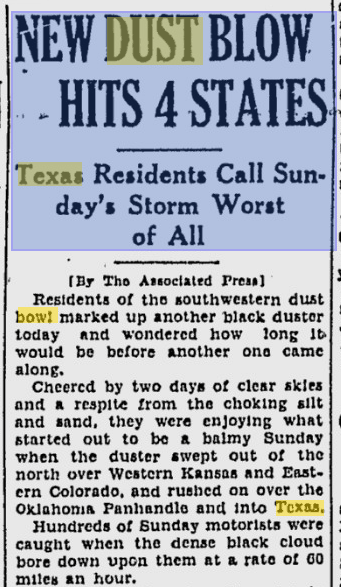
1930s : Heat Drought And Wind In Texas

‘

http://news.google.com/newspapers

Posted in Uncategorized | Leave a comment

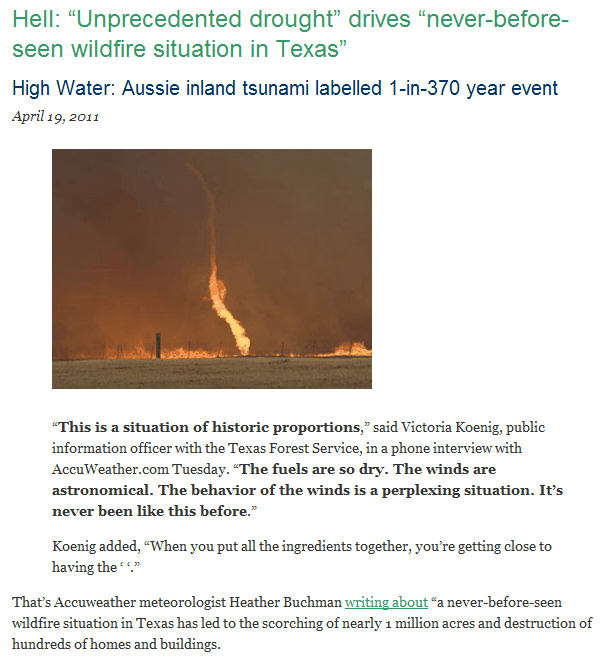
250 Year Old Information Officer Says It Has Never Been Like This Before In Texas

What Romm didn’t bother to mention from the article :

Texas is in the midst of one of the worst droughts, in terms of the depth and expanse of drought conditions, since the early 1900s.

http://www.accuweather.com/

Maybe he doesn’t understand the meaning of the word “unprecedented?”

Posted in Uncategorized | 5 Comments

Zero Credibility

When Time Magazine makes claims like the 1970s Ice Age or the current claim that tornadoes are caused by CO2, why don’t climate scientists go to the press with strong statements of disagreement? Obviously Hansen can get access to the press anytime he wants to.

Climate scientists say now that they never agreed with the ice age scare, but we see no evidence that they attempted to clear the air in 1975. We see little evidence that they are trying to clear up the endless stream of disaster stories currently coming from Romm and the press.

The only logical conclusion is that they are perfectly happy to let the disaster stories stand.

Posted in Uncategorized | 13 Comments

Atmospheric Physics In 100 Words Or Less

The Sun heats the surface of the Earth. Warm air at the surface is less dense than the cold air above it, causing convection. The rising air expands and cools – while the sinking air compresses and heats. If the lapse rate is greater than the adiabatic lapse rate (10C per km) the air is unstable and storms can form. If the lapse rate is less than the adiabatic lapse rate, the air is stable and storms don’t form (i.e. inversion.)

When cold air overrides warm moist air (like in North Carolina over the weekend) the lapse rate gets very large and violent storms form.

Blaming global warming for tornadoes is freaking stupid (i.e. Time Magazine) because tornadoes usually require passage of a strong cold front.

Posted in Uncategorized | 5 Comments