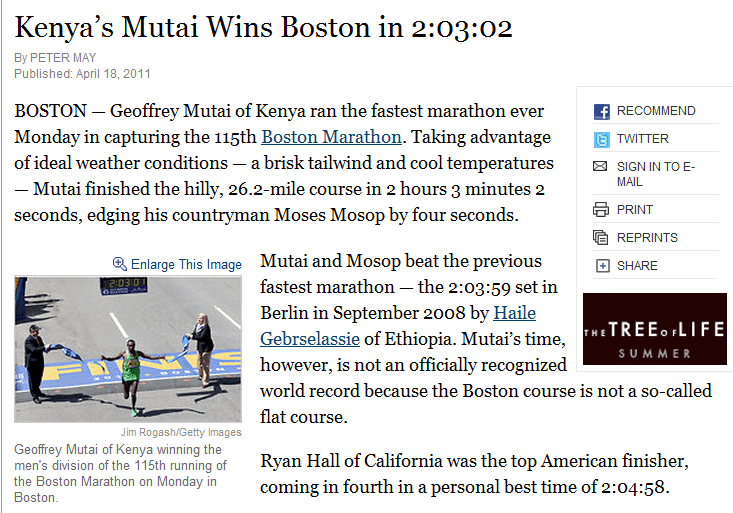
Kenyan Breaks Marathon World Record. Obama Not There To Greet Him

http://www.nytimes.com/2011/04/19/sports/19marathon.html

Posted in Uncategorized | 8 Comments

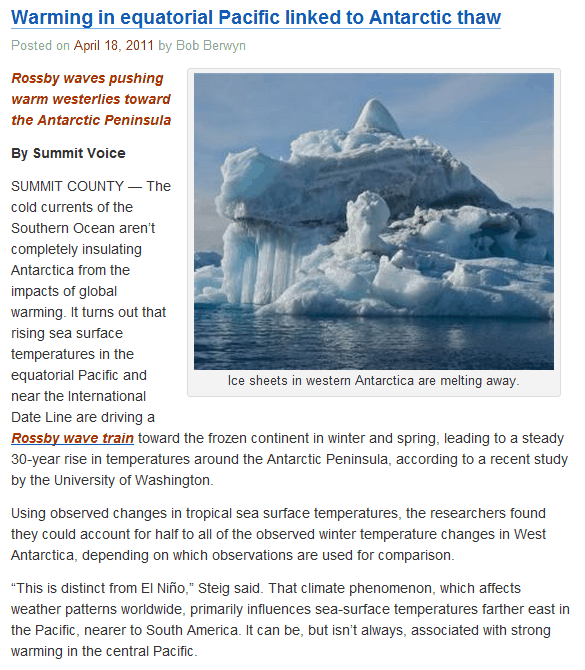
Steig Says Antarctica Is Melting

Steig reminds that a short term trend on a tiny portion of Antarctica, can be extrapolated to represent long term trends across the entire continent.

http://summitcountyvoice.com/

Posted in Uncategorized | 16 Comments

Despite High Levels Of CO2, Mars Is Cold

Mars has a mean surface pressure of 600 pascals, compared with Earth’s 100,000 pascals. In other words, the atmospheric pressure on Earth is about 150 times higher than Mars.

Mars has 0.95 mole fraction CO2, compared to 0.0004 on earth. The concentration of CO2 in Mars atmosphere is more than 2,000 times higher than Earth.

So lets do the math for Mars and Earth.

Mars : 600 pascals * 0.95 = 575 pascals (partial pressure of CO2)

Earth : 100,000 pascals * 0.0004 = 40 pascals (partial pressure of CO2)

The partial pressure of CO2 on Mars is 14X larger than earth, yet Earth is much warmer. Now use your brain and figure out the connotations.

Hint : It is the pressure, not the CO2 (stupid)

Posted in Uncategorized | 65 Comments

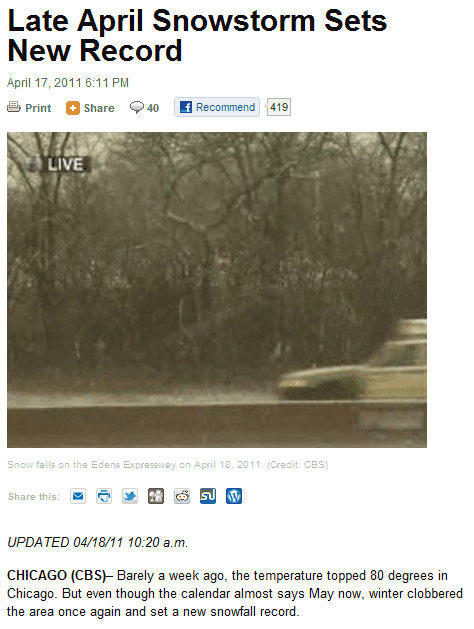
Record Global Warming In Chicago

It may be record cold in Australia, India, Canada and Greenland, but Chicago is heating up with record snow. This is what Hansen was trying to show us with his GISS temperatures that nearly tied the hottest year ever last month.

http://chicago.cbslocal.com/2011/04/17/chicago-area-could-see-spring-snow-in-april/

Posted in Uncategorized | 2 Comments

Chinook Winds

http://www.eol.ucar.edu/

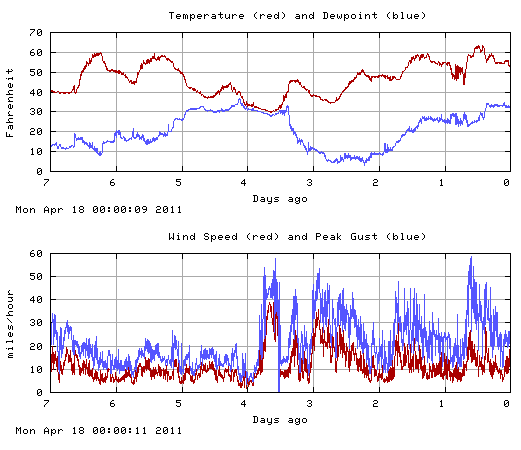
Yesterday at NCAR in Boulder, temperatures shot up 15 degrees in a matter of a few minutes. This was due to the arrival of Chinook winds. When the wind blows out of the west, the air compresses as it falls down the Front Range of the Rockies, and heats at the adiabatic lapse rate of 10C per kilometer. This is independent of the amount of GHG (water vapor) in the atmosphere on that day.

There really is not an easy way to explain chinook winds without getting into some pretty technical meteorology, but no discussion of Black Hills weather would be complete without mentioning the chinook. The reason is that the Black Hills of South Dakota are home to the world’s fastest recorded rise in temperature, a record that has held for nearly six decades.
On January 22, 1943, the northern and eastern slopes of the Black Hills were at the western edge of an Arctic airmass and under a temperature inversion. A layer of shallow Arctic air hugged the ground from Spearfish to Rapid City. At about 7:30am MST, the temperature in Spearfish was -4 degrees Fahrenheit. The chinook kicked in, and two minutes later the temperature was 45 degrees above zero. The 49 degree rise in two minutes set a world record that is still on the books. By 9:00am, the temperature had risen to 54 degrees. Suddenly, the chinook died down and the temperature tumbled back to -4 degrees. The 58 degree drop took only 27 minutes.

http://www.blackhillsweather.com/chinook.html

Posted in Uncategorized | 8 Comments

NPR : Threat Of Global Warming Making Bears Hungry

NPR says beetles are investing in trees. Sophisticated little buggers – first they invest, then they destroy – driving the price up. Sick the SEC on them.

National Parks Week kicks off Saturday, but the celebration comes at a rough time for National Parks. Harried by federal funding cuts and urban development, the nation’s park system is also facing the rising threat of climate change.

Those effects are becoming most visible in Yellowstone, one of the best known of all national parks, according to Paul Solotaroff. He wrote about Yellowstone’s climate challenge in April’s issue of Men’s Journal and tells Weekend All Things Considered guest host Noah Adams that the damage is putting the park’s ecosystem out of balance.

As a consequence of the heat and dryness, pine beetles have invested the trees and left many of them dead, he says. This is a big problem for Yellowstone, as the pines are especially essential to the park’s inhabitants. They provide shade, stabilize the soil and, perhaps most importantly, feed the local grizzly bears.

http://www.npr.org/

Flooding primary concern with big snowpacks in Wyoming

http://trib.com/

Posted in Uncategorized | 8 Comments

Carnegie Explains Why Inefficient Crops Which Waste Water Are Good

Scientists with the Carnegie Institutions’s Department of Global Ecology at Stanford University and the University of Montana analyzed temperature, reflectivity, and evapotranspiration from satellite data across 733,000 square miles—an area larger than the state of Alaska. They found converting from natural cerrado grassland vegetation to crop/pasture on average triggered warming of 2.79 °F (1.55 °C), but that subsequent conversion to sugarcane, cooled the surrounding air by an average of 1.67 °F (0.93°C).

“We found that shifting from natural vegetation to crops or pasture results in local warming because the plants give off less beneficial water. But the bamboo-like sugarcane is more reflective and gives off more water—much like the natural vegetation,” said Carnegie’s Scott Loarie, lead author of the research. “It’s a potential win-win for the climate—using sugarcane to power vehicles reduces carbon emissions, while growing it lowers the local air temperature.”

http://news.mongabay.com/

Posted in Uncategorized | 7 Comments

Facts Are Not Important When You Are Saving The Universe

“If you ask me as a person, do I think the Russian heat wave has to do with climate change, the answer is yes,” said Gavin Schmidt, a climate researcher with NASA in New York. “If you ask me as a scientist whether I have proved it, the answer is no — at least not yet.”

http://www.nytimes.com/

Posted in Uncategorized | 16 Comments

Cold In Pachauri’s World

SHIMLA: Even as concern is being spread about global warming, it has been the coldest April in over a decade, as far as this erstwhile summer capital of the British raj is concerned, with both the average day and average night temperatures being the lowest recorded since 2001.

Though director meteorological office here, Manmohan Singh said that there were still about 12 days to go before the month comes to an end, but taking into consideration the fact that the average day temperature has so far not gone up above 20 degrees C and the nigh temperature above 10 degrees C, it can be safely presumed that both the maximum and minimum average temperatures are likely to remain the lowest for the decade.

http://timesofindia.indiatimes.com/

Posted in Uncategorized | 4 Comments

The Lapse Rate Is Independent Of Greenhouse Gas Content

Some readers insist on denying the obvious fact that Venus temperatures are due to high atmospheric pressure. The latest argument being that the lapse rate is dependent on GHG levels. This is trivial to demonstrate as incorrect.

The first problem with that argument is that the lapse rate on Earth is very similar to Venus, despite very different atmospheres.

The second problem is that on Earth, water vapor is the most important GHG – yet the dry adiabatic lapse rate is independent of humidity (for unsaturated air.)

For an adiabatic process, first law of thermodynamics can be written as

ncvdT ? VdT / ? = 0
For adiabatic process:

PdV = ? VdP / ?
Also since : ? = V / n and : ? = cp / cv we can show that:

cpdT ? ?dP = 0
where cp is the specific heat at constant pressure and ? is the specific volume.

Assuming an atmosphere in hydrostatic equilibrium: [ 8 ]

dP = ? ?gdz
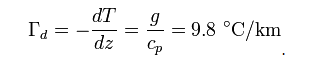
where g is the standard gravity and ? is the density. Combining these two equations to eliminate the pressure, one arrives at the result for the DALR, [ 9 ]

http://abitabout.com/Adiabatic+lapse+rate

In other words, the lapse rate is fixed on Earth – whether greenhouse gas levels are high or low.

Posted in Uncategorized | 157 Comments