Romm : Renewable Energy Never Runs Out – Until The Wind Stops Blowing, Or It Gets Cloudy, Or The Sun Sets, Or Autumn Arrives, Or It Gets Too Cold ….

Posted in Uncategorized | 9 Comments

1922 : Hotspot In Libya

September 1922 set the record for hottest temperature ever recorded – Libya at 136F. GISS seems to think that the heat was confined to about one thermometer.

http://data.giss.nasa.gov/

Posted in Uncategorized | 4 Comments

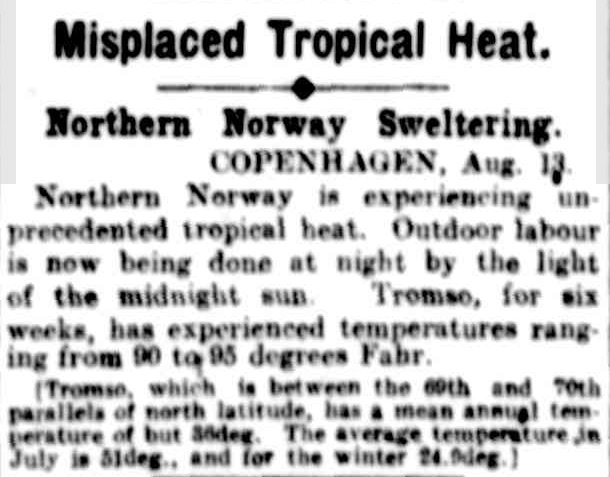
1922 : 100F In The Arctic

http://query.nytimes.com/

95F in northern Norway.

http://trove.nla.gov.au


Posted in Uncategorized | 3 Comments

Research Confirms : IPCC Forecasts Match IPCC Forecasts

What remains uncertain is how these increases of carbon dioxide– an important greenhouse gas– and other human impacts such as land use changes will react with naturally occurring climate forces and variability in the future. Predictions of global temperature increases vary, but various modeling scenarios run for the Intergovernmental Panel on Climate Change ( IPCC) suggest a range of global warming of between 2.5–10.4°F by 2100. How these changes will impact regional climate and hydrologic dynamics is also largely uncertain.

http://www.ncdc.noaa.gov/paleo/ctl/future.html

http://www.woodfortrees.org/

Quick quiz for IPCC gurus. Temperatures have not increased at all this century. If the current temperature decline continues, how long will it take to reach 2.5F warming? How long will it take to reach 10.4F warming?

Temperatures rose about 1F over the last 150 years, so it makes perfect sense to forecast 10.4F warming over the next 90 years. If you have the IQ of a snail.

h/t to Marc Morano

Posted in Uncategorized | 7 Comments

Why Extreme Weather Statistics Are Hopelessly Misleading

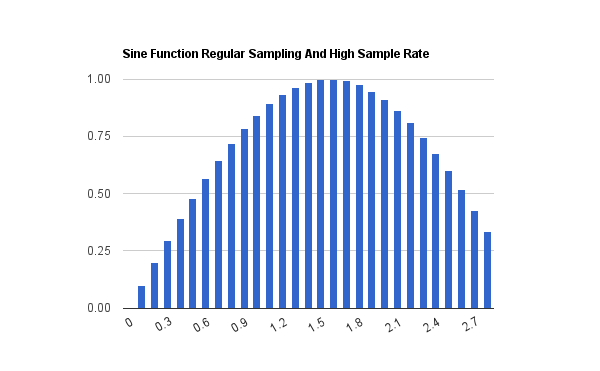
In the satellite era, we get very high, regular sample rates across almost the entire planet. This guarantees capture of minimums and maximums (like minimum pressure of a hurricane, or peak rainfall.) The graph above shows a sine wave with an adequate sample rate.
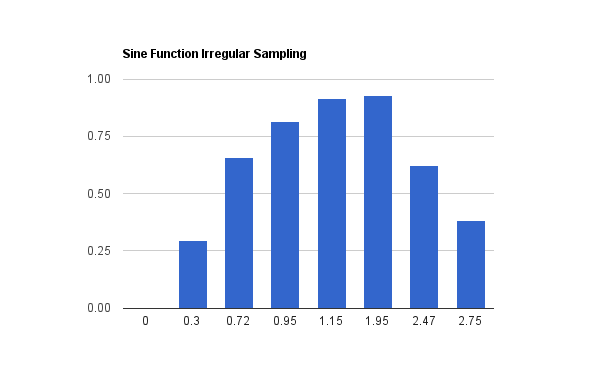
Looking at the same function with a lower, irregular sample rate – we see that the peak value is lower. This is analogous to collection of weather data prior to satellites and radar. Besides temporal sampling rates, another problem is the lower spatial sampling. During the 1930s, many mid-Atlantic hurricanes were probably missed entirely because there weren’t any viewers to report them.

Some scientists seem to be unable to comprehend the difference between more extreme weather data, and more extreme weather. If a 1935 hurricane were measured today, the minimum pressure would almost certainly be reported lower, simply because of the ability to sample data regularly on a finer grid, with finer time resolution.



Posted in Uncategorized | 6 Comments

Blistering Start To Spring In Greenland

http://www.summitcamp.org/status/webcam/

Temperatures on top of the ice sheet averaging -53F this fine Spring month.

http://www.wunderground.com/history/station/04416/2011/3/21/MonthlyHistory.html

Posted in Uncategorized | 3 Comments

Vietnam Severely Affected By Global Warming – But No One Can Say What The Effects Are

Turns out the weather in Vietnam is not exactly the same every year.

http://english.vietnamnet.vn/

http://www.argophilia.com/news/unseasonal-snow-in-vietnam/21723/

Posted in Uncategorized | 4 Comments

January 1974 : Brisbane Recieved 34 Inches Of Rain – Almost 300% Of What It Received This year

http://news.google.com/

http://www.weatherzone.com.au/

Posted in Uncategorized | 4 Comments

1947 : Greenland Melting – Sea Level Rising At A Dizzying Rate – Seashores To Be Inundated – Speedy International Intervention Needed

http://trove.nla.gov.au/

Posted in Uncategorized | 12 Comments

No Greater Truth : California Skiing Is Doomed

As the San Francisco Chronicle wrote five years ago, skiing in California and Colorado is doomed. Alpine Meadows is closed today due to too much snow.

http://www.skimusic.com/cams/am6_rndhs.jpg

Posted in Uncategorized | 5 Comments