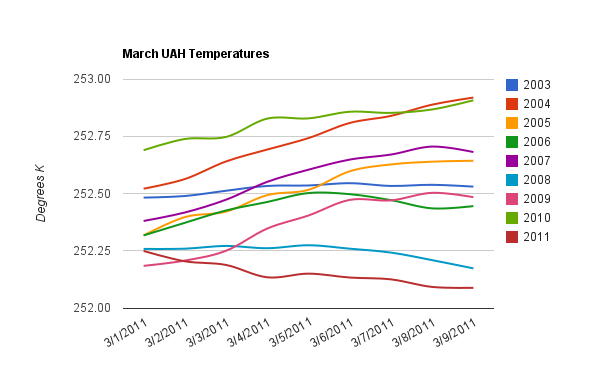
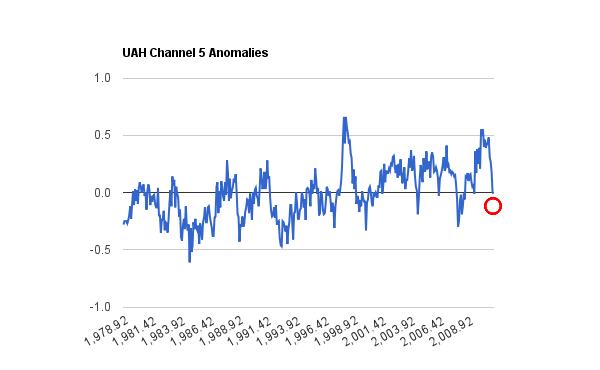
Strange, no mention of global warming.

Large earthquakes repeatedly occur along a large-scale fault, and the entire recurrence process includes the following stages:
| (I) |
fault healing and re-strengthening just after the previous earthquake occurred, |
| (II) |
accumulation of the elastic strain energy with tectonic stress loading, |
| (III) |
local concentration of deformation and rupture nucleation at the final stage of tectonic stress buildup in which an enough amount of the strain energy has been stored, |
| (IV) |
mainshock earthquake rupture, and |
| (V) |
rupture arrest and its aftereffect. |
An earthquake cannot occur without any accumulation of the elastic strain energy in the medium surrounding the fault. In this sense, stage (II) may be regarded as the preparatory process in a broad sense, which is characterized by the process of elastic deformation. In this stage, tectonic stress level is below critical, and the amount of the stored strain energy is insufficient to cause the ensuing large earthquake on the same fault.
As the tectonic stress continues to build up, the stress eventually reaches a critical level. At this final preparatory stage (III), an enough amount of the strain energy has been stored. Laboratory studies demonstrate that local concentration of deformation inevitably occurs and rupture begins to nucleate if the fault is characterized by mechanical and/or structural inhomogeneity. The nucleation may be accelerated by a triggering effect of stress transfer due to fault-fault interaction. Fluid-solid rock interaction may be activated at this stage as well because of high tectonic stress, and the nucleation may also be accelerated by activation of the fluid-rock interaction. In spite of these possible accelerating effects, a large earthquake will be preceded by a slow growth of the nucleation, though the time to the ensuing earthquake may be shortened by these possible effects. This stage may be regarded as the preparatory process in a narrow sense.
The process of earthquake dynamic rupture during which short-period seismic waves are generated is characterized by rapid stress drop with ongoing slip on the fault, and almost complete release of the stored strain energy.
The phase of rupture arrest and its aftereffect are characterized by time-dependent stress relaxation and stress transfer, and as a consequence, aftershocks and aftereffect of crustal deformation follow.
http://wwweprc.eri.u-tokyo.ac.jp/EPRC_E.html