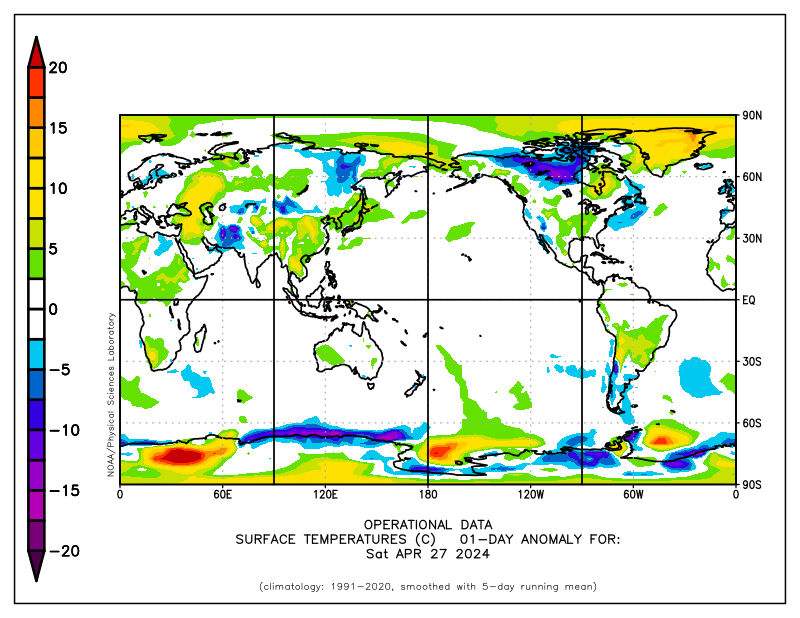

Right after it stops being super cold. Temperatures have been running far below normal in Antarctica for more than two months.

http://www.esrl.noaa.gov/psd/map/ANIM/sfctmpmer_01a.fnl.30.gif
Right after it stops being super cold. Temperatures have been running far below normal in Antarctica for more than two months.
http://www.esrl.noaa.gov/psd/map/ANIM/sfctmpmer_01a.fnl.30.gif
The spirit of resistance to government is so valuable on certain occasions, that I wish it always to be kept alive.
– Thomas Jefferson
Homeland Security would have been all over that guy.
You are all going to die a horrible death, and it is your parent’s fault.


In possibly related news, there are 60 medical marijuana warehouses in Boulder.

According to a sobering new study, the Southwest’s aridity is about to get worse. Published in the April 9 issue of Science, “Model Projections of an Imminent Transition to a More Arid Climate in Southwestern North America” predicts that climate change will permanently alter the landscape of the Southwest so severely that conditions reminiscent of the Dust Bowl days of the 1930s could become the norm within a few decades.
http://www.ucar.edu/communications/staffnotes/0705/drought.shtml

During 1972 record rains in parts of the U.S., Pakistan and Japan caused some of the worst flooding in centuries. In Canada’s wheat belt, a particularly chilly and rainy spring has delayed planting and may well bring a disappointingly small harvest.

Climatologists are pessimistic that political leaders will take any positive action to compensate for the climatic change, or even to allay its effects. They concede that some of the more spectacular solutions proposed, such as melting the Arctic ice cap by covering it with black soot or diverting arctic rivers, might create problems far greater than those they solve. But the scientists see few signs that government leaders anywhere are even prepared to take the simple measures of stockpiling food or of introducing the variables of climatic uncertainty into economic projections of future food supplies. The longer the planners delay, the more difficult will they find it to cope with climatic change once the results become grim reality.


In England, farmers have seen their growing season decline by about two weeks since 1950, with a resultant overall loss in grain production estimated at up to 100,000 tons annually. During the same time, the average temperature around the equator has risen by a fraction of a degree – a fraction that in some areas can mean drought and desolation. Last April, in the most devastating outbreak of tornadoes ever recorded, 148 twisters killed more than 300 people and caused half a billion dollars’ worth of damage in 13 U.S. states.
http://southdakotapolitics.blogs.com
I confess that I have a simple idea about science. I think that any scientific claim is meaningful only if it is falsifiable. If hypothesis X or theory Y is viable, each has to state what data will confirm it and, what is the same thing, what data will refute it. The Daily Caller asks the obvious question concerning Anthropogenic Global Warming:
Increased warm temperatures indicate global warming. Severe winter storms also help prove global warming, according to a recent op-ed in the New York Times. So is there any weather pattern that would disprove or call into question the existence of global warming?