
I stumbled across one of the most clueless sites on the web today. It seems to be designed to propagandize schoolchildren through their teachers.

I went through their bullets, in thirty words or less.

That’s called summer.
I stumbled across one of the most clueless sites on the web today. It seems to be designed to propagandize schoolchildren through their teachers.
I went through their bullets, in thirty words or less.
That’s called summer.
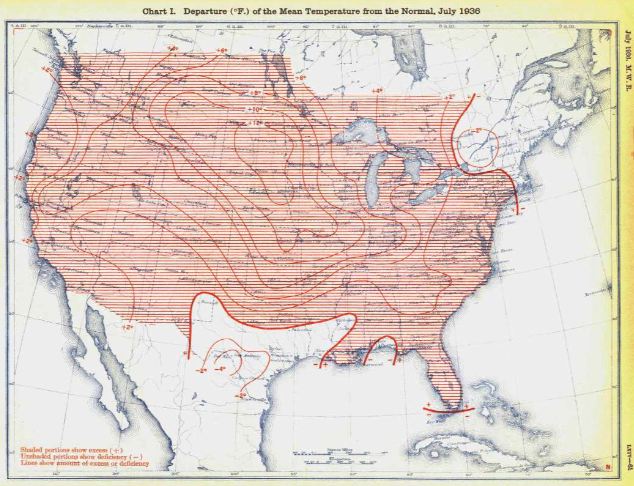
http://docs.lib.noaa.gov/rescue/mwr/064/mwr-064-07-c1.pdf
Joe Romm tells us that the hot summer of 2010 on the Eastern Seaboard is proof of global warming.


http://www.care2.com/greenliving/the-world-clock-of-global-statistics.html#
I’d rather watch football, thanks anyway.

http://arctic.atmos.uiuc.edu/cryosphere/
Arctic ice continues to grow at a very fast rate, despite the fact that 2010 is the hottest year on record and the Arctic is the fastest warming place on earth.

Now if we can just get them to solve global climate disruption, the world will be perfect.
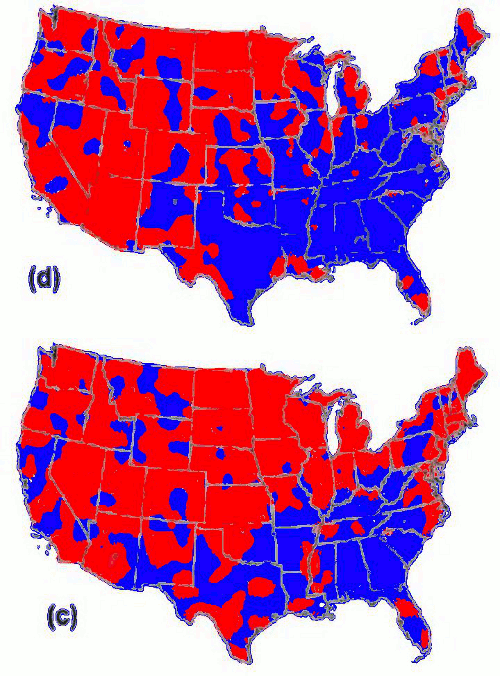
GISS US temperature data is based on the USHCN2 historical network, which adjusts recent thermometer readings upwards by a substantial amount before releasing the data to the public. The before/after blink comparator above shows that before adjustments, most of the US has seen cooling or neutral (blue) nighttime temperatures since 1895. (Some global warming eh?) But after adjustments, more than two thirds of the US shows warming (red) nighttime temperatures.
Same thing for daytime temperatures. Before adjustments, about three quarters of the US has cooled or remained the same (blue) since 1895. After adjustments, more than half of the country has warmed (red.)
[youtube=http://www.youtube.com/watch?v=_YXqf_6ug54]
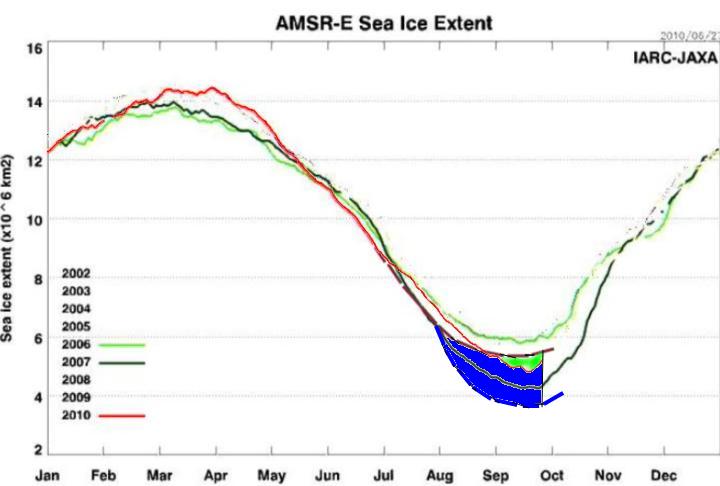
One of the readers yesterday asked how my forecast did compared with PIOMAS, which forecast a new record low of 3.7 million km².

Lake Superior Contains 10% of all of the Earth’s (non-frozen) freshwater. It is the largest freshwater lake on the planet, and is only 10,000 years old. Average summer temperature there is only 40ºF.
How did it form, and why is it so cold?

http://ocean.dmi.dk/arctic/icecover.uk.php
It is now 35% higher than 2007 and back to 2009/2005 levels.

