

http://en.wikipedia.org/wiki/File:Chicago-fire2.jpeg
On October 8, 1871 (before global climate disruption) the city of Chicago burned to the ground. What is less known is that several other much larger fires occurred the same day.
http://en.wikipedia.org/wiki/File:Chicago-fire2.jpeg
On October 8, 1871 (before global climate disruption) the city of Chicago burned to the ground. What is less known is that several other much larger fires occurred the same day.

We were taught as kids that we could do anything, be anything, accomplish anything. The power of positive thinking.
Kids now are taught that they and their families are destroying the planet, and that they should probably move into a cave and stop reproducing.
And then we wonder why there is so much anti-social behaviour among teenagers. Teen drug usage here in Colorado is in excess of 90%.
“There are claims coming from some communities that the Arctic sea ice is recovering, is getting thicker again,” Mark Serreze, director of the Colorado-based centre, told Postmedia News on Wednesday.
“That’s simply not the case. It’s continuing down in a death spiral.”
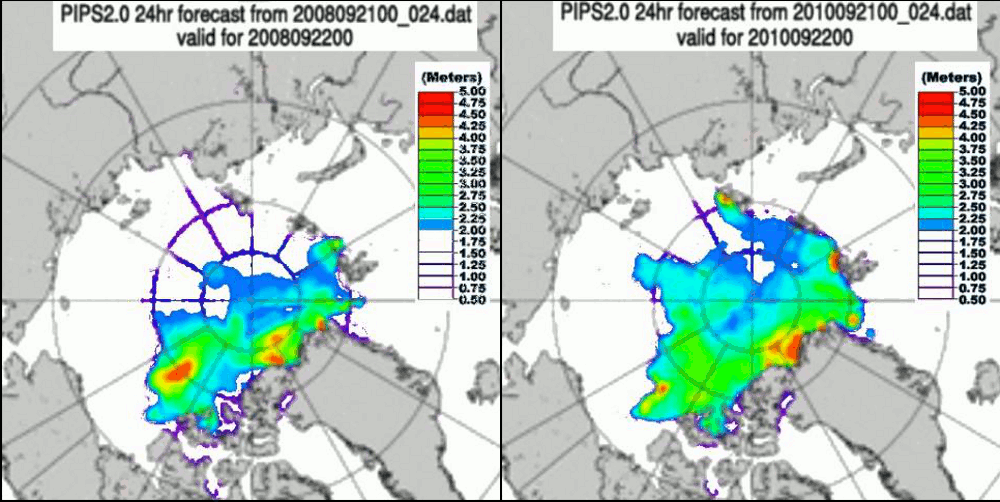
US Navy PIPS2 maps show that the area of Arctic ice greater than 2 metres thick has increased by about 50% since the same date in 2008. The blink comparator below removes all ice reported as less than two metres thick.
How can Obama get his approval ratings up? Next July 4th he could do this:
[youtube=http://www.youtube.com/watch?v=2899HBZ8wtI]
Moon photo : http://www.campchesterfield.net/

http://arctic.atmos.uiuc.edu/cryosphere/timeseries.anom.1979-2008
Ice area is a better gauge (than extent) of the length of the melt season, because it is affected less by the wind blowing the ice edge around. As you can see, after September 8, formation of new ice became dominant in the Arctic. All of the area graphs show the same thing.

During the summer of 1910 (before global climate disruption had kicked in) Idaho and Montana had a three million acre fire.
It was the largest forest fire in American history. Maybe even the largest forest fire ever. No one knows for sure, but even now, it is hard to put into words what it did. For two terrifying days and night’s – August 20 and 21, 1910 – the fire raged across three million acres of virgin timberland in northern Idaho and western Montana. Many thought the world would end, and for 86, it did. Most of what was destroyed fell to hurricane-force winds that turned the fire into a blowtorch. Re-constructing what happened leads to an almost impossible conclusion: Most of the cremation occurred in a six-hour period. A forester named Edward Stahl wrote of flames shooting hundreds of feet in the air, “fanned by a tornadic wind so violent that the flames flattened out ahead, swooping to earth in great darting curves, truly a veritable red demon from hell.”
Ice cover is near its minimum in The Arctic. The Sun is also setting in the Arctic.
Put those two pieces of information together, and it becomes clear that the September minimum has very little effect on the Earth’s shortwave radiation budget.
On the other hand, areas of open water allow longwave radiation to escape.
Put those two pieces of information together, and it is not at all clear whether late summer Arctic ice loss is a negative or positive climate feedback.
“Stop the presses! Arctic melt ain’t over ’til it’s over.”
Joe Romm – September 18, 2010


“I happily talk to the plants and trees, and listen to them. I think it’s absolutely crucial”


