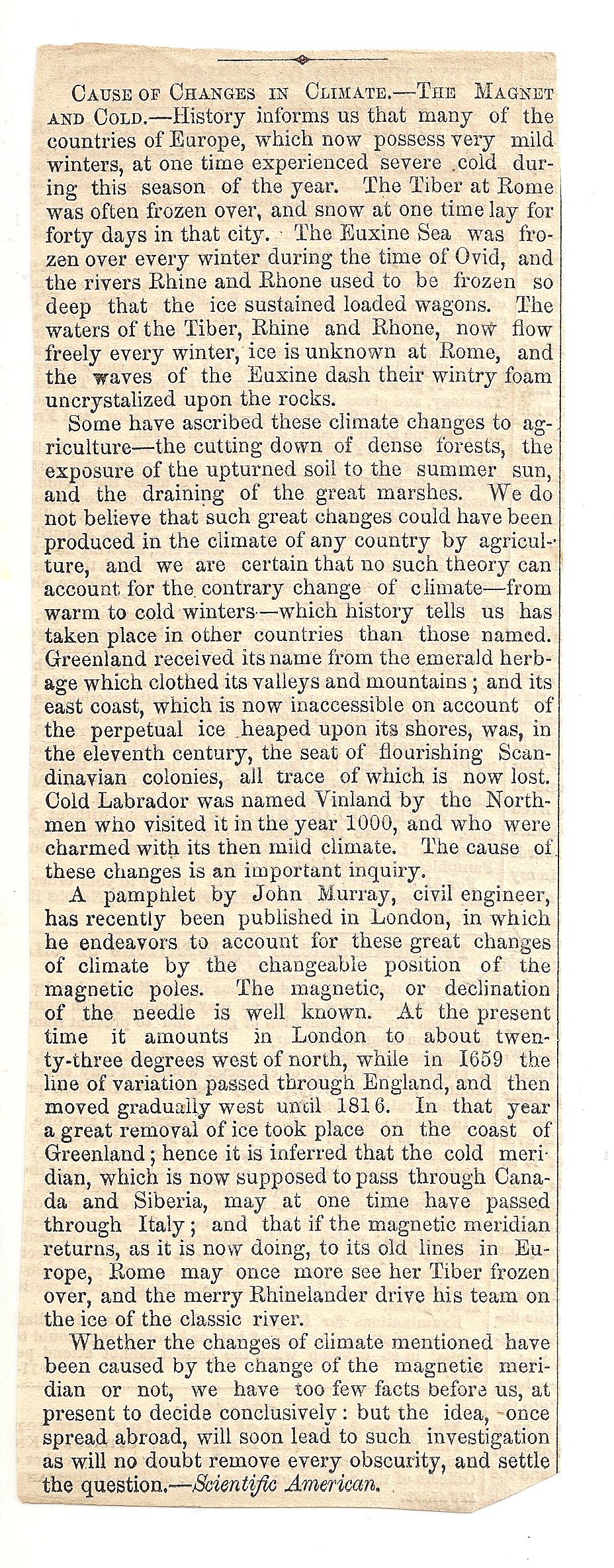
1855 Scientific American article discussed the great changes in climate and the strong evidence for a very mild MWP.
CAUSE OF CHANGES IN CLIMATE — THE MAGNET AND COLD.–History informs us that many of the countries of Europe, which new possess very mild winters, at one time experienced severe cold during this season of the year. The Tiber at Rome was often frozen over, and snow at one time lay for forty days in that city. -· The Euxine Sea was frozen over every winter during the time of Ovid, and the rivers Rhine and Rhone used to be frozen so deep that the ice sustained loaded wagons. The waters of the Tiber, Rhine and Rhone, new flow freely every winter, ice is unknown at Rome, and the waves of the Euxine dash their wintry foam uncrystalized upon the rocks.
Some have ascribed these climate changes to agriculture–the cutting down of dense forests, the exposure of the upturned soil to the summer sun, and the draining of the great marshes, We do not believe that such great changes could have been produced in the climate of any country by agriculture, and we certain that no such theory can account for the contrary change of climate-from warm to cold winters –which history tells us has taken place in other countries than those named. Greenland received its name from the emerald herbage which clothed its valleys and mountains , and its east coast, which is now inaccessible on account of the perpetual ice heaped upon its shores, was, in the eleventh century, the seat of flourishing Scandinavian colonies, all trace of which is now lost. Cold Labrador was named Vinland by the Northmen who visited it in the year 1000, and who were charmed with its then mild climate, The cause of these changes is an important inquiry.
A pamphlet by John Murray, civil engineer, has recently been published in London, in which he endeavors to account tor these great changes of climate by the changeable position of the magnetic poles. Tho magnetic, or declination of tho needle is well known. At the present time it amounts in London to about twenty-three degrees west of north, while in 1659 the line of variation passed through England, and then moved gradually west until 1816. In that year a great removal of ice took place on the coast of Greenland; hence it is inferred that the cold meridian, which is now supposed to pass through Canada and Siberia, may at one time have passed through Italy, and that if the magnetic meridian, returns, as it is now doing, to its old lines in Europe, Rome may once more see her Tiber frozen over, and the merry Rhinelander drive his team on the ice of the classic river.
Whether the changes of climate mentioned have been caused by the change of the magnetic meridian or not, we have too few facts before us, at present to decide conclusively: but the idea, -once spread abroad, will soon lead to such investigation as will no doubt remove every obscurity, and settle the question.–Scientific American
h/t to Mike Mellor