A lot of hysteria this week from the usual scoundrels, about CO2 driven hot nighttime temperatures in Phoenix.
The National Weather Service reports that nighttime temperatures outside the metropolitan area are 7-13 degrees cooler (as anyone who lives there already knows)
The effects of the UHI are most pronounced during the summer (June-July-August) months. In a simple comparison, average high and low temperatures from Maricopa, AZ and Phoenix Sky Harbor International Airport were compared (Figures 2 and 3). Little difference exists between the high temperatures from 1961 through 2007; however, low temperatures have trended warmer at Sky Harbor as compared to Maricopa, indicative of the existence of a strengthening UHI. Similar results have been found by Brazel et al. (2000), who compared temperature observations at several urban stations in the PMA (Phoenix, Mesa, and Tempe) to a rural station outside the PMA (Sacaton). The average minimum May temperature at the urban locations displayed an apparent upward increase through the time series (1910 through 2000), which was attributed to the urban growth of the region. By the end of the series, there was a +4 to 7 ºC (7 to 13 ºF) difference between the urban minimum temperatures and the rural minimum temperatures.
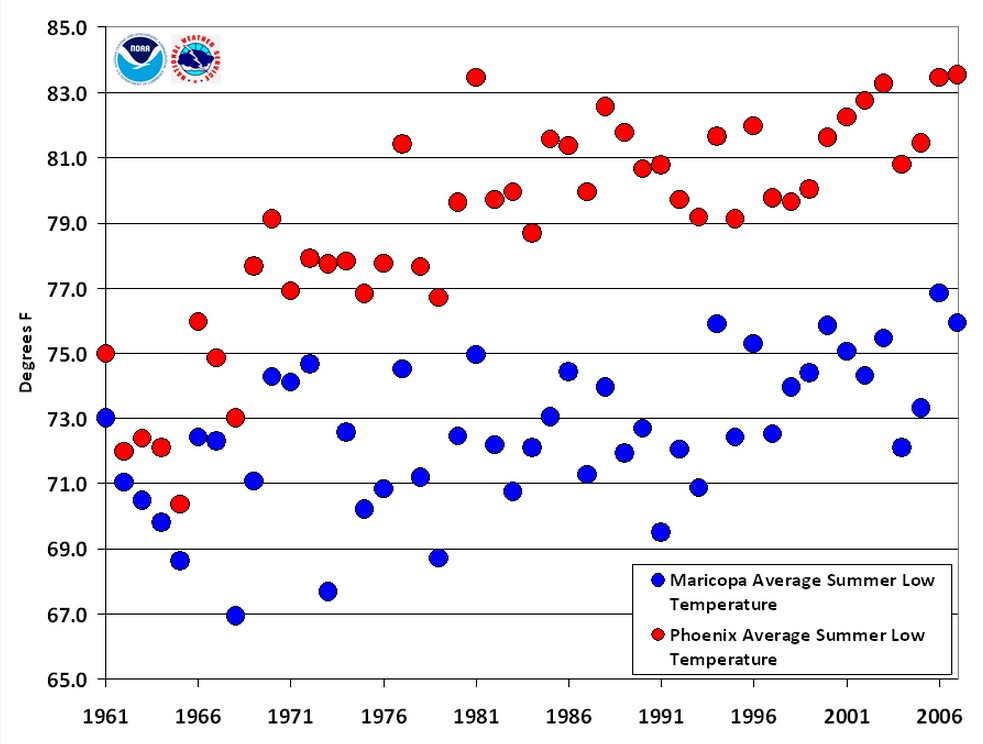
National Weather Service – NWS Phoenix
There must be a CO2 bubble sitting over the city.