The Joy Of Shutting Down Fossil Fuels

Sometime around 1980, I was driving to Chaco Canyon, New Mexico – when a massive failure occurred at the Four Corners Power Plant. This caused an electricity blackout across the entire northwest quadrant of the state for many hours.

When the electricity is out, gasoline pumps don’t work at the gas station. I didn’t have enough gas to drive the thirty miles each way in and out of Chaco Canyon, so I stopped at a Navajo trading post and bought two gallons of Coleman Lantern Fuel (essentially unleaded gasoline.)

The owner of the store realized what I was doing, and jacked the price up to $10 per gallon.  Shutting down the coal industry will indeed make energy prices skyrocket.

Perhaps Obama can get a job working at a Navajo trading post. Ya-Ta-He.

Posted in Uncategorized | 7 Comments

Washington Post Has Never Endorsed A Republican For President, But Say They Aren’t Biased

The Post’s endorsements tend Democratic

Tend? ROFLMAO

The Post began regularly endorsing candidates for president in 1976, with Jimmy Carter. The Post editorial board hasn’t endorsed a Republican for the Oval Office

Is The Post, in its endorsements, more left than right of center? Yes. But that doesn’t make it an arm of any party or faction.

Yes it does.

Patrick Pexton: The Post’s endorsements historically tend Democratic – The Washington Post

Posted in Uncategorized | 2 Comments

1984 : WWF President Says That Humans Are A Plague On The Planet

[youtube=http://www.youtube.com/watch?v=taoHk_enqWA]

Posted in Uncategorized | 18 Comments

Little Ice Age Storm Surges Killed Tens Of Thousands Of People In Europe

Climate experts Bloomberg and McKitten tell us that storm surges are caused by global warming, because they have absolutely no idea what they are talking about.

The (1st) Grote Mandrenke (/?ro?t? mandr??k?/, Low Saxon for “Great Drowning of Men”,[1]) was the name of a massive southwesterly Atlantic gale (see also European windstorm) which swept across England, the Netherlands, northern Germany, and Schleswig around January 16, 1362, causing at minimum 25,000 deaths.[1] January 16 is the feast day of St. Marcellus (pope Marcellus I), hence the terrible storm tide is also called the “2nd St. Marcellus flood”. The “1st St. Marcellus flood” which drowned 36,000 men mainly in West Friesland and Groningen (today provinces in the north of the Netherlands) took place on the same day (January 16) in 1219.

An immense storm tide of the North Sea swept far inland from the Netherlands to Denmark, breaking up islands, making parts of the main land into islands, and wiping out entire towns and districts, such as Rungholt on the island of Strand in North Frisia.

This storm tide, along with others of like size in the 13th century and 14th century, played a part in the formation of the Zuiderzee,[1] and was characteristic of the unsettled and changeable weather in northern Europe at the beginning of the Little Ice Age.

Grote Mandrenke – Wikipedia, the free encyclopedia

Posted in Uncategorized | 3 Comments

Quiz : What Is The Prime Minister Looking At?

Prime Minister Peter O’Neill of New Guinea takes a look at Prince Charles’ carbon footprint.

Prince Charles is known as the Queen’s “pikinini” in the pidgin English spoken in the Pacific nation.

Prince Charles and Camilla begin Jubilee tour in Papua New Guinea – Telegraph

Posted in Uncategorized | 5 Comments

More Atmospheric Physics From Bette Midler

Bette explains how CO2 affects her flight plans.

[youtube=http://www.youtube.com/watch?v=i-T1h7J0R-Q]

Posted in Uncategorized | Leave a comment

David Cameron’s Hillsborough Apology

[youtube=http://www.youtube.com/watch?v=mavTTc21sCY]

Posted in Uncategorized | 2 Comments

1933 : Two Major Hurricanes Hit The US On Consecutive Days

The 1933 Treasure Coast hurricane … made landfall near the border of Palm Beach and Martin counties, Florida, as a strong Category 3 hurricane on September 4.

1933 Treasure Coast hurricane – Wikipedia, the free encyclopedia

The 1933 Cuba–Brownsville hurricane … struck near Brownsville early on September 5 with winds estimated at 125 mph

1933 Cuba–Brownsville hurricane – Wikipedia, the free encyclopedia

By contrast, it has now been more than 2,500 days since the US was hit by a major hurricane, the longest such period on record since the Civil War.

h/t to Andy DC

Posted in Uncategorized | 1 Comment

1821 : Only Major Hurricane To Hit New Jersey

Good thing that morons like McKitten weren’t around to blame the storm on democracy.

For those who live in the Garden State and the New York City area, and think that a major hurricane isn’t possible here better think again. This weekend commemorates the 185th anniversary of the Great Hurricane of 1821. On September 3rd that summer, a Category Four Hurricane rapidly moved up the east coast. As a matter of fact, the storm moved from North Carolina’s outer banks to the New York City area in just ten hours. This storm struck the Cape May area of extreme South Jersey, and moved up along a path that is covered by the Garden State Parkway today.

The Great Hurricane of 1821 was a classic Cape Verde storm. Originating off the African coast, the hurricane was picked up by ships near Grand Turk Island in the Turks and Caicos Islands. The storm headed northward, where on September 3rd, it was in Cape Hatteras by dawn, the Virginia Capes by noon, and in Delaware Bay by mid-afternoon according to the book, Great Storms of the Jersey Shore written by Larry Savadore and Margaret Thomas Buchholz. Coastal areas in the tip of Southern New Jersey such as Cape May were separated from the rest of that Southern Jersey Peninsula while heavy tree damage was reported on Long Beach Island in Ocean County.

According to an article written by Kirk Moore and Todd Bates of the Asbury Park Press on July 23, 2006, Cape May was known as Cape Island, which was appropriate, especially when a “wall of water surged across the peninsula from Delaware Bay to the sea.” Today, tourists visit the Cape May Point and its lighthouse, a place where storm surge, wind and waves forced residents including fishermen, farmers, and children to flee for higher ground.

It was the only time on record that a major hurricane has impacted the Garden State. The hurricane produced 100 mph winds as far west as Philadelphia, and a thirteen foot storm surge in what is now today, the Battery Park section of lower Manhattan. The surge was the highest ever recorded in New York Harbor. Continuing further to the north, the Great Hurricane of 1821 didn’t stop there. It roared through New England as well producing winds between minimal Category One strength, and strong Category Two strength on the Saffir-Simpson Scale.

As mentioned in the book, Hurricane Watch by Jack Williams and former National Hurricane Center director, Bob Sheets, winds were reported by amateur meteorologist, William C. Redfield to be between seventy-five and one hundred miles per hour in Connecticut. Redfield noted a peculiar quality about the damage created by this storm in Litchfield County, Connecticut as well as other parts of the Nutmeg state. It finished up by heading into the rest of New England, particularly, Worcester Massachussetts.

Looking Back On The 1821 Hurricane–185th Anniversary

Posted in Uncategorized | 2 Comments

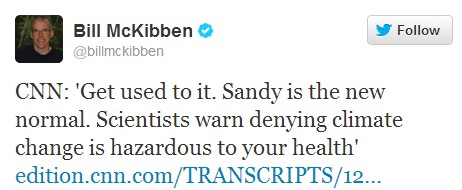
McKitten Says That Once Every 200 Year Event Is The New Normal

In 1821, Manhattan was split into two islands by the storm surge of a hurricane. A similar even happened last weekend. McKitten has determined from these two data points that Sandy is the new normal.

Twitter / billmckibben: CNN: ‘Get used to it. Sandy …

Eric Berger calls himself the SciGuy and is a big global warming advocate. He wrote this column yesterday.

My concern is whether the end justifies the means. My concern is setting expectations that Sandy, that large, destructive hurricanes striking the United States, is the “new normal.” My concern is that we’re telling people that we’ve entered an era in which super-storms are the new normal and that there will be a mega-disaster every year.

My concern is that we’re not debating facts when it comes to hurricanes and climate science.

IT’S SCIENCE, STUPID

Science tells us this is not a new normal.

There will probably be fewer Sandy-like storms in the future | SciGuy | a Chron.com blog

h/t to Marc Morano

Posted in Uncategorized | 2 Comments