Temperatures in Boulder have not increased for 60 years, yet the University of Colorado has obtained $800,000 to study how global warming has affected the local rodents. Perhaps the fat furry rats are teleconnected to Yamal?
The massive grant — from the Division of Environmental Biology at the National Science Foundation — is designed to give the researchers three years in the field to try and figure out how climate change is altering prairie dog habitat and how the rodents are responding to those changes. The study also will examine the interactions between native and non-native plants, including whether new species are taking up water used by the native variety.
Heather Swanson, Boulder’s wildlife ecologist, said some of the changes reported in recent years include loss of topsoil and changes in plant species where prairie dogs can be found. One of the primary questions is whether those changes are causing prairie dogs to change their habits, including being more active during the winter — which can lead to soil erosion after the rodents eat plants to the bare ground.
“I’m concerned that our management plan has not been informed by science that would look at what’s happening on these fragmented parcels” of open space, Wilson said. “We’ve seen some impacts that are disturbing, where (prairie dogs) totally defoliate these areas. We need to understand why that’s happening so that we can manage our grasslands better.”
CU to study impact of climate change on Boulder prairie dogs – Boulder Daily Camera
Let me save the taxpayers almost a million bucks and complete the study in the next 30 seconds.
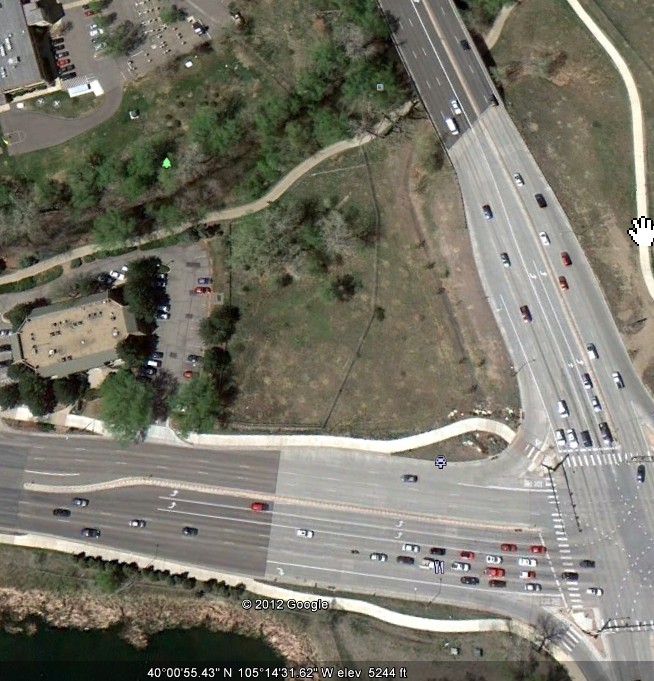
Boulder’s most famous Prairie Dog town is at the corner of Arapahoe and Foothills. Both roads are about eight or nine lanes wide at the intersection. If you look closely at the Google Earth image below, you can see dozens of circular Prairie Dog mounds in an overpopulated village of potential Bubonic Plague carriers. The animals are boxed in, their natural predators have been nearly eliminated, and they are protected by law.
The little rats are overpopulated and they eat all the grass.