
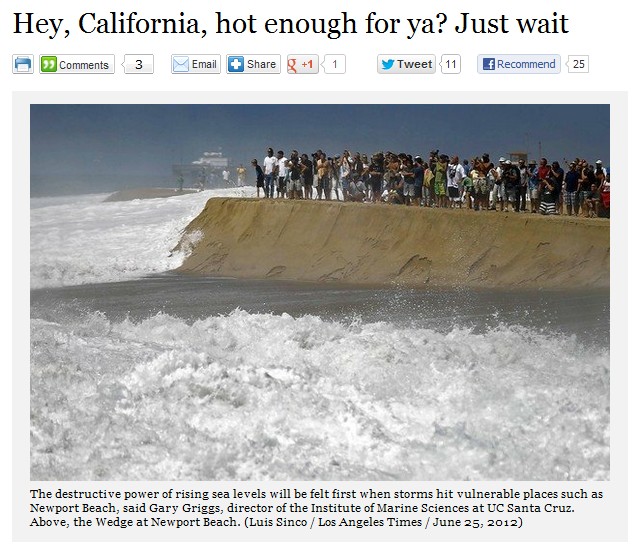
Hey, California, hot enough for ya? Just wait
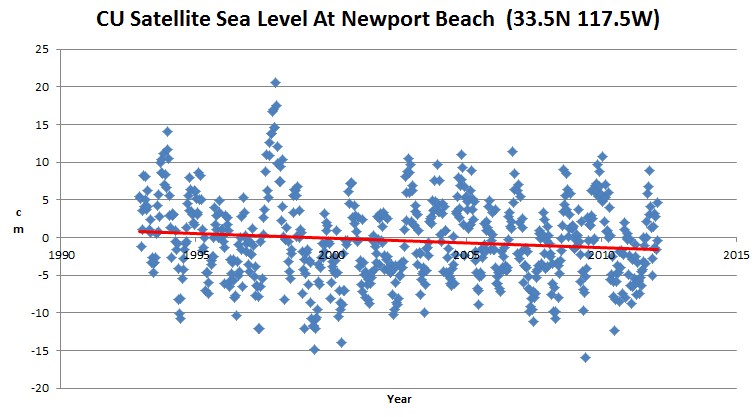
California hit 134 degrees in 1913, and sea level has been declining at Newport Beach for as long as the satellite records have been made. As usual, the author has all of his facts wrong.
Hey, California, hot enough for ya? Just wait
California hit 134 degrees in 1913, and sea level has been declining at Newport Beach for as long as the satellite records have been made. As usual, the author has all of his facts wrong.
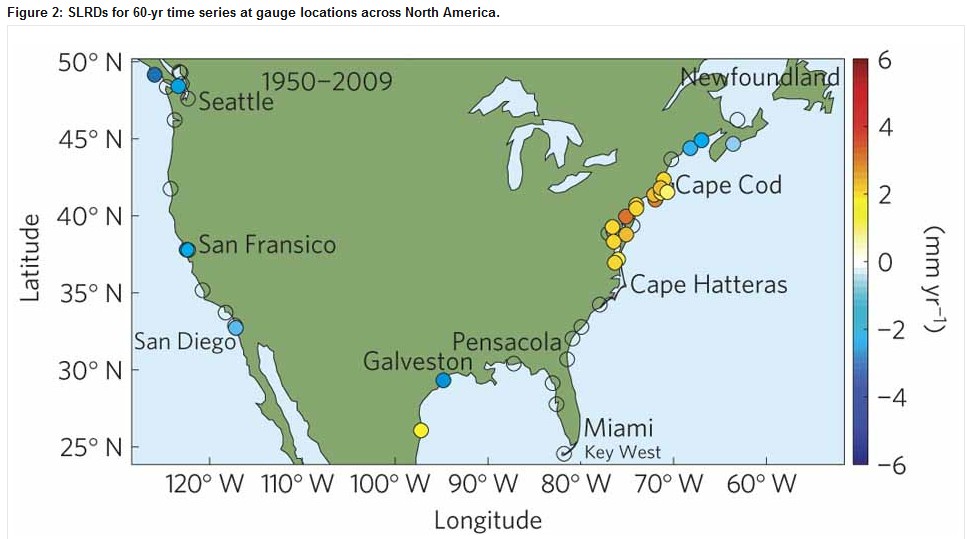
The report says that sea-level rise from Cape Hatteras, North Carolina to Boston, Massachusetts (a 600-mile expanse of coastal zone called the “hotspot” by scientists) has grown 2-3.7 millimeters per year since 1990. For comparison, scientists say that the global growth rate over the same time frame was 0.6 -1.0 millimeter per year.
The report warns that if global temperatures continue to increase, rates of sea level rise along the East Coast are likely to continue growing. Scientists say this prediction is based on data and analyses that are detailed in the report.
Good thinking. Anomalous local effects are caused by global warming.
Scientists say that global sea level will not increase at the same rate at every location, even though calculations show that it is likely to rise approximately two-to-three feet or more by the end of the 21st century. Sea level rise can vary both regionally and locally due to deviations in land movements, strength of ocean currents, water temperatures and other factors.
Study: Global warming could destroy the East Coast | The Bunsen Burner
Eighty eight years left in the century, and a global growth rate of 0.6 to 1.0 mm per year. According to the government, that works out to two or three feet (600 to 900 mm.)
Any paper which includes the words “Since the beginning of satellite measurements” is a red flag that someone is about to start lying to you.
A new view on sea level rise Stefan Rahmstorf
Over the course of the twentieth century, the rate of sea level rise has roughly tripled in response to 0.8 °C global warming. Since the beginning of satellite measurements, sea level has risen about 80 per cent faster, at 3.4 millimetres per year, than the average IPCC model projection of 1.9 millimetres per year.
A new view on sea level rise : article : Nature Reports Climate Change
Utter tripe. Tide gauges show a steady 1.8 mm/year over the last 100 years. There has been no acceleration.
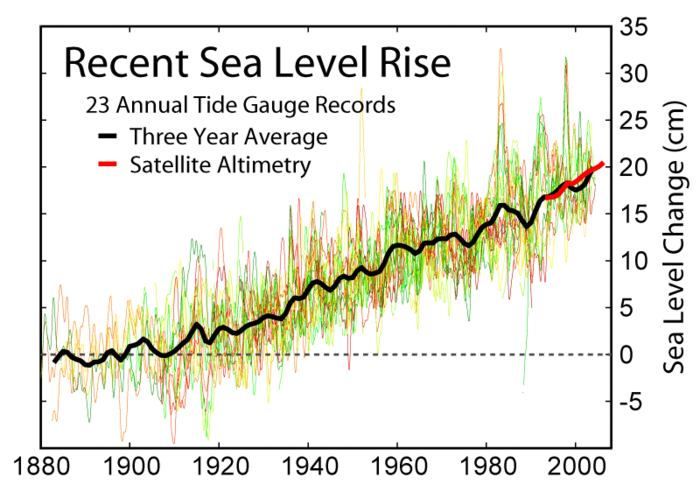
From 1991
GLOBAL SEA-LEVEL RISE Author(s): DOUGLAS, BC (DOUGLAS, BC) Source: JOURNAL OF GEOPHYSICAL RESEARCH-OCEANS Volume: 96 Issue: C4 Pages: 6981-6992 DOI: 10.1029/91JC00064 Published: APR 15 1991
The value for mean sea level rise obtained from a global set of 21 such stations in nine oceanic regions with an average record length of 76 years during the period 1880-1980 is 1.8 mm/yr +/- 0.1. This result provides confidence that carefully selected long tide gauge records measure the same underlying trend of sea level and that many old tide gauge records are of very high quality.
From 2012
Source found for missing water in sea-level rise Human use of water contributes markedly to rising tides. Amanda Mascarelli 20 May 2012
During the latter half of the twentieth century, global sea level rose by about 1.8 millimetres per year, according to data from tide gauges. The combined contribution from heating of the oceans, which makes the water expand, along with melting of ice caps and glaciers, is estimated to be 1.1 millimetres per year, which leaves some 0.7 millimetres per year unaccounted for.
Source found for missing water in sea-level rise : Nature News & Comment
What changed is that Rahmstorf was disappointed that tide gauges blew away his theory, so he switched to an uncalibrated measurement system – i.e. satellites. Call it Stefan’s Nature trick.
But it sucks to be Stefan, because even the satellites have turned against his nonsense. Since 2005, satellites are also reporting 1.8 mm/year.
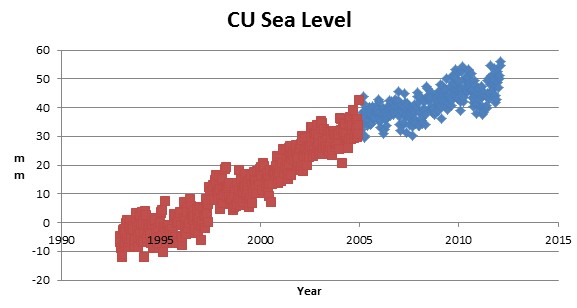
Here is where Rahmstorf goes full stupid
Whether the response of continental ice to warming is well represented by empirical models is harder to judge, though the linear dependence on temperature is similar to that also used in glacier modelling studies and by the IPCC. The semi-empirical approach, however, was recently criticized in the popular media9 on the grounds that it is, to a large extent, calibrated to the past glacier contribution, and that glaciers would be “largely gone by 2050”. Apart from this being just not so, the melting of all glaciers would add 60 centimetres to global sea level10, a lot more than in the worst-case scenario projected by semi-empirical models for 2050. And that contribution would be in addition to seawater expansion and melting of continental ice sheets.
If two-thirds of glacier ice were lost, this would add 40 centimetres to the global sea level, which is close to the lower bound of 37 centimetres recently estimated by glacier experts12. In that case, the percentage contribution of glacier melting to sea level rise would remain the same as in past decades13. The big ice sheets would then need to contribute only about 50 centimetres — corresponding to less than one per cent of their mass — to bring sea level rise up to 114 centimetres. None of this appears any less plausible than the IPCC’s assumptions.
Glaciers gone by 2050? 600 mm of sea level rise by 2050? 1140 mm of sea level rise? Rahmstorf has absolutely no idea what he is talking about.
Experts tell us that the hot weather in Colorado proves global warming. These same experts completely ignored us during the previous two Junes when we were experiencing flooding and record snowpack.
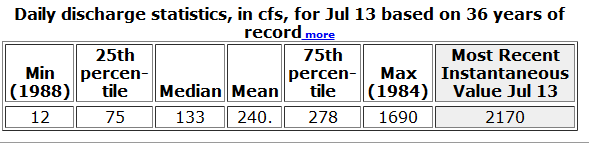
July 13, 2011 broke the record for most snow melt runoff in the Poudre River that late in the summer.
January 12, 1888 started out as a very mild day on the Great Plains. During the afternoon, an incredible blizzard moved into the region without warning. Hundreds of children froze to death walking home from school that day. It became known as the Schoolhouse Blizzard.
Schoolhouse Blizzard – Wikipedia, the free encyclopedia
Two months later, the Great Blizzard of 1888 struck the Northeast – dropping 40-50 inches of snow on New York. It was the biggest snowstorm in history in that region, and became the motivation for building the subway system in New York.

Some days our clueless friends tell us that big snowstorms are due to global warming, and on other days they say that snow is a thing of the past.
But that’s not all. On July 11, 1888 – Colorado set its all time high temperature record at 118F. www.ncdc.noaa.gov/oa/pub/data/special/maxtemps.pdf
This was seven years after Europe set their all-time temperature record of 122F in 1881. World Temperature Extremes
Experts tell us that record heat can’t happen without man made CO2, because they have their heads firmly planted where the sun never shines.
Colorado’s 114°: hottest temperature in state history
The remarkable heat wave that affected Colorado on Saturday and Sunday has tied the all-time heat record for the state. According to wunderground’s weather historian Christopher C. Burt, Saturday’s 114° reading in Las Animas tied for the hottest temperature ever measured in the state of Colorado. Two other 114° readings have occurred in Colorado history: in Las Animas on July 1, 1933, and in Sedgwick on July 11, 1954.
What Jeff was trying to say, is that he thinks Colorado is just as hot as it was 80 years ago. He got a bit confused when he wrote the headline.
But it is worse than it seems. NOAA says it was 118 F on July 11, 1888 in Bennett, Colorado.
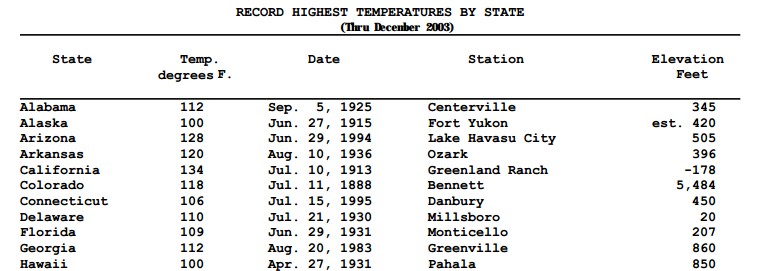
www.ncdc.noaa.gov/oa/pub/data/special/maxtemps.pdf
He also wrote :
In Fort Collins, the mercury hit 102° on Sunday, just 1° below the city’s all-time hottest temperature of 103° set on Jul 21, 2005. The heat did no favors for firefighters struggling to the contain the massive 81,000 acre High Park fire fifteen miles northwest of Fort Collins. The fire is the second largest and most destructive wildfire in Colorado’s history, and is 45% contained.
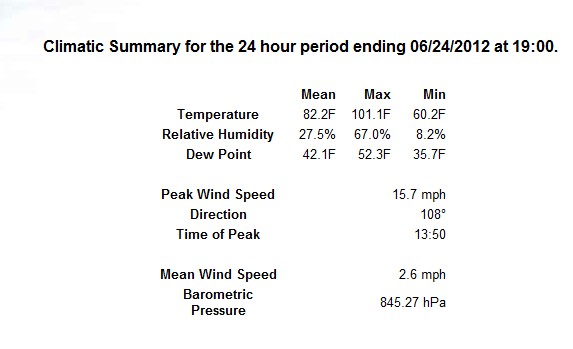
Once again, Jeff is spreading BS. The official high temperature in Fort Collins on Sunday was 101F, and according to USHCN it was 102F on three days in 1954 and one day in 1925.
I wonder why he forgot to tell the truth?
As far as the fire goes, it is perhaps 1% the size of the 1898 fire.
The UnChristian AntiScience Monitor reports :
Global warming spells bad news for emperor penguins, study finds
Researchers at the Woods Hole Oceanographic Institution have found that melting sea ice could lead to dramatic declines in populations of emperor penguins.
Global warming spells bad news for emperor penguins, study finds – CSMonitor.com
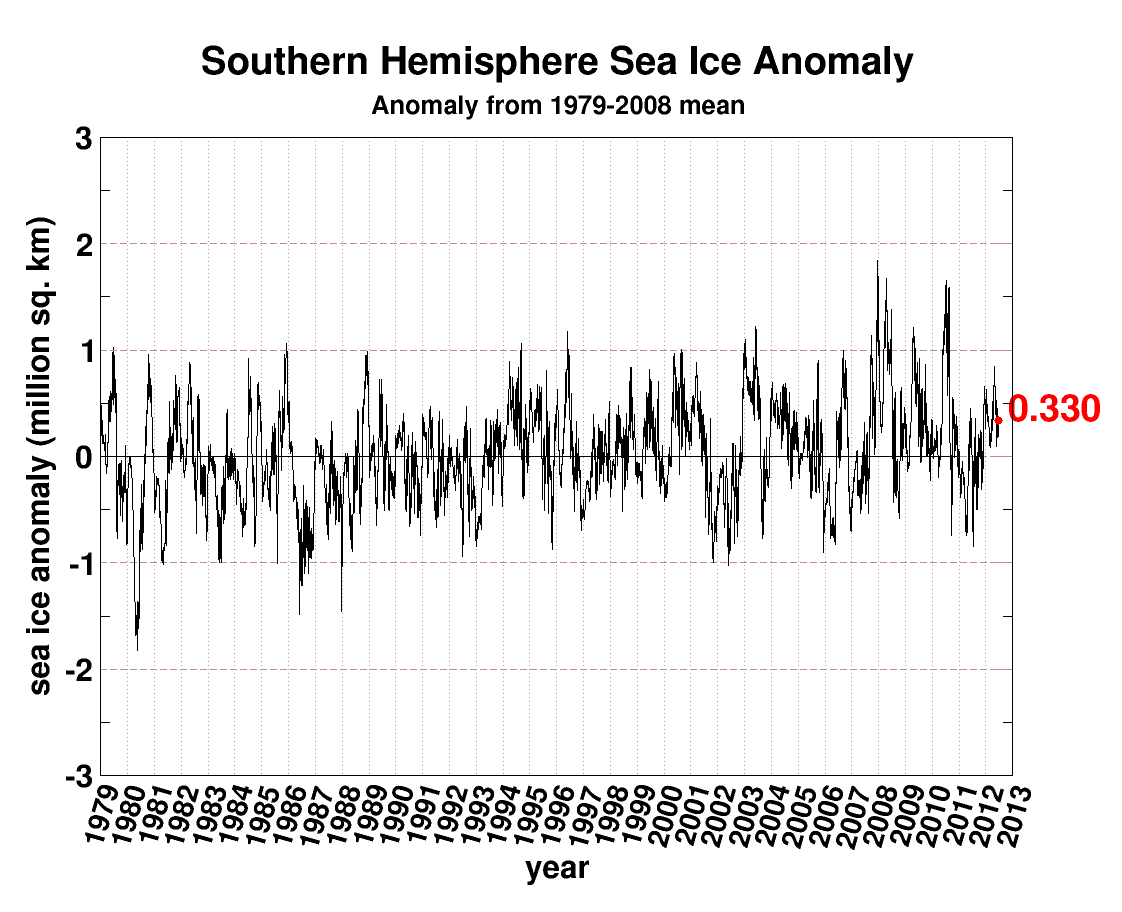
Had anyone involved with the newspaper or the study actually done any research, they would have know that sea ice is increasing in Antarctica.
Like the West Side Highway in Manhattan, the peer review process in climate science had drowned by the year 2008.
A new article in Nature claims that sea level is rising much faster in the Northeastern US than on the rest of the planet.
WASHINGTON — From Cape Hatteras, N.C., to just north of Boston, sea levels are rising much faster than around the globe, putting one of the world’s most costly coasts in danger of flooding, government researchers report.
U.S. Geological Survey scientists call the 600-mile swath a “hot spot” for climbing sea levels caused by global warming. Along the region, the Atlantic Ocean has risen at an annual rate three to four times faster than the global average since 1990, according to the study published Sunday in the journal Nature Climate Change.
Rise in E. Coast sea levels exceeds global average | Nation | News from Fort Worth, Dall…
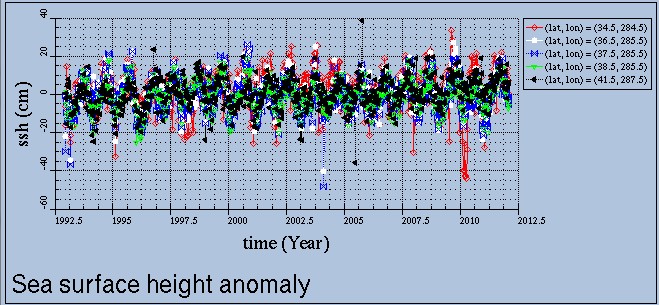
Had anyone with half a brain peer-reviewed this paper, they would have looked at the satellite data and realized that there has been little or no sea level rise in that region over the last decade. Much of the rise in sea level which the authors think they are seeing, is actually due to subsidence of the land.
2008 : Australian skiing doomed!
Global warming to shorten ski season: CSIRO Updated May 28, 2008 09:02:00
Australia Scientists say Australian skiers should prepare for shorter ski seasons because of global warming. A report published in the New Scientist magazine has found the average number of days of snow in the Swiss Alps is lower than ever before. CSIRO climate change expert Dr Penny Whetton says Australia’s mountain snow cover could be reduced by up to 54 per cent by 2020. “The probability of any precipitation falling as snow rather than rain is going to decrease, and any snow lying on the ground is going to melt more quickly,” she said. “So the outcome of that is, there’s going to be shorter snow seasons, not as much depth of snow on the ground
Global warming to shorten ski season: CSIRO – ABC News (Australian Broadcasting Corporation)
2012
Australian skiers rejoice in 70cm of snow by: By Angela Saurine From: news.com.au June 25, 2012 1:21pm
SKIERS and snowboarder were basking in deep powder snow over the weekend after a huge storm hit Australian ski resorts. Mt Hotham in Victoria received 70cm of fresh snow since Thursday – the most of any resort in the country. “It was a busy weekend after news broke that Heavenly Valley would open two weeks earlier than last year,’‘ spokeswoman Gina Woodward said. “The snow conditions were outstanding. “It certainly was a case of ‘pinch me is it June?”

Azaria Chantel Loren Chamberlain
11 June 1980 – 17 August 1980
This is the story of a little girl who lived, and breathed,
and loved, and was loved. She was part of me.
She grew within my body and when she died, part of me died,
and nothing will ever alter that fact.
This is her story, and mine.
On the evening of Sunday, 17 August 1980 Lindy Chamberlain was an innocent, 32 year old mother of two boys, and a girl – Aidan, 6, Reagan, 4, and nine-week-and-four-day-old Azaria. Lindy wanted all of her children to have names with strong meanings, choosing Azaria because the book of baby names she found it in said it meant ‘Blessed of God’. It was exactly how she felt finally getting the daughter she had so badly wanted.
The family was staying in the public campground at Ayers Rock (now Uluru). Before the night was over her daughter was to disappear from the tent where she was sleeping. Lindy had seen a dingo coming out of the tent, and when she checked on her daughter, found her gone. There were dingo prints leading into the cold desert night and blood in the tent. But by morning, people who had not been with Lindy comforting her, or searching on that night, were already spreading wild, untrue rumours. Of sacrifice, murder, dingoes not being capable, and of weird behaviour.
There was never a question of the events and evidence on the part of the eyewitnesses – none of whom had met the Chamberlains before – or the rangers, trackers, and police first on the scene. It was a natural tragedy that the head Ranger had warned his government of some time earlier. The first Coroner’s Inquest confirmed that a dingo had killed Azaria. That verdict was later overturned, and Lindy was to spend the next seven years living a nightmare – nearly three of them in prison – before finally managing to prove her innocence, and receiving complete exoneration – a first for Australian justice.

