12 Mar 2009
Prince Charles told 200 business leaders in Rio de Janeiro that the world has “less than 100 months” to save the planet

We are 1/5 of the way to the end of the world.
12 Mar 2009
Prince Charles told 200 business leaders in Rio de Janeiro that the world has “less than 100 months” to save the planet
We are 1/5 of the way to the end of the world.
Golf, basketball, bankrupting the country, marginalizing people who disagree with him, getting public money to his banker friends …..
“He’s almost 50 years old and he’s president of the United States and I don’t think anybody would debate his intelligence and so now we need to get serious … let’s just get serious and get back to focusing on what’s important,” senior Obama adviser Valerie Jarrett said on The Joe Madison Show this morning.

They were cheered by 500,000 well-wishers who gathered outside the palace, as RAF planes flew past in honour of the new royal couple.
Police estimate a million people lined the procession route from the abbey to the palace.
The bride will now be known as the Duchess of Cambridge.
The Queen is hosting a buffet reception at the palace for 650 guests.
This couple was not invited to the wedding.
Michaels refers to greenhouse gas scenarios A, B, C in our 1988 paper, failing to note that precisely measured greenhouse gas climate forcing since 1988 fall almost exactly on our scenario B, which we had described as the most likely
Scenario B wasn’t based on logarithmic forcing. It was based on linear growth of greenhouse gases.
Scenario A assumes continued exponential trace gas growth, scenario B assumes a reduced linear linear growth of trace gases, and scenario C assumes a rapid curtailment of trace gas emissions such that the net climate forcing ceases to increase after the year 2000.
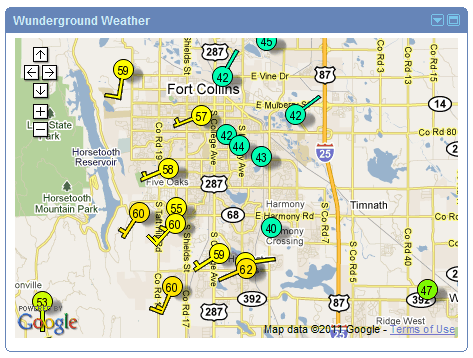
I was just out cycling towards the mountains in cool air, and was suddenly hit by a blast of heat from downslope winds. West of College Ave temperatures are 15 degrees warmer. This remarkable transition occurs over just a few metres. Note that warm temperatures have SW winds and cool temperatures have NE winds.
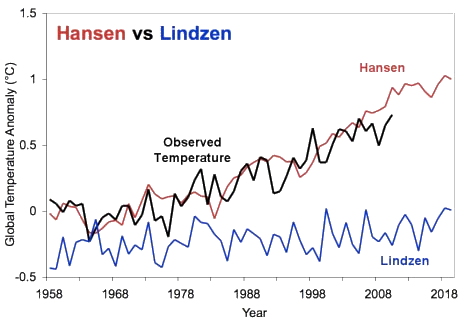
Cook published this graph purporting to show that Hansen is better than Lindzen at forecasting temperatures. There are so many things wrong with this graph, it is difficult to know where to start.
1. Hansen made three forecasts, Cook picked scenario “B” which Hansen described as “a reduced linear linear growth of trace gases.” Obviously that has not happened and is not the correct one. He should be comparing against scenario A. Joe Romm says that greenhouse gases have been “accelerating super-exponentially.”
2. He used Hansen’s temperature data to verify Hansen’s predictions. That is like trusting Al Gore’s lawyers to count ballots in Florida.
3. Cook offset Lindzen’s start point downwards by half a degree. Obviously the data needs to be normalized before comparing.
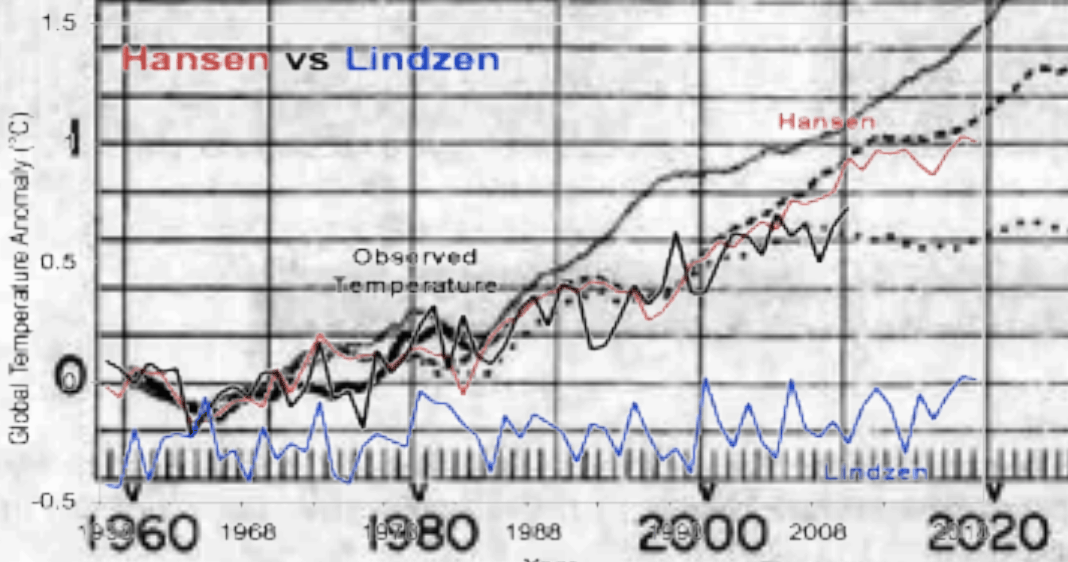
4. He drew scenario B below Hansen’s actual scenario B. Note the red line above is too low.
5. He drew Hansen’s measured data too high. The thick red line below and horizontal bars are from the GISS web site. The black line above it is what Cook drew. Hansen reported 0.63 for 2010, Cook placed it above 0.7
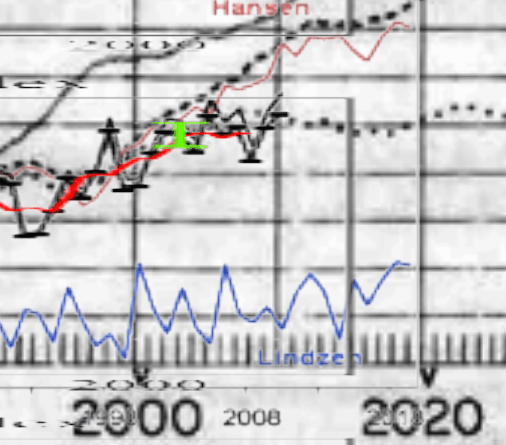
In summary, he used the wrong projection, he let Hansen officiate, he didn’t normalize Lindzen’s data, and he misplaced both the projection and the results on the graph.
Reader Chilli adds :
Another deception is that Cook just made up the “Lindzen graph”. It does not represent any prediction ever made by Lindzen. Cook made the bogus graph by simply removing CO2 from Hansen’s temperature model. Naturally this produced a flat line since Hansen’s failed model is programmed to only respond to CO2.
The flat line merely shows how the model fails to account for natural effects of sun and ocean cycles – effects which Lindzen acknowledges and Cook does not.
So bravo to Cook for setting up and knocking down a strawman using an entirely circular argument.
Climate change may give America’s venomous brown recluse spiders a choice: Move to a more northern state or face dramatic losses in range and possible extinction, a new theoretical study suggests.
Currently, brown recluse spiders are found in the interior of roughly the southeastern quarter of the continental United States. Researcher Erin Saupe used two ecological models to predict the extent of the spider’s range in 2020, 2050 and 2080 given the effects of global warming.
She probably should have actually checked the temperature records at some point, since she is doing a dissertation based on changes in temperature. Then she would have known that the premise was fatally flawed.