Last week :
This week :
a weather front moving in from the Atlantic is expected to see temperatures fall. The outlook for the royal wedding on Friday remains uncertain, but forecasters said there could be brief downpours in London during the day.
Last week :
This week :
a weather front moving in from the Atlantic is expected to see temperatures fall. The outlook for the royal wedding on Friday remains uncertain, but forecasters said there could be brief downpours in London during the day.
A new study shows that CO2 molecules emitted by people who feel guilt and express anger towards others who are actually productive, are much less harmful to the environment.
Local extinction rates of American pikas have increased nearly five-fold in the last 10 years, and the rate at which the climate-sensitive species is moving up mountain slopes has increased 11-fold, since the 20th century.
What a crock. I’ve lived near the mountains most of my life, and spent a couple of summers 30 years ago working as a wilderness ranger at 10,000 and 12,000 feet. The flora and fauna hasn’t changed a bit. There are Pikas all over the place. Who are these nutcases?
Climate models are simply amazing at retroactively predicting whatever the weather is at the present time.
2007 – Projections of climate change caused by human activities conducted by 19 different climate modeling groups around the world, using different climate models, show widespread agreement that southwestern North America, and the subtropics in general, are heading toward a climate even more arid than it is today.
2011 – A panel of scientists has said that climate change was behind this years heavy snow and extreme storms that struck much of the planet. As temperatures continue to rise, affecting weather patterns, they are also warning that spring could come early, bringing with it devastating floods. The researchers say it has led to more moisture in the air is likely to bring about extraordinary flooding across huge areas when deep snow-pack melts and heavy rain falls as spring arrives.
T.J. HOLMES, CNN anchor: Well, in today’s “XYZ,” I’d like confess my sins. I drive a Chevy Tahoe. It gets 15 miles to the gallon in the city. While some people have SUVs to haul their large families around, it’s just me driving by myself to work every day. I have a number of TVs in my high house and leave them on just about all day, every day. I often turn the water on in the shower, then I walk downstairs to maybe grab breakfast, leave the water running, then I go back upstairs to take a shower.
I buy 24 packs of bottled water at a time. Then I throw those bottles away without recycling. In the winter I crank the heat up to 75 or 76. All the light bulbs in my house are still the old school, less efficient incandescent bulbs.
Those are my eco-sins. I’m confessing them to you because tomorrow is Earth Day. It often goes ignored by many of us, including me. Not going to ignore this year. Why? Well, maybe it was an awakening. Maybe I was scolded recently by an environmentalist. Maybe I’m tired of wasting my own money. Whatever my reasons, whatever yours, happy Earth Day.
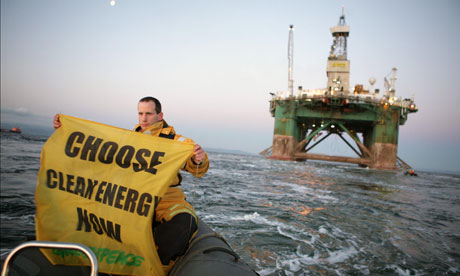
They hate oil and never, ever use it themselves.
The fight to stop the global oil industry exploring the pristine deep waters of the Arctic has been dubbed the new cold war, and early on Friday it escalated as environmental activists from 12 countries occupied the world’s second largest rig on its way from Turkey to Greenland to drill among the icebergs.
If everyone who believed in CAGW simply quit using energy, their problem would be solved. What are they waiting for?
McKibben, who has been called the “world’s best green journalist” by Time Magazine, discussed 350.org, his worldwide campaign against climate change, and the dangers of global warming.
“When you have heat like that, it manifests in many ways,” McKibben said. “Warm air holds more vapor than cold air, effectively loading the dice for deluges. What we’re seeing here is snake eyes — just look at Pakistan.”
Human activity has sent Earth “profoundly out of balance,” he said. Human actions have caused temperature to rise a collective two degrees Celcius across the globe, he said.
He described his experiences in Bangladesh last year during an outbreak of dengue fever, a disease spread by mosquito bites. The rapid and intense occurrence of the tropical disease was caused by an upsurge of the mosquito population in the region — sparked by increasingly warmer temperatures, he said.
“This is not fair that those 150 million people — half the population of the U.S. — have to suffer for our carbon emissions,” McKibben said.