[UPDATE : Correction below. It doesn’t change the conclusion.]
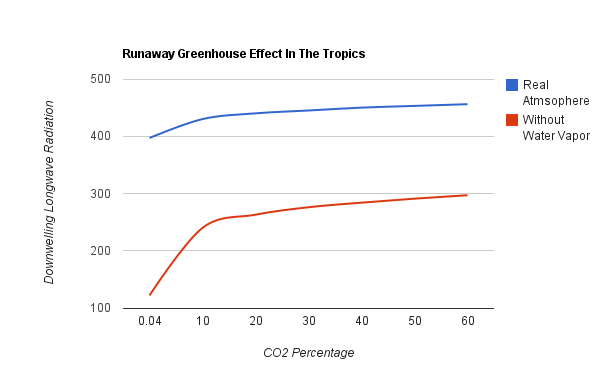
I tried an experiment on RRTM – the radiative transfer model used by NCAR’s climate and weather models – which shows how ridiculous the Hansen/Sagan runaway greenhouse effect is. The control run used current conditions in the tropics – 299K, 2% H20, 393 ppm CO2. This is what it produced :
 LEVEL    PRESSURE   UPWARD FLUX   DOWNWARD FLUX    NET FLUX       HEATING RATE
             mb          W/m2          W/m2           W/m2          degree/day
   0     1013.         459.2934      397.0788        62.2146           -2.92635
The downward LW flux at the surface is 397 w/m2. Next I tried the same experiment with a 95% CO2/0% water atmosphere, which is similar to Venus :
[UPDATE : The numbers below are incorrect. It turns out that the model is not stable at 95% CO2]
LEVEL PRESSURE UPWARD FLUX DOWNWARD FLUX NET FLUX HEATING RATE mb W/m2 W/m2 W/m2 degree/day 0 1013. 459.2930 36.8353 422.4577 -0.50246
The downward LW flux drops to less than one-tenth of the normal atmosphere.
[UPDATE : Here are more accurate numbers at 60% CO2]
Next I tried the same experiment with a 60% CO2/0% water atmosphere. That is 1,500 times more CO2 than the atmosphere actually has.
 LEVEL    PRESSURE   UPWARD FLUX   DOWNWARD FLUX    NET FLUX       HEATING RATE
             mb          W/m2          W/m2           W/m2          degree/day
   0     1013.         459.2943      308.5074       150.7869           -0.99265
The downwards LW flux drops by 23%. Snowball Earth.
Why? because H2O is by far the most important greenhouse gas. The absorption spectra of H2O at 1000mb is much wider than CO2. Without the high pressure on Venus, it would be a cold planet more like Mars – which also has 95% CO2.
Conclusion : the Sagan/Hansen runaway greenhouse effect is complete nonsense, and if Hansen was a competent climate modeler he would already know this.