http://nsf.gov/news/news_summ.jsp?cntn_id=119165&org=NSF&from=news
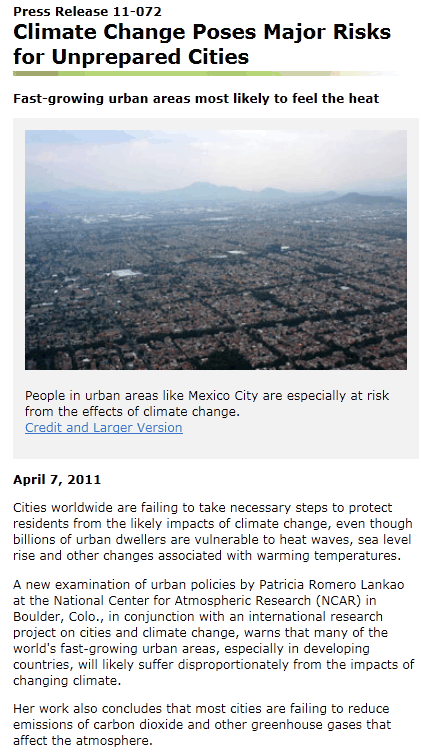
Only 2.1 million millimetres of sea level rise will cause them to drown!
h/t to Marc Morano
http://nsf.gov/news/news_summ.jsp?cntn_id=119165&org=NSF&from=news
Only 2.1 million millimetres of sea level rise will cause them to drown!
h/t to Marc Morano
Turns out that Antarctica is the canary in the ocean acidification coal mine.
A second major consequence of carbon dioxide emission from human activities – ocean acidification – is also likely to take its toll. “The Southern Ocean is the canary in the coal mine with respect to ocean acidification. This vulnerability is caused by a combination of ocean mixing patterns and low temperature enhancing the solubility of carbon dioxide,” noted co-author Dr. James McClintock of the University of Alabama at Birmingham, USA.
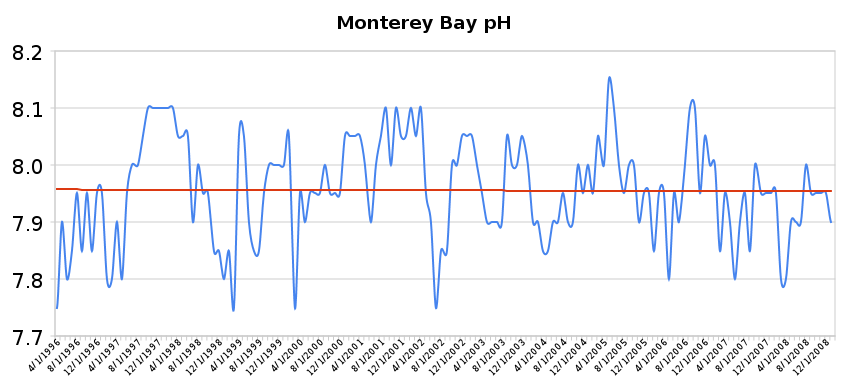
Monterey Bay Aquarium has measured no change in ocean pH, but why let actual data get in the way of a theory which generates lots of funding?
http://sanctuarymonitoring.org/regional_docs/monitoring_projects/100240_167.pdf
h/t to Marc Morano
CO2 has gone way up over the last century, while temperature has done almost nothing (a little over half a degree.) This indicates climate sensitivity close to zero. But why let actual observation supersede the unverified output of a grossly deficient computer model?
[youtube=http://www.youtube.com/watch?v=nLD917PVftg]
Trenberth appears to have a history of creativity with climate statistics. We can’t trust the IPCC for glaciers, hurricanes, temperatures, snow, rain, floods, drought or sea level. But otherwise they are extremely valuable.
Shortly after Dr. Trenberth requested that I draft the Atlantic hurricane section for the AR4’s Observations chapter, Dr. Trenberth participated in a press conference organized by scientists at Harvard on the topic “Experts to warn global warming likely to continue spurring more outbreaks of intense hurricane activity” along with other media interviews on the topic. The result of this media interaction was widespread coverage that directly connected the very busy 2004 Atlantic hurricane season as being caused by anthropogenic greenhouse gas warming occurring today. Listening to and reading transcripts of this press conference and media interviews, it is apparent that Dr. Trenberth was being accurately quoted and summarized in such statements and was not being misrepresented in the media. These media sessions have potential to result in a widespread perception that global warming has made recent hurricane activity much more severe.
I found it a bit perplexing that the participants in the Harvard press conference had come to the conclusion that global warming was impacting hurricane activity today. To my knowledge, none of the participants in that press conference had performed any research on hurricane variability, nor were they reporting on any new work in the field. All previous and current research in the area of hurricane variability has shown no reliable, long-term trend up in the frequency or intensity of tropical cyclones, either in the Atlantic or any other basin. The IPCC assessments in 1995 and 2001 also concluded that there was no global warming signal found in the hurricane record.
Moreover, the evidence is quite strong and supported by the most recent credible studies that any impact in the future from global warming upon hurricane will likely be quite small. The latest results from the Geophysical Fluid Dynamics Laboratory (Knutson and Tuleya, Journal of Climate, 2004) suggest that by around 2080, hurricanes may have winds and rainfall about 5% more intense than today. It has been proposed that even this tiny change may be an exaggeration as to what may happen by the end of the 21st Century (Michaels, Knappenberger, and Landsea, Journal of Climate, 2005, submitted).
It is beyond me why my colleagues would utilize the media to push an unsupported agenda that recent hurricane activity has been due to global warming. Given Dr. Trenberth’s role as the IPCC’s Lead Author responsible for preparing the text on hurricanes, his public statements so far outside of current scientific understanding led me to concern that it would be very difficult for the IPCC process to proceed objectively with regards to the assessment on hurricane activity. My view is that when people identify themselves as being associated with the IPCC and then make pronouncements far outside current scientific understandings that this will harm the credibility of climate change science and will in the longer term diminish our role in public policy.
– Chris Landsea : National Hurricane Center Chief Scientist
Summers are known for pleasant weather. Spring is known for wind, heavy snow, floods and tornadoes. Winter brings blizzards, snow, wind and bitter cold.
During the warm years of the 1990s, the weather was mild. Now that the Earth is starting to cool off, we are seeing more floods and heavy snowstorms.
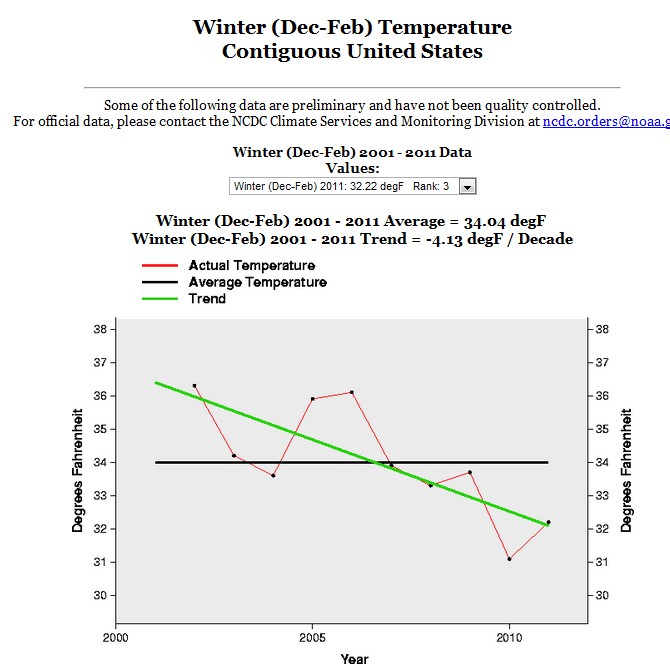
The climate science community seems to be running about ten years behind the times, blaming the recent snow and floods on weather which happened a decade ago. Winter temperatures in the US, and much of the rest of the northern hemisphere, have been plummeting over the last decade – at a rate of 41 degrees per century. It is time for climate scientists to adjust their thinking to the current millennium.
The press has no interest in Moscow any more. Four weeks of hot weather was climate. Eight months of cold is just weather.
MOSCOW, April 9 (Itar-Tass) — The heavy snowfall, which swept the capital and the surrounding region overnight and is still continuing, and gusts of wind have cut off electricity supply from a number of power lines, a source at the Moscow Integrated Electricity Distribution Company said on Saturday.
“As of 10:00, problems with electricity supply are experienced by residents in the Moscow Region’s 70 localities with the population of about 3,000 people. The main strike of the snowfall hit the south and the east of the suburban region. In particular, 123 transformer substations are cut off in the Ramenskoye district, 56 in the Podolsk district, 54 in the Chekhov district, 51 in the Stupino district and 47 in the Kolomna district, said the company’s report received by Itar-Tass.
The last hurricane to make landfall in New England was hurricane Bob, a category 2 which struck in August 1991.
[youtube=http://www.youtube.com/watch?v=Pg0Lk4cc2X8]
In August 1955, New England was flooded by two hurricanes (Connie and Diane) within five days.
[youtube=http://www.youtube.com/watch?v=w4ktZPAuqs0]
Despite the fact that CO2 levels were too low to have floods, Connecticut took a beating twice in 1955
“It was the worst such catastrophe to ever hit the region”
On November 3, 1955, the Connecticut Flood Recovery Committee’s final report declared, “Connecticut was the hardest hit victim of the worst flood in the history of the eastern United States.” 1 The state endured Nature’s fury in two major floods, one on August 19 and the second on October 16. Both were results of torrential rains.
On August 13 Hurricane Connie dropped four to six inches of rain on Connecticut. Five days later, another hurricane, Diane, dropped an additional fourteen inches of rain in a thirty-hour period between Thursday morning and Friday noon. The floods came on the 19th. The greatest loss of life and destruction to property occurred along the Mad and Still Rivers in Winsted, the Naugatuck, the Farmington, and the Quinebaug in the Putnam-Killingly region. Governor Abraham Ribicoff personally visited the scenes of destruction. President Dwight Eisenhower declared Connecticut a disaster area. The survivors, however, hardly had time to recover when the second flood took place. From October 14 through the 16th, heavy rains once more saturated the state. Gale winds and high tides resulted in new destruction along the shore in towns such as Norwalk. Again Governor Ribicoff visited sites of destruction, and the President issued a second declaration designating Connecticut as a disaster area.

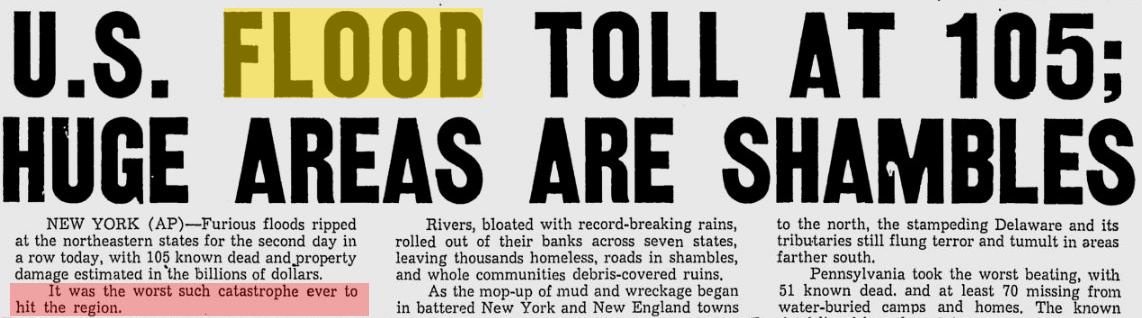
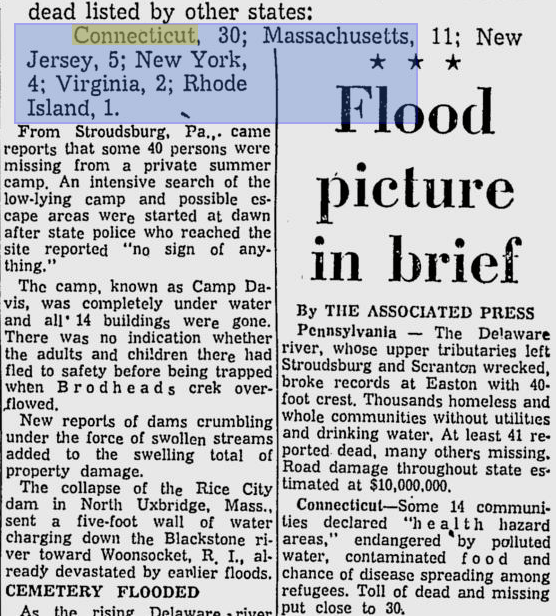
http://news.google.com/newspapers

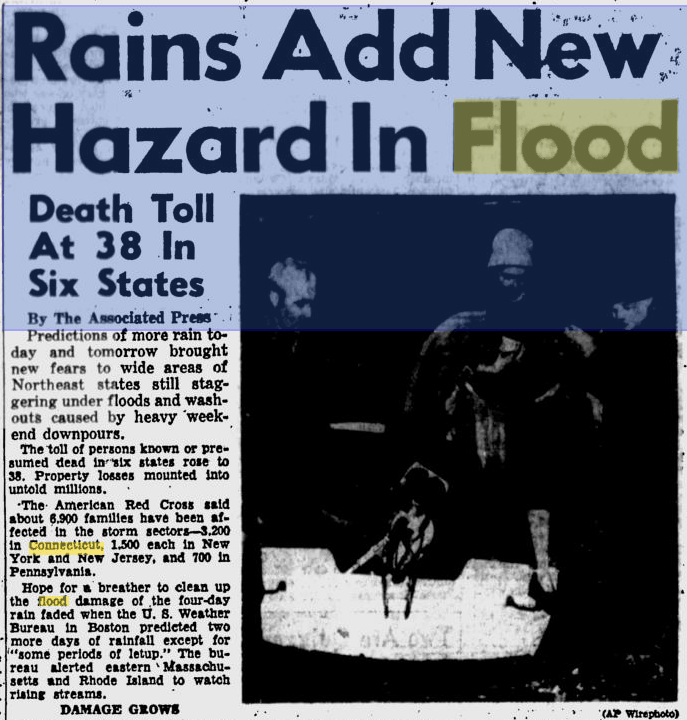
http://news.google.com/newspapers
h/t to Sparks
To get a feel for just how dishonest climate reporting is at the BBC, check this piece out.
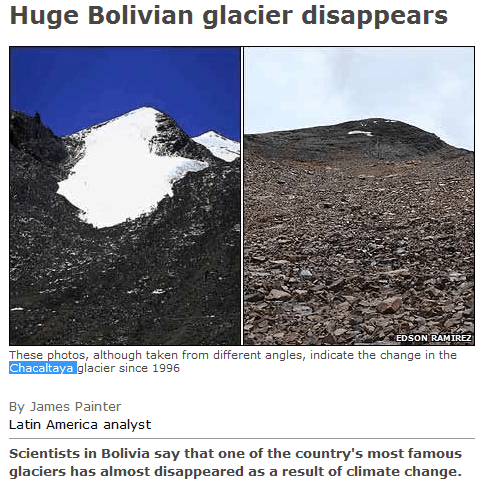

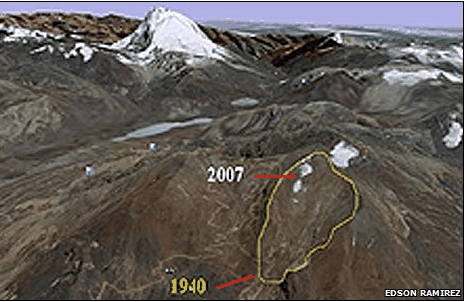
http://news.bbc.co.uk/2/hi/8046540.stm
Below, I measure the size of the glacier in 1940 on Google Earth – 0.6 miles long X 0.3 miles wide. Basically a medium sized snowfield.
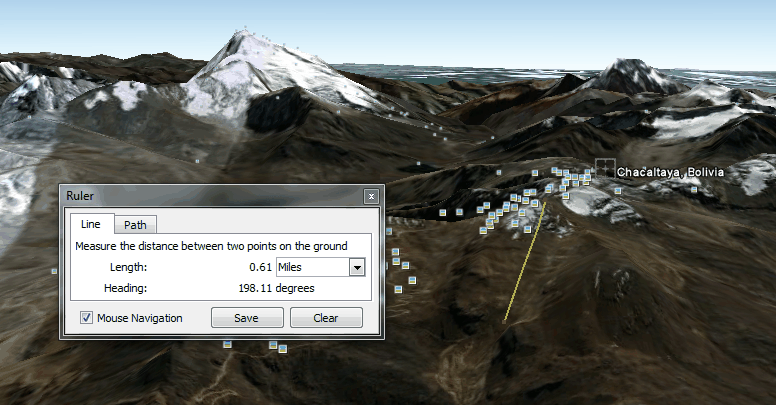
In the top picture (1996) in the article, their “huge” glacier was about a quarter of a mile long.
No doubt the glacier was bigger 18,000 years ago, and that many glaciers have disappeared since then – including the one that covered Canada, Chicago and New York.