September 1, 2007 — Geographers have projected temperature increases due to greenhouse gas emissions to reach a not-so-chilling conclusion: climate zones will shift and some climates will disappear completely by 2100. Tropical highlands and polar regions may be the first to disappear, and large swaths of the tropics and subtropics will reach even hotter temperatures.
Isn’t 2012 The End Of The Earth?
Climate negotiators discuss ways to curb global warming beyond 2012
TOKYO — Climate negotiators from about 30 countries and international organizations gathered Thursday in Tokyo for a two-day informal meeting to discuss ways to tackle global warming beyond 2012. TOKYO — Climate negotiators from about 30 countries and international organizations gathered Thursday in Tokyo for a two-day informal meeting to discuss ways to tackle global warming beyond 2012.
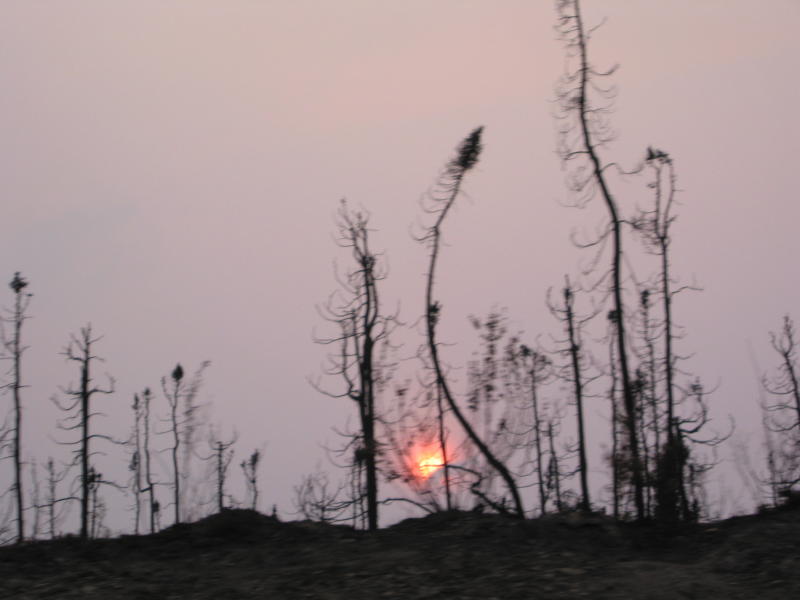
Alaska Has Become A Post-Apocalyptic Wasteland
ScienceDaily (Feb. 20, 2011) — Alaskan forests used to be important players in Mother Nature’s game plan for regulating carbon dioxide levels in the air. It’s elementary earth science: Trees take up carbon dioxide and give off oxygen.
But now, American and Canadian researchers report that climate change is causing wildfires to burn larger swaths of Alaskan trees and to char the groundcover more severely, turning the black spruce forests of Alaska from repositories of carbon to generators of it. And the more carbon dioxide they release, the greater impact that may have in turn on future climate change.
“Since the proliferation of black spruce, Alaskan soils have acted as huge carbon sinks,” says Evan Kane, a research assistant professor in Michigan Technological University’s School of Forest Resources and Environmental Science. “But with more frequent and more extensive burning in recent decades, these forests now lose more carbon in any fire event than they have historically been able to take up between fires.”
http://www.sciencedaily.com/releases/2011/02/110218221921.htm
NASA Used To Send People To The Moon
Now they are swimming with the fishes. It looks like NASA’s primary mission (appeasing Islamic countries) is also going very smoothly.
2006 : People Everywhere Notice That “We don’t get the snow anymore”
ORLANDO, Fla.– f you don’t like the weather now … Just wait, huge changes could be in store. Some scientists predict severe weather events will be even more extreme over the next few decades — more snow, harder rain, and hotter heat waves.
People everywhere are noticing the changes in climate. Susan Decker, from Broomfield, Colo., says, “It seems warmer. Not as cold. We don’t get the snow anymore.” Rob Topolski, from Paducah, Ky., says, “We also don’t have not nearly as much snow as we used to in Kentucky.” Abbie Pumarejo, from Augusta, Ga., says, “It just seems like every summer gets a little bit warmer.”
Gerald Meehl, from the Climate and Global Dynamics Division at the National Center for Atmospheric Research (N-CAR) in Boulder, Colo., tells Ivanhoe, “We see the biggest increase in heat waves in the Pacific Northwest where we don’t presently have heat waves.

CO2 Has Little Effect In The Tropics, And Will Make It Much Hotter There
Our Changing Climate
Climatologists Forecast Completely New Climates
Increasing CO2 Causes Decreased Greenhouse Gas Emissions
H2O is by far the most important greenhouse gas.
ScienceDaily (Mar. 4, 2011) — As carbon dioxide levels have risen during the last 150 years, the density of pores that allow plants to breathe has dwindled by 34 percent, restricting the amount of water vapor the plants release to the atmosphere, report scientists from Indiana University Bloomington and Utrecht University in the Netherlands in an upcoming issue of the Proceedings of the National Academy of Sciences.
http://www.sciencedaily.com/releases/2011/03/110303111624.htm