

“From 2000 to 2005, the growth rate of carbon dioxide emissions was more than 2.5 per cent per year, whereas in the 1990s it was less than one per cent per year,”
http://www.sciencedaily.com/releases/2006/11/061130190831.htm
June 1, 2007 — A physicist from Colorado State University and his colleagues from the North American Carbon Program (NACP) have discerned and confirmed the unforeseen advantages of rising carbon dioxide levels. Through the processes of photosynthesis and respiration, scientists have been able to elucidate why plants are growing more rapidly than they are dying. The NACP is employing methods, such as the use of cell phone and aircraft towers to monitor and retrieve carbon data for their continuing study.
Too much carbon dioxide can be a bad thing, but sometimes it can have a positive effect on plants and trees. The more carbon emissions we dump into the air, the faster forests and plants grow.
This new revelation is the result of research done by the North American carbon program. Scott Denning, Ph.D., a physicist from Colorado State University in Fort Collins, Colorado, explains the North American Carbon Program, “We are measuring CO2 in the atmosphere at dozens of places every hour around the United States and Canada.”
About 100 cell phone and aircraft towers dotting the North American landscape are providing a network to measure CO2 in the atmosphere. Physicists tracking the data have found an unexpected benefit of rising carbon dioxide levels. Dr. Denning says it’s unusual. “Stuff is growing faster than it’s dying, which is weird,” he says.
Carbon Emissions Linked To Global Warming In Simple Linear Relationship
ScienceDaily (June 11, 2009) — Damon Matthews, a professor in Concordia University’s Department of Geography, Planning and the Environment has found a direct relationship between carbon dioxide emissions and global warming. Matthews, together with colleagues from Victoria and the U.K., used a combination of global climate models and historical climate data to show that there is a simple linear relationship between total cumulative emissions and global temperature change.
http://www.sciencedaily.com/releases/2009/06/090610154453.htm
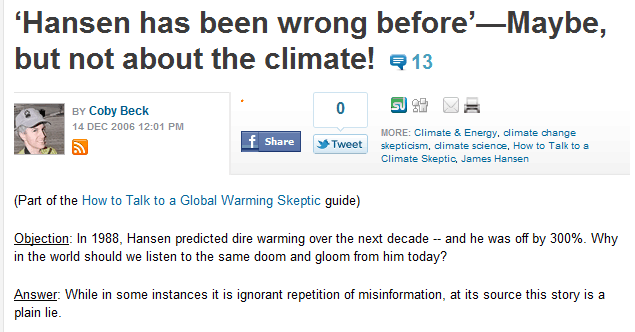
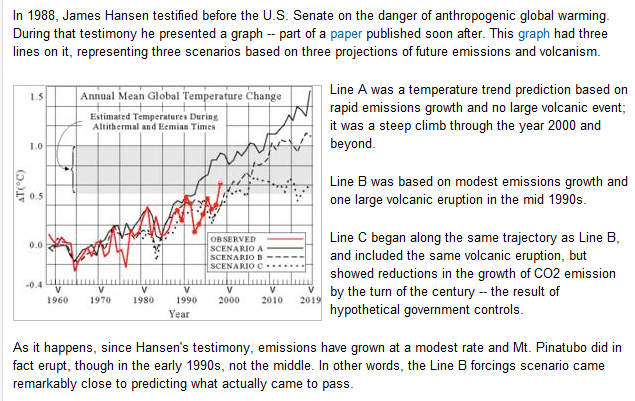
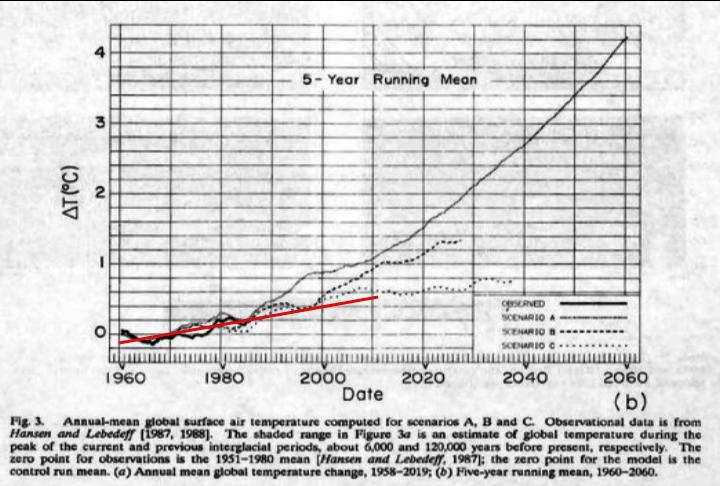
Marc Morano sent over this interesting piece from Grist in 2006. His Hansen comparison graph ends right at the peak temperature of 1998, he claims that CO2 “emissions have grown at a modest rate“, and he implies that the 1993 eruption of Pinatubo somehow affects the current climate.
?
http://www.grist.org/article/hansen-has-been-wrong-before/
Meanwhile, back in the real world – Hansen is way of the mark and CO2 emissions growth has doubled since the 1990s.
ScienceDaily (Dec. 8, 2006) — According to the co-Chair of the Global Carbon Project, CSIRO Marine and Atmospheric Research scientist Dr Mike Raupach, 7.9 billion tonnes of carbon were emitted into the atmosphere as carbon dioxide in 2005 and the rate of increase is accelerating.
“From 2000 to 2005, the growth rate of carbon dioxide emissions was more than 2.5 per cent per year, whereas in the 1990s it was less than one per cent per year,”
http://www.sciencedaily.com/releases/2006/11/061130190831.htm
If Republicans were smart, they could understand this simple concept. Ten years is a very long time, but 100 years isn’t.

Jeff Masters, director of meteorology at the Weather Underground, has to quite patiently concede, “Have we learned a great deal since the IPCC 2001 report? I would say yes, we have. Climate science, like any other field, is a constantly evolving field and we are always learning.”
They just learned it, but they expected it all along. Because they knew they were going to learn it later.
“Oh what a tangled web we weave, when first we practice to deceive!”
-Sir Walter Scott

Eleven years ago the US Park Service did a controlled burn (in 40 mph winds) southwest of Los Alamos, NM, -which burned up 50,000 acres and 400 homes.
The Cerro Grande Fire was a disastrous forest fire in New Mexico, United States of America that occurred in May 2000. The fire started as a controlled burn, and became uncontrolled owing to high winds and drought conditions. Over 400 families in the town of Los Alamos, New Mexico lost their homes in the resulting 48,000 acre (190 km²) fire. Structures at Los Alamos National Laboratory were also destroyed or damaged, although without loss or destruction of any of the special nuclear material housed there. Amazingly, there was no loss of human life. The US General Accounting Office estimated total damages at one billion US Dollars.
After the fire stopped, the government had to quickly build huge dams (ahead of the summer monsoons) to stop the spread of shallow buried WWII nuclear waste into the Rio Grande. Good thing we have government working hard to protect our environment!
“We expected this”
Midwest:
http://www.epa.gov/climatechange/effects/usregions.html
Chicago had their coldest summer on record in 2009, which must have been the calm before the storm.
We have been subjected recently to massive doses of propaganda correlating record snow with alleged warming, but GISS shows winter temperatures plummeting in North America, Europe and Asia.
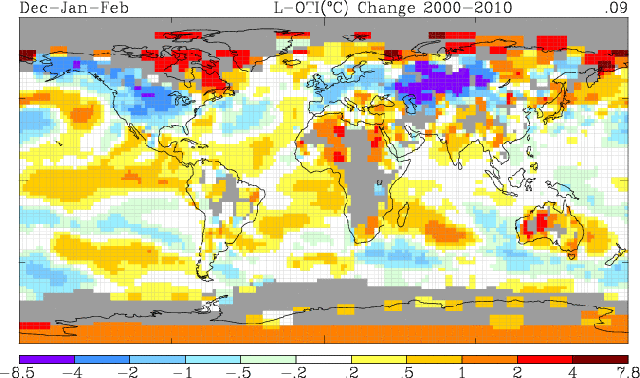
Are these climate experts ignorant about the climate, or are they dishonest? What do you think?
climate scientists today overwhelmingly agree that man-made climate change is occurring. A 2009 study of 77 active climate scientists found that 97% agreed that “human activity is a significant contributing factor in changing mean global temperatures.”
