That is why a lot of people from Florida retire in Minnesota.

http://scienceblogs.com/tfk/2011/02/mt_legislator_explains_why_glo.php
That is why a lot of people from Florida retire in Minnesota.
http://scienceblogs.com/tfk/2011/02/mt_legislator_explains_why_glo.php
One summer during the early 1980s I worked as a wilderness ranger in the Pecos Wilderness of New Mexico. I spent half the summer camped at 12,000 feet – at Truchas Lake in the red circle below.

North Truchas Peak on June 10, 2009
The lake was partially frozen over until late July and was the only place I had to bathe. Needless to say, I took pretty short baths.
After a few more years of global warming, the lake will look like the picture below. Temperatures are expected to rise somewhere between zero and one hundred degrees over the next 40 years.


http://www.realclearpolitics.com/
Obama promised 6.5% unemployment in 2011, and delivered over 9%. I would say that he exceeded all expectations of how to waste a trillion dollars.

Energy flow is driven by differences in energy, not absolute energy.
If you have two objects at 100C, no energy flows between them. If you have two locations with equal pressure, no wind flows between them. A rock will not fall off the middle of a high plateau, even though its potential energy is high.
Energy flows between warm and cold places, between high pressure and low pressure, and between high potential energy and low potential energy. Electricity flows between positive and negative. Lines of magnetic force flow between opposite poles. Convection occurs when the ground is warm and the upper atmosphere is cold. Tornadoes occur when cold air meets warm moist air.
A personal appeal to climate morons. Please stop saying that “more energy means more severe weather.” I have kids in school and I don’t want them exposed to your hyper-stupidity.
Thank You!
If you really believe that cold is associated with less extreme weather, take your next vacation in the Arctic.
[youtube=http://www.youtube.com/watch?v=IiSmVanWRAQ]
[youtube=http://www.youtube.com/watch?v=4NUsi72hu9w]

If you run broken code on a million machines, does that make it any less broken?
Logically, a warming climate would be expected to increase the rate of extreme weather events.
Ahh. That explains why the climate is so extreme in warm Hawaii and so benign in the cold Antarctic. It also explains why they have no weather to speak of on Venus (where temperatures are hot enough to melt lead.)
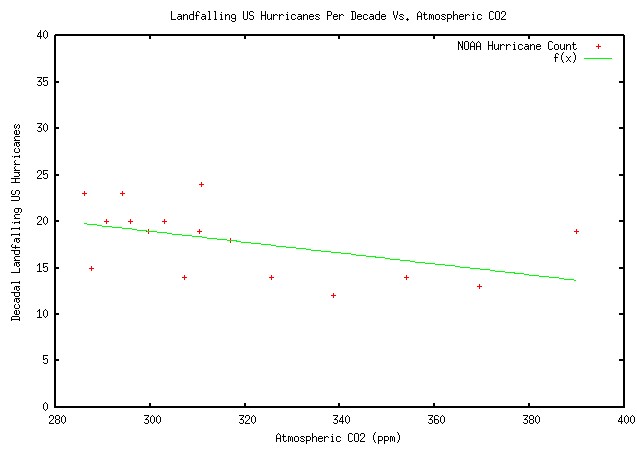
http://www.aoml.noaa.gov/hrd/hurdat/ushurrlist18512009.txt
The graph above plots number of hurricanes per decade (since 1851) vs. CO2 levels at the end of the decade. Like with tornadoes, as CO2 has increased hurricane activity has decreased.

The worst years for tornadoes in the US were those where the GISS anomaly was between -0.3 and +0.2.

http://lwf.ncdc.noaa.gov/img/climate/research/tornado/tornadotrend.jpg
How much does the use of markets as a decentralized social planning mechanism for economic life matter? How much richer are we because we live in a market economy rather than in a command-and-control bureaucratic economy?
We are fortunate–if that is the word–to be able to answer this question because the twentieth century provided us with a natural experiment in the form of High Stalinist central planning. Karl Marx, you see, completely missed the utility of markets as devices for providing decision makers with proper incentives and for achieving allocative efficiency. (Why he missed this is, I think, a result of his crazy metaphysics of value, but I won’t go there today.) He saw markets only as surplus extraction devices–ways to quickly and fully separate the powerless from the value that they had created and that ought to have been theirs.
So when the Communists took over, they followed Marx and said: “we don’t want no stinking markets in our economies.” This naturally raised the question of how they were then to coordinate economic activity. And they hit on the clever plan of attempting to reproduce the Rathenau-Ludendorff Imperial German war economy of World War I. And they did so.
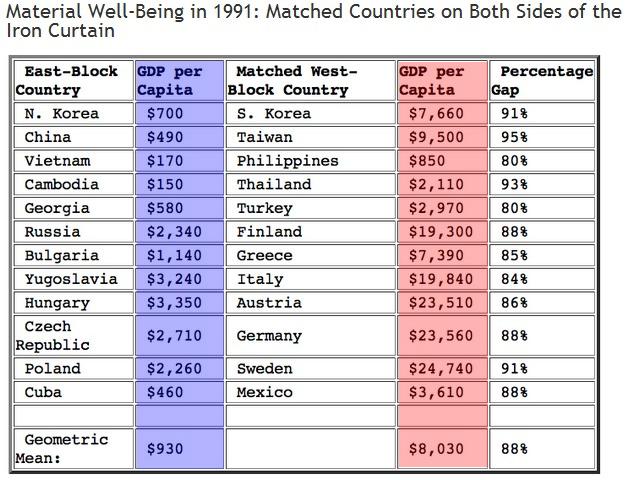
In 1989, the Iron Curtain came down, and we could see what a difference it made as we could examine levels of material well-being on both sides of the Curtain. This is as close to a perfect natural experiment as anyone could wish: the Iron Curtain’s location was determined by where Stalin’s and Mao’s and Giap’s armies marched–which is as exogenous to other determinants of economic well-being as anyone could wish.