Mann/Schmidt preemptively spank Gore/Overland.

http://pubs.giss.nasa.gov/docs/2001/2001_Shindell_etal_1.pdf
Mann/Schmidt preemptively spank Gore/Overland.
http://pubs.giss.nasa.gov/docs/2001/2001_Shindell_etal_1.pdf

During the 1930s, drought covered as much as 80% of the US. Atmospheric CO2 at that time was far below Hansen’s safe number of 350 ppm.
Now that we are well over the safe level of CO2, drought only affects about 20% of the country. Should we destroy the economy to bring back the economic depression and drought of the 1930s?

The whole crew of climate hysterics appears to have shot their wad all at once.

http://www.sustainablebusiness.com/index.cfm/go/news.display/id/21834
[youtube=http://www.youtube.com/watch?v=xtWIzMY7Dqs]
h/t to MikeTheDenier

http://www.nasa.gov/vision/earth/environment/Earth_Temperature.html
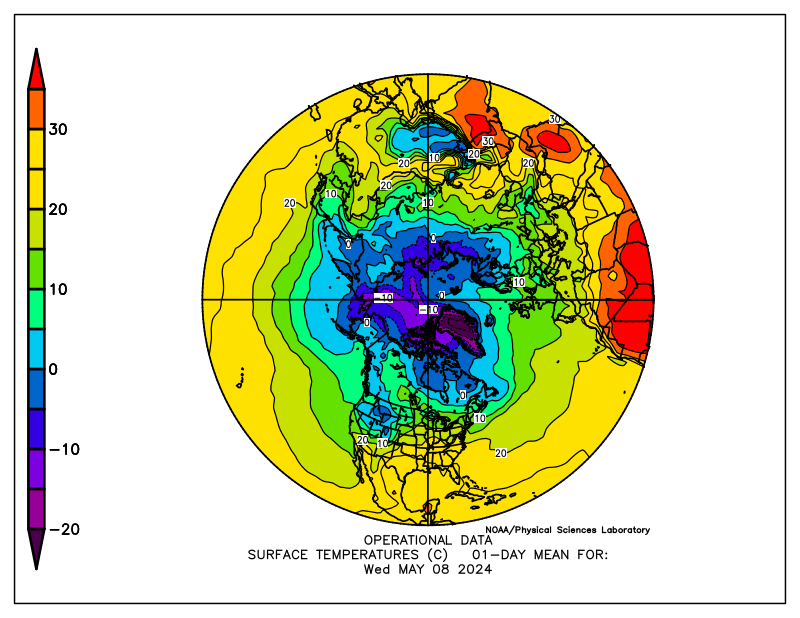
This explains why temperatures across much of the US are running 15-25 degrees below normal. Tomorrow is expected to be 40 degrees below normal, here in Colorado.

http://www.hprcc.unl.edu/products/maps/acis/MonthTDeptUS.png
When scientists trained their analytical tools on the North Pole and its environs, they quantified the local knowledge: The polar ice cap is 40 percent thinner and millions of acres smaller than it was in the 1970s.
What happens at the North Pole can affect the rest of the planet, potentially altering the course of the Gulf Stream, which moderates climate from the East Coast of the United States to the British Isles. Closer to home, the jet stream that dictates much of Seattle’s weather can be diverted when the polar vortex speeds up.
“It’s probably contributing to the fact that it’s warmer and we’ve been getting less snow,” Overland said.
http://seattletimes.nwsource.com/html/localnews/2001910590_northpole23m.html
Our region experienced record snowfall last winter, topping the charts dating at least as far back as the late 1800s. In all, more than six feet of snow fell at sites such as Baltimore-Washington International Marshall Airport. Extreme weather nailed other U.S. cities last winter, too, and swaths of Europe saw unprecedented snowfalls and record cold temperatures. This year, the nation’s capital has suffered one unusually severe storm. Parts of the East Coast from Atlanta to Boston have been experiencing blizzard conditions. Last week, a vast swath of the country’s midsection and East Coast got deluged with sleet and snow, paralyzing travel. What gives?
To understand how warming and snowstorms may be connected, it helps to start with the epicenter of winter weather. Around the North Pole, some of the world’s coldest air currents blow in what’s typically a tight loop known as the polar vortex. Air masses inside the vortex tend to have not only low temperatures but also low barometric pressures compared with air outside the vortex. The surrounding high-pressure zones push in on the vortex from all sides, helping the cold air stay where it belongs, at the top of the world.
……
The root of the problem, Overland says, is melting sea ice. Sea ice forms in the Arctic Ocean during the cold, dark days of fall and winter and hangs around, melting slowly but not completely vanishing, throughout the summer. In recent years, more sea ice has melted during the warm months than can be replenished during the chillier ones.
[youtube=http://www.youtube.com/watch?v=MnI3Hp0fJhE]
Both weather and climate models currently do a decent job. Weather can be predicted pretty accurately up to about four days ahead and the broad patterns of global climate are well replicated in climate models. That’s because over past decades a multitude of researchers have tested and refined the models, improving how they represent the atmosphere and oceans and their interaction.
When scientists talk about uncertainties, they are not saying they are clueless. They are saying they have a working explanation of the world which gives a range of answers, usually a usefully narrow range.
While it is true that snow is a thing of the past, I am not so sure about the barbecue summer prediction.
“Snow has two simple ingredients: cold and moisture. Warmer air collects moisture like a sponge until it hits a patch of cold air. When temperatures dip below freezing, a lot of moisture creates a lot of snow.”

http://www.esrl.noaa.gov/psd/map/images/fnl/sfctmp_01.fnl.gif
Elaborating on his comments – warm, moist -30C air sweeps down from the Arctic and hits the much colder 0C air in Texas. This causes record snow to fall in locations that used to be warm before global warming made them cold.


http://wxmaps.org/pix/temp1.html