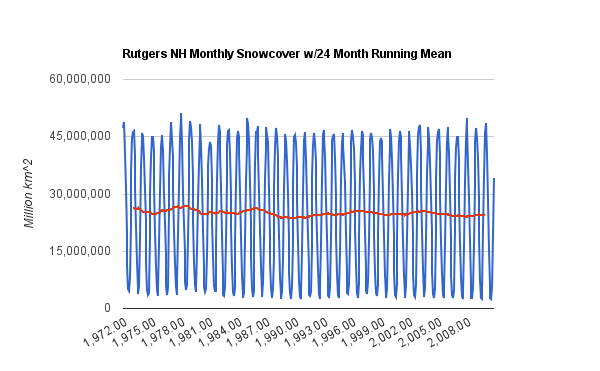
No Evidence Of Declining Snowcover

I plotted out RutgersĀ  northern hemisphere snowcover, with the 24-month running mean, and as you can see there is no trend to the data since at least 1990. Claims of declining snowcover are incorrect.

http://climate.rutgers.edu/snowcover/files/moncov.nhland.txt


Posted in Uncategorized | 14 Comments

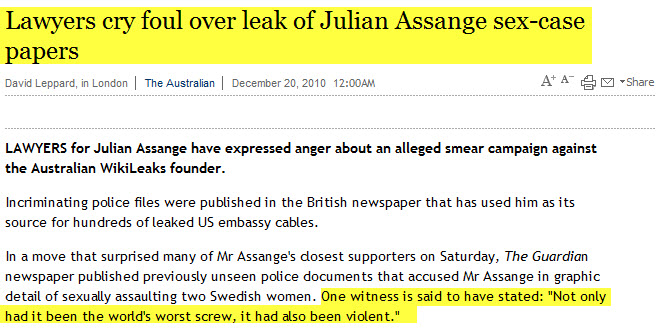
Wikileaks Upset About Leaks

http://www.theaustralian.com.au/

Posted in Uncategorized | 5 Comments

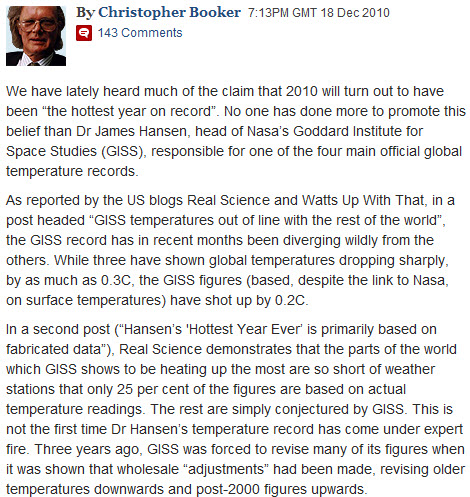
It’s ‘the hottest year on record’, as long as you don’t take its temperature

http://www.telegraph.co.uk/

Posted in Uncategorized | 9 Comments

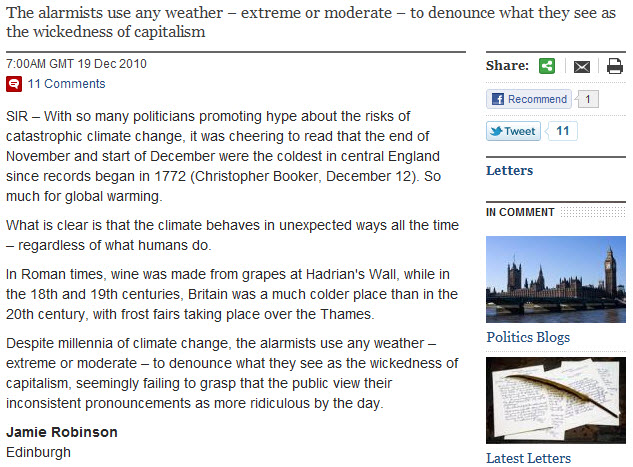
“Whatever the weather, climate alarmists blame mankind”

http://www.telegraph.co.uk/

Posted in Uncategorized | Leave a comment

This Is Getting Serious Now!

http://www.guardian.co.uk/

Posted in Uncategorized | Leave a comment

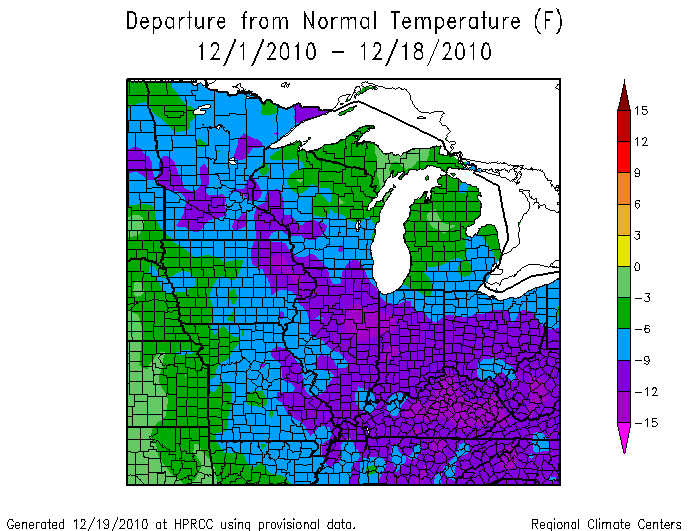
Ohio Climatologist Worried About Warming

http://www.hprcc.unl.edu/products/maps/acis/mrcc/MonthTDeptMRCC.png

Getting warmer: Climatologist says it’s time to act on global warming
Sunday, December 19, 2010 Ā 02:58 AM

Lonnie Thompson is one of the country’s most respected climatologists for his research examining the retreat of high altitude glaciers around the globe. In his most recent paper, “Climate Change: The Evidence and Our Options,” Thompson offers his conclusions on what must be done to address global warming.

The Ohio State University researcher sat down with The Dispatch this month to discuss his paper

http://www.dispatch.com/

Posted in Uncategorized | 5 Comments

NASA : Groundwater Mining And Urbanization Increases Sea Level 0.4-0.9 mm/year

However, other processes increase the rate of streamflow to the oceans. These include groundwater mining (or pumping of groundwater at rates exceeding the natural recharge rate), deforestation, and urbanization. Deforestation reduces the infiltration capacity of the soil due to compaction by heavy logging, farm machinery, overgrazing and trampling by cattle, and increased soil erosion. In newly cleared areas, runoff usually increases, especially in the rainy season, leading to greater chances of flooding. Urbanization expands the area of impermeable surfaces, which impedes infiltration of rainwater, reduces evapotranspiration, and thus augments streamflow. The combined effect of these processes is to increase sea level by 0.4 to 0.9 mm/yr.

http://www.giss.nasa.gov/research/briefs/gornitz_06/

That accounts for most of the sea level rise seen by tide gauges.

Posted in Uncategorized | 1 Comment

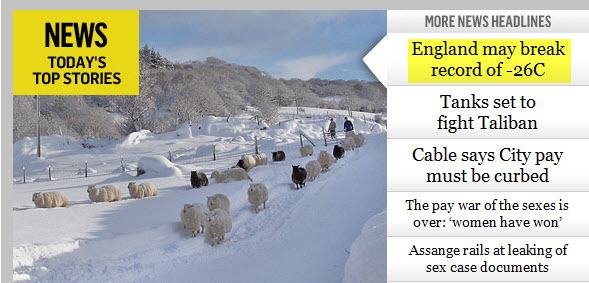
Sunday Times : England May Break Record Of -26C

http://www.thesundaytimes.co.uk/sto/?CMP=INTni26


Posted in Uncategorized | 2 Comments

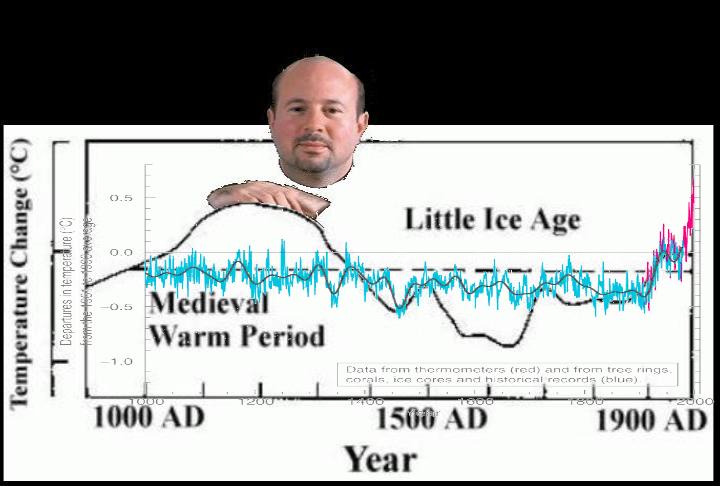
AGU Paper : MWP 2-3C Warmer In The Arctic

Abstract

Lake-based paleotemperature reconstructions are of particular importance in the Arctic, where other useful archives (e.g., tree rings, speleothems) for developing dense networks of quantitative climate records are absent or limited. Lacustrine alkenone paleothermometry offers a new avenue for investigating the evolution and variability of Arctic temperatures during the Holocene. We have generated a ~5,000 year long, decadally-resolved record of summer water temperature from the annually-laminated sediments of Lower Murray Lake on Ellesmere Island in the Canadian High Arctic. The varved sediments of Lower Murray Lake allowed high-resolution sampling and excellent chronologic control of the sedimentary record. We calibrated the alkenone paleothermometer for Lower Murray Lake using previously published data as well as new data from lakes in Norway and Svalbard, providing a quantitative record of temperature variability for the past 5,000 years. The previously published mass accumulation rate from Lower Murray Lake has been interpreted as a paleotemperature record and provides complimentary information to the new alkenone record. Melt percentage measurements from the nearby Agassiz Ice Cap provide another independent summer temperature reconstruction for comparison. Most strikingly, the alkenone record reveals warm lake water temperatures beginning ~800 AD and persisting until ~1200 AD, with temperatures up to 2-3 deg C warmer than the mean temperature for the past 100 years. This dramatic medieval warm period on Ellesmere Island interrupted a distinct (neoglacial) cooling trend that had begun approximately 2000 years earlier. Furthermore, the three warmest intervals seen in the alkenone record during the past 5,000 years correspond to the periods during which the area was occupied by Paleo-Eskimo groups, providing evidence that local climate conditions played a significant role in determining migration patterns of people of the Arctic Small Tools tradition.

http://adsabs.harvard.edu/abs/2010AGUFMPP43C..10D

h/t to Marc Morano


Posted in Uncategorized | 5 Comments

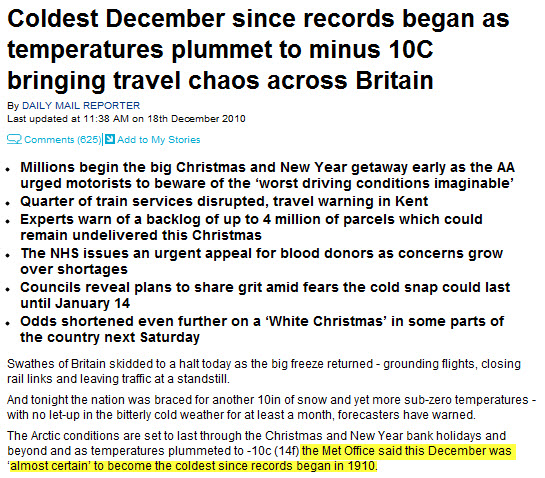
Hottest Year Ever : Coldest December On Record

http://www.dailymail.co.uk/

Posted in Uncategorized | 4 Comments