


Disrupting the Borg is expensive and time consuming!

Google Search
-
Recent Posts
- Bullseye!
- It’s Getting Closer
- Greenland Meltdown Scam
- Greenland Ice Update
- Wyoming Gold
- Three Years Since The Apocalypse
- Arctic Report card Summer 2026
- Elon Pushing Pushing Geoengineering
- Earth, Wind And Fire
- On The Road Again
- Vandalism At The Reflecting Pool
- Fifty Years Ago Today
- Truth Or Consequences
- US Climate Trend Maps
- Declining Spring Snow Cover In Northern New Mexico
- You Can’t Fool Mother Nature
- Cattle And The Climate
- One Atomic Bomb Per Hour
- New Video : Analyzing Oil And Gas
- Is Antarctica Melting?
- High Speed Analysis And Visualization
- El Nino To The Rescue?
- Fake News Update
- Growth Of Antarctic Sea Ice
- 65 Years Of Progress!
Recent Comments
- Stuart Hamish on Three Years Since The Apocalypse
- Stuart Hamish on Cattle And The Climate
- Stuart Hamish on Cattle And The Climate
- Stuart Hamish on Cattle And The Climate
- Bob G on Bullseye!
- conrad ziefle on Bullseye!
- arn on Greenland Ice Update
- D. Boss on Bullseye!
- D. Boss on Bullseye!
- scott allen on Bullseye!
Disrupting the Borg is expensive and time consuming!
Funny.
Even funnier is he will probably not get it!
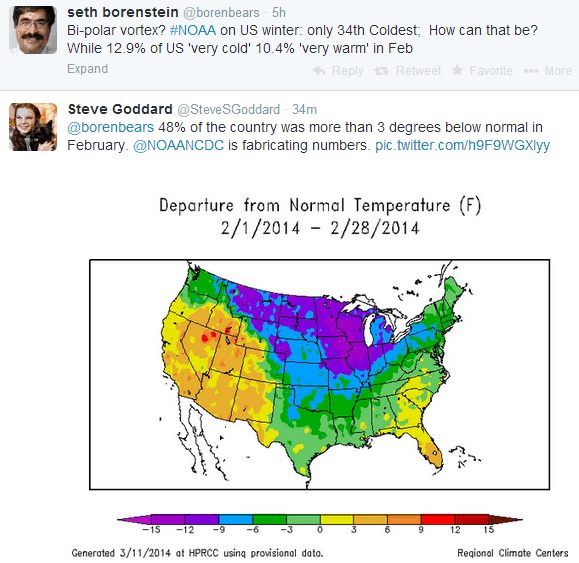
The fact that he is asking “how can that be?” should alert him that something is up; that it doesn’t, speaks volumes.
With a little effort he could make for a passable Gene Shalit.
http://upload.wikimedia.org/wikipedia/commons/d/de/Geneshalit.JPG
Other than that I’m afraid he has no redeeming qualities.
Steve,
I posted a similar comment earlier. The Energy Information Administration (EIA) is the best source of data on unadjusted temperatures. EIA tracks changes in energy consumption relative to historical norms. Their latest report includes the following comment:
“Temperatures east of the Rocky Mountains have been significantly colder this winter (October-February) compared with the same period both last winter and the average for the past 10 years, straining distribution networks and putting upward pressure on consumption and prices of fuels used for space heating. U.S. average heating degree days were 13% higher than last winter (indicating colder weather) and 10% above the October through February 10-year average. The Northeast was 13% colder than last winter, the Midwest and South both 19% colder, while the West was 5% warmer.”
Mothatdebos … now the GLO-BULL warming is hiding in the west 😉 I wonder if it went to Disneyland?
Apparently Borenbears is a sugar bear. Pathetic.