If you doubt that parts of the planet really are warming, talk to residents of Barrow, the Alaskan town that is the most northerly settlement in the US.
In the last 34 years, the average October temperature in Barrow has risen by more than 7°C ? an increase that, on its own, makes a mockery of international efforts to prevent global temperatures from rising more than 2°C above their pre-industrial levels.
Ice loss sends Alaskan temperatures soaring by 7C | Environment | theguardian.com
Look what these Guardian scumbags did. In 1976, the PDO shift occurred, causing Alaska temperatures to rise nearly five degrees in one year. That was 38 years ago, not 34 years. There has been very little warming over the past 34 years.
This is what the University of Alaska says.
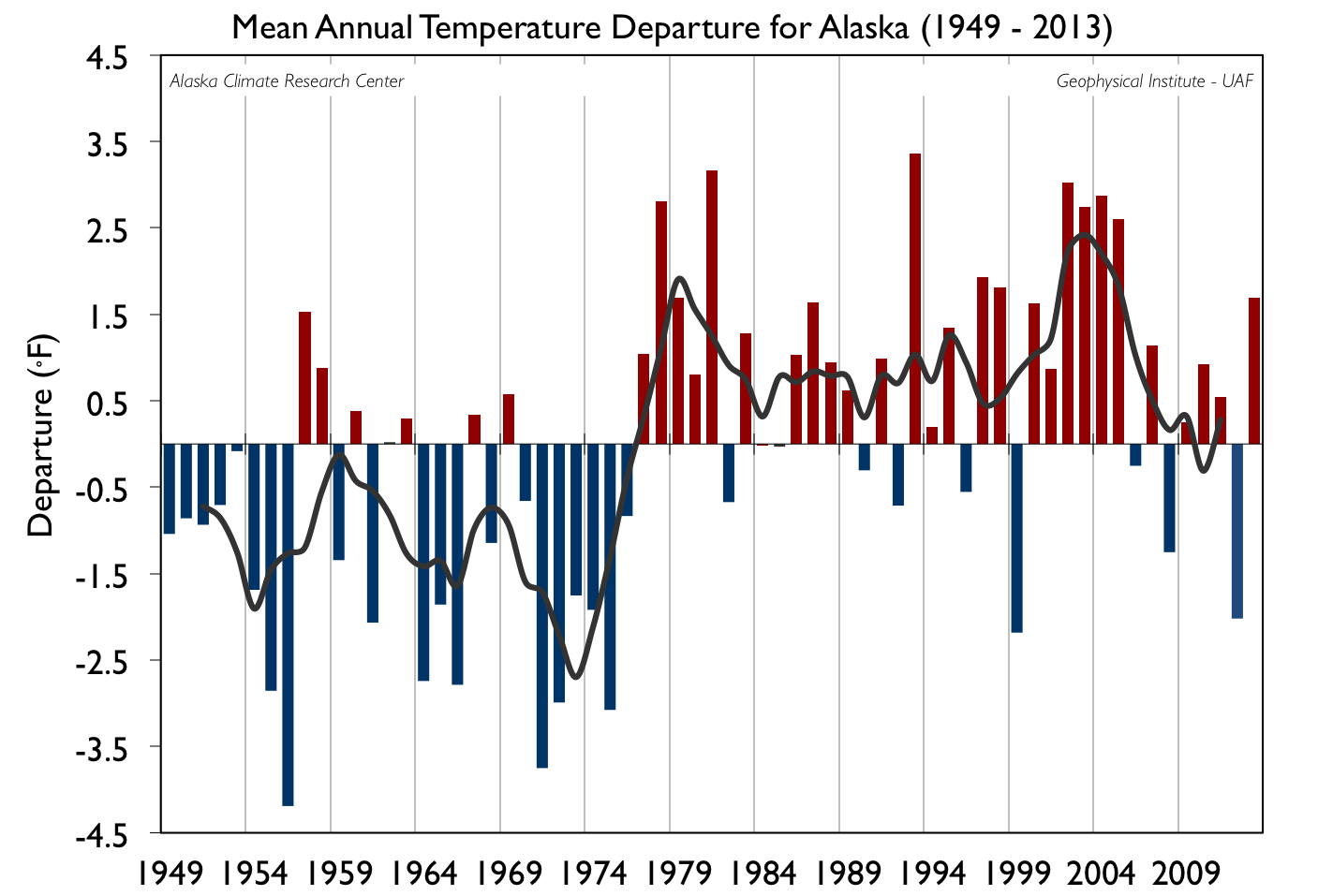
Considering just a linear trend can mask some important variability characteristics in the time series. The figure at right shows clearly that this trend is non-linear: a linear trend might have been expected from the fairly steady observed increase of CO2 during this time period. The figure shows the temperature departure from the long-term mean (1949-2009) for all stations. It can be seen that there are large variations from year to year and the 5-year moving average demonstrates large increase in 1976. The period 1949 to 1975 was substantially colder than the period from 1977 to 2009, however since 1977 little additional warming has occurred in Alaska with the exception of Barrow and a few other locations. The stepwise shift appearing in the temperature data in 1976 corresponds to a phase shift of the Pacific Decadal Oscillation from a negative phase to a positive phase. Synoptic conditions with the positive phase tend to consist of increased southerly flow and warm air advection into Alaska during the winter, resulting in positive temperature anomalies.
Temperature Changes in Alaska | Alaska Climate Research Center
But it is worse than it seems. All of the rest of the warming at Barrow is due to UHI
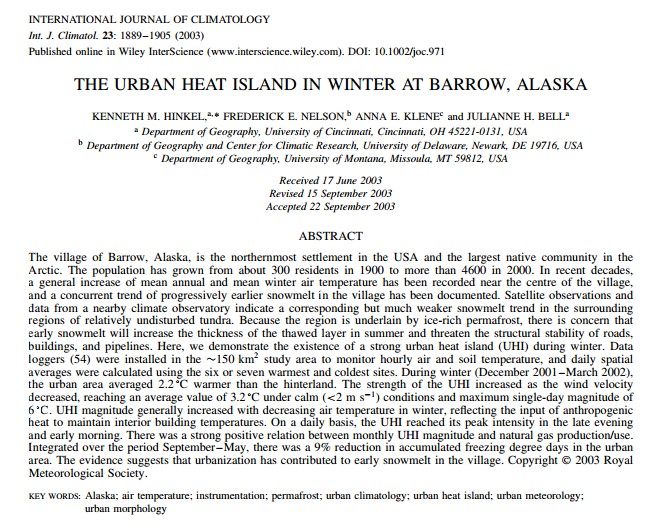 Hinkel_etal_2003_winter_UHI.pdf
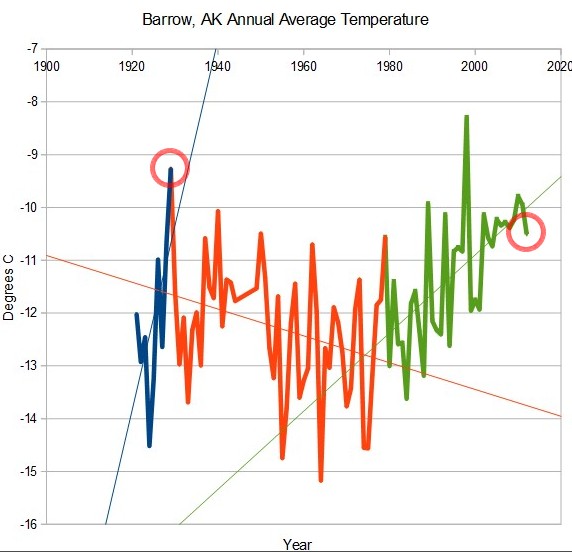
And it gets even worse. Temperatures at Barrow in 1929 were warmer than they are now, even with the recent UHI. They cherry-picked the start date because it was near a local minimum. During the 50 years prior to 1979, temperatures in Barrow fell nearly as much as they have risen since 1979. And they rose much faster prior to 1929 than they have since.
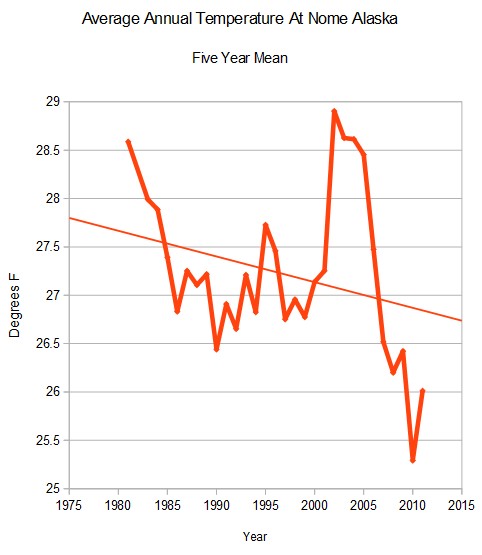
Almost every single thing the Guardian writes about climate is fraudulent. Temperatures at Nome have plummeted since 1979.
The University of Alaska says that the whole state has cooled over the past decade.
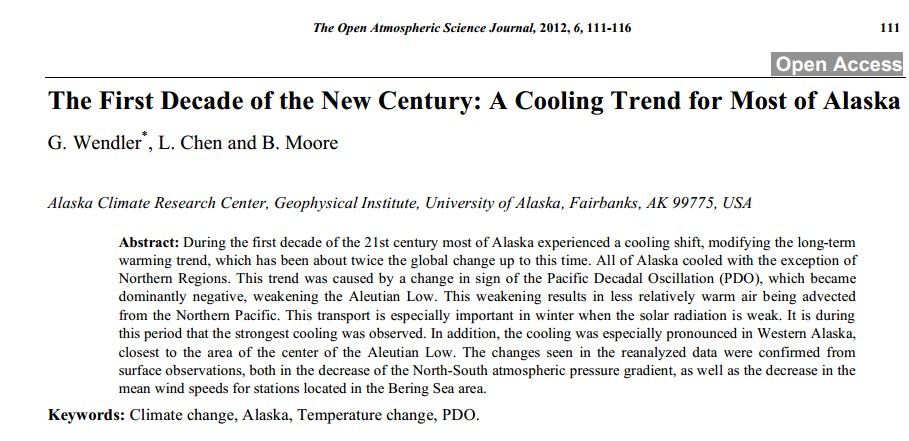 benthamopen.com/toascj/articles/V006/111TOASCJ.pdf
Two years ago, the Bering Sea set an all-time record for sea ice
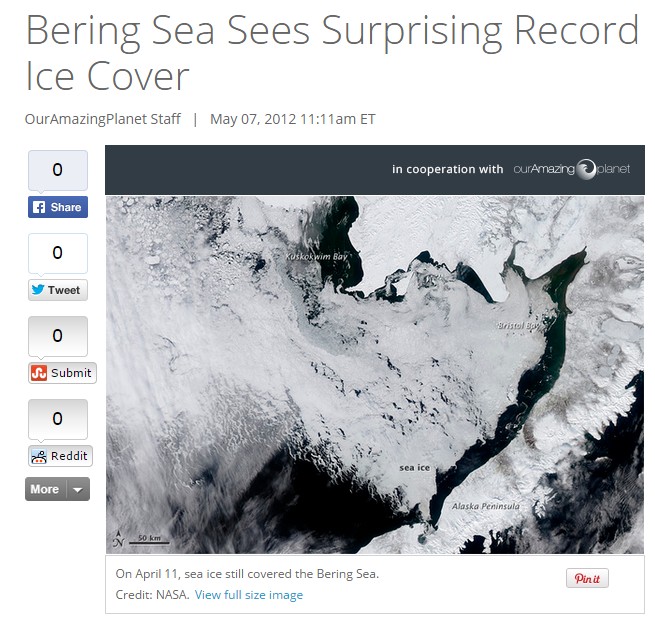
Bering Sea Sees Record Sea Ice Cover ? Arctic Effects of Climate Change