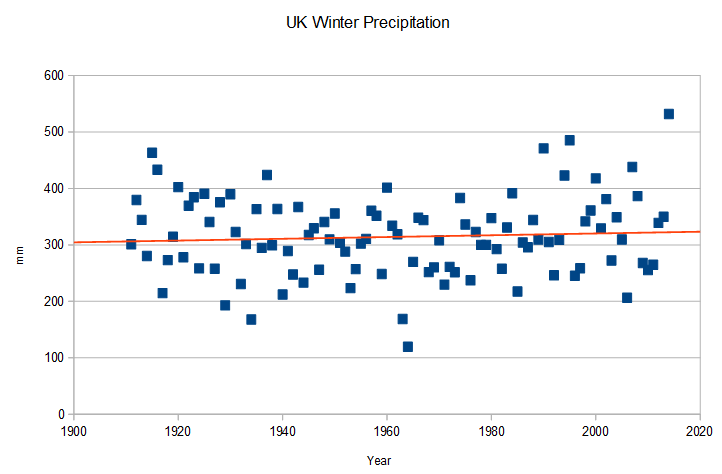
The conversation on the Venus thread has gone way past my tolerance for stupid.
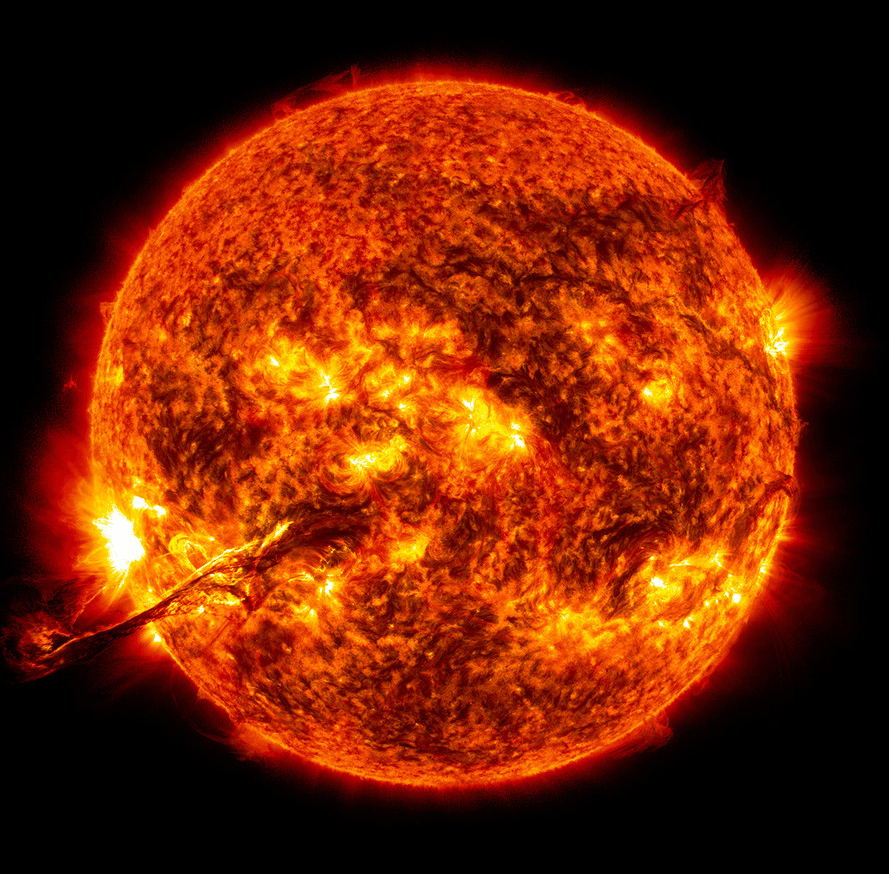
Venus is not a closed system. It is located near this object – which provides a steady stream of shortwave radiation to the top of the Venusian atmosphere.
The ideal gas law is PV=nRT . R is a constant. P(ressure) and n(umber of molecules) are essentially constants, because the n(umber) of molecules in the atmosphere and Venusian gravity doesn’t change much over short time periods. The atmospheric P(ressure) is fixed by the weight of the atmosphere, which doesn’t change.
The only things that can change in the Venusian system are V and T. V(olume) is determined by the height of the atmosphere, which remains fixed due to the steady stream of solar radiation that keeps the molecules in the atmosphere vibrating. So T(emperature) at the surface remains constant. During the long Venusian night (thousands of hours) the temperature doesn’t drop. It behaves nothing like a greenhouse.
If the Sun turned off, the height of the atmosphere would shrink, as would the temperature. Eventually the atmosphere would freeze, so there would be no gas volume and the temperature would approach absolute zero.
It is similar on Earth. Our average surface temperature remains relatively constant because we receive a steady stream of solar radiation and the number of molecules in the atmosphere doesn’t change much over short time periods. What makes Earth different is that we have much less cloud cover, and we have oceans with a large heat capacity. Unlike Venus, the albedo of Earth can change due to variations in snow/ice and cloudiness. Ocean circulation also has an effect on temperature, so Earth’s average surface temperature can vary +/- 10C.
Comment from Omnologos :
What would be the temperature at the bottom of the Mediterranean if the sea evaporated again, as it has done in the past?
As every student of planetary atmospheres know, the existence of a lapse rate is a property of every troposphere – it even applies deep down in the Jupiter’s hydrogen ‘ocean’. This has nothing to do with the presence of greenhouse gases.
Therefore once the Cytherean tropopause is determined, together with the average lapse rate, the temperature at the surface can be computed, with or without CO2.
If the GHGs have any effect, it has to be seen in the height of the tropopause.
In fact one could think heat as exchanged via conduction (in the planet), convection (in the troposphere) and radiation (above the troposphere). Even pierrehumbert’s planetary atmospherics book says that radiation is in first approximation irrelevant when studying the troposphere.