Arctic sea ice delusions strike the Mail on Sunday and Telegraph
When it comes to climate science reporting, the Mail on Sunday and Telegraph are only reliable in the sense that you can rely on them to usually get the science wrong. This weekend’s Arctic sea ice articles from David Rose of the Mail and Hayley Dixon at the Telegraph unfortunately fit that pattern.
Both articles claimed that Arctic sea ice extent grew 60 percent in August 2013 as compared to August 2012. While this factoid is technically true, it’s also largely irrelevant. For one thing, the annual Arctic sea ice minimum occurs in September – we’re not there yet.
Arctic sea ice delusions strike the Mail on Sunday and Telegraph | Dana Nuccitelli | Environment | theguardian.com
It was 60% in August. Now it is up to 61%. Green shows ice present in 2013 which wasn’t present in 2012. Red shows the opposite.
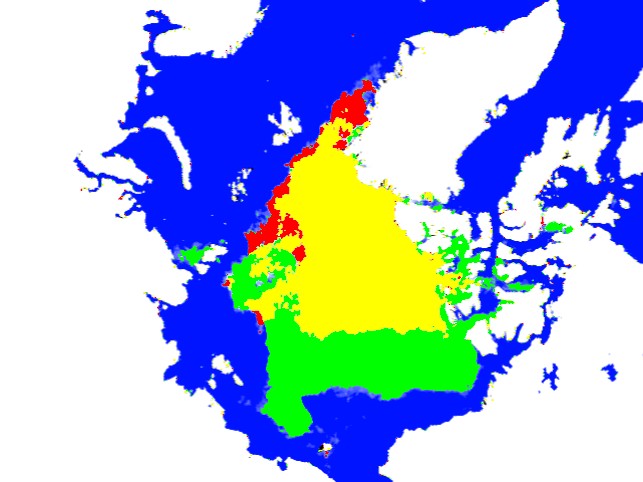
Arctic Sea-Ice Monitor
Then Nutter claims that scientists predicted the massive recovery all along.
that’s not the least bit surprising.
Around 80% of the ~100 scientists at the Bjerknes [Arctic climate science] conference thought that there would be MORE Arctic sea-ice in 2013, compared to 2012
Kook and Nuttercelli are now in the first stages of their never was a global warming consensus history rewrite.
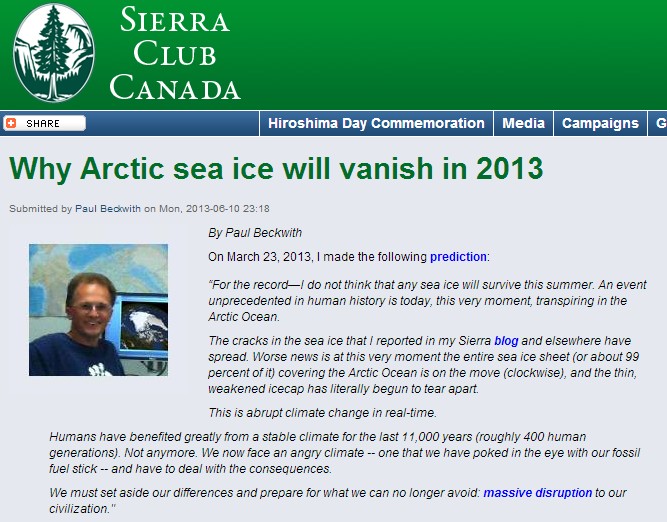
Why Arctic sea ice will vanish in 2013 | Sierra Club Canada
the Arctic will be ice-free in the summer of 2013
– John Kerry, US Secretary of State
John Kerry: We Can’t Ignore the Security Threat from Climate Change
James Hansen : ‘This is the last chance’
6/23/2008
“We see a tipping point occurring right before our eyes,” Hansen told the AP before the luncheon. “The Arctic is the first tipping point and it’s occurring exactly the way we said it would.”
Hansen, echoing work by other scientists, said that in five to 10 years, the Arctic will be free of sea ice in the summer.
NASA warming scientist: ‘This is the last chance’ – USATODAY.com
June 26, 2013
The alarming loss of sea ice which has grown worse each summer over the past several decades, has taken a sharp turn for the worse: this year the loss is right in the middle, the most resilient part of the ice cover. This could lead to a completely ice-free Arctic Ocean by September.
Unprecedented hole is growing in Arctic sea ice – Fairfax Climate Watch