Obama believes that Antarctica is melting down and is going to drown Miami.
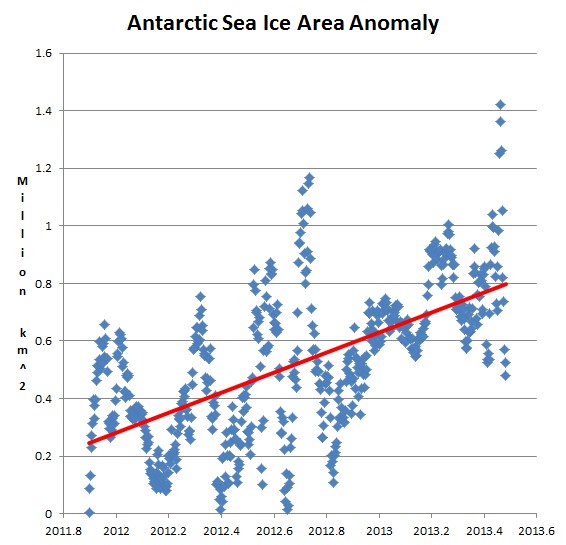
arctic.atmos.uiuc.edu/cryosphere/timeseries.south.anom.1979-2008
Obama believes that Antarctica is melting down and is going to drown Miami.
arctic.atmos.uiuc.edu/cryosphere/timeseries.south.anom.1979-2008
Barack Obama blathered this week about a “coming storm” and told us that only really stupid people don’t share his faith in the 100% failed climate models.
Unlike Obama, London Mayor Boris Johnson is quite intelligent.
Weather prophets should be chucked in the deep end
“….for more than 20 years now, we have been told that this country was going to get hotter and hotter and hotter, and that global warming was going to change our climate in a fundamental way,” writes Johnson. “Do you remember that? We were told that Britain was going to have short, wet winters and long, roasting summers. It was going to be like 1976 all over again, with streakers at Lord’s and your Mr Whippy melting before you could even lick it, and Hyde Park scorched into a mini Kalahari.”
“They said we were never going to have snow again, and that we should prepare for southern England to turn gradually into a Mediterranean world. There were going to be olive groves in the Weald of Kent, and the whole place was going to be so generally broiling in summer that no one would be able to move between noon and 4pm, after which people would come out to play boules and sip pastis, to the whine of a mandolin, in the dusty square that had once been a village green.
“That’s what they said: the BBC, and all the respectable meteorologists – and I reckon there were tens of thousands of people who took these prophecies entirely seriously. Omigod, they said to themselves, we are all going to fry. The only answer was to build a source of permanent refreshment – and so they did. They saved up, and they remortgaged, and they got in the diggers. They moved huge cuboids of earth and used them to create curious berms at the bottom of the garden, and then they lined these trenches with tiles (jolly expensive) or with a kind of blue plastic sheeting (virtually indistinguishable and much cheaper) and then they filled these holes with thousands of gallons of water that circulated endlessly by an unintelligible process known only to the people who had installed it but who seemed unfortunately to have gone bust.
“…They were fools! Fools who believed that the global warming soothsayers really meant what they said or that they had a clue what the weather would be in the next 10 years.
“I hope I don’t need to tell you that we have not experienced a Mediterranean climate – not since they started to tell us to expect it. On the contrary, we have had some pretty long and miserable winters – including the last one, in which I saw snow settle in London on four separate occasions – and our summer is at risk of becoming a bit of a farce.”
See entire great commentary:
http://www.telegraph.co.uk/topics/weather/10138096/The-weather-prophets-should-be-chucked-in-the-deep-end.html?placement=mid2
h/t to Ice Age Now
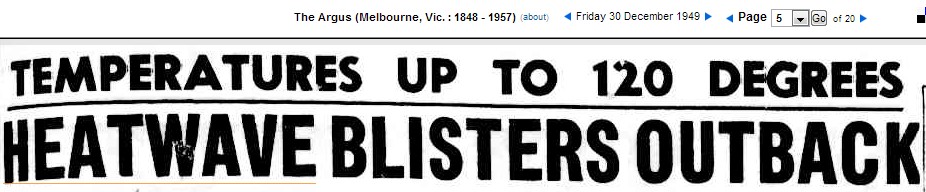
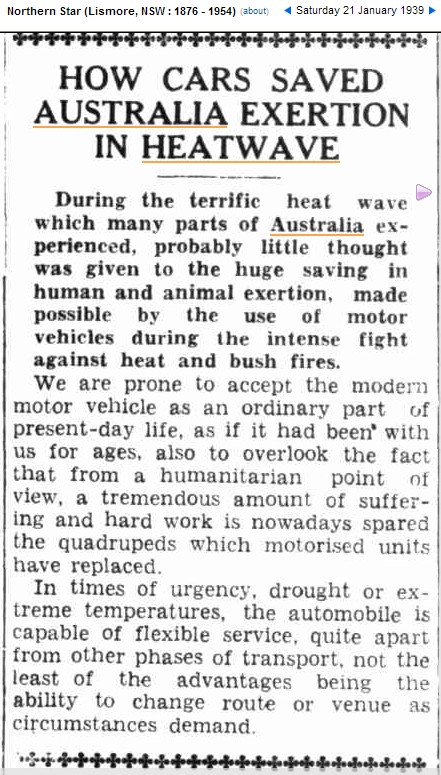
Heatwaves in South Australia
Temperatures above 40°C are common in the north of South Australia in summer, but rarely for such a prolonged period as in the first half of January 1979.
The heatwave began on 31 December, and up until 15 January, maximum temperatures of at least 45°C were a daily occurrence in the north of the state, at places such as Marree and Oodnadatta. Further north, at Alice Springs in the Northern Territory, the temperature exceeded 40°C on 12 days, but did not go higher than 42°C, in part because of the town’s elevation (546m). The extreme heat reached further south on several days: at Port Augusta the mercury topped 44°C on 6 days, and at Broken Hill in NSW on 7 days. Adelaide did not have many days of extreme heat, but 42°C on 3 January was the highest temperature for 11 years.
Livestock and wild animals suffered. Kangaroos were found dead, and 100 cattle died on a train at Marree, despite the efforts of railway staff to offload them (Around 1979 it was usual for 10 to 20 animals to die during transport in hot weather). Hundreds of dead birds, including crows and parrots, were found. A goods train was derailed at Immarna on the trans-continental line, probably because the rails buckled in the heat.
A similar heatwave in January 1960 was not so sustained, because cool changes brought relief, but temperatures exceeded 45°C in the north of the State from 31 December to 3 January. On 2 January, Oodnadatta reached a state record – and arguably an Australian record – of 50.7°C. The minimum that day was 34.6°C. The temperature again reached the low 40s on 6-8 January, and on the 10th.
There were several deaths in the 1960 heat wave: five babies and eight adults died, including five found dead beside an outback road. Other victims were admitted to hospital with heat exhaustion, including 18 in Broken Hill. However hospitals would have provided little relief, because few were air-conditioned at that time.
Marble Bar heatwave, 1923-24
The world record for the longest sequence of days above 100°Fahrenheit (or 37.8° on the Celsius scale) is held by Marble Bar in the inland Pilbara district of Western Australia. The temperature, measured under standard exposure conditions, reached or exceeded the century mark every day from 31 October 1923 to 7 April 1924, a total of 160 days.
During March, the US government’s top experts told us that the corn belt was headed for heat and drought this summer.
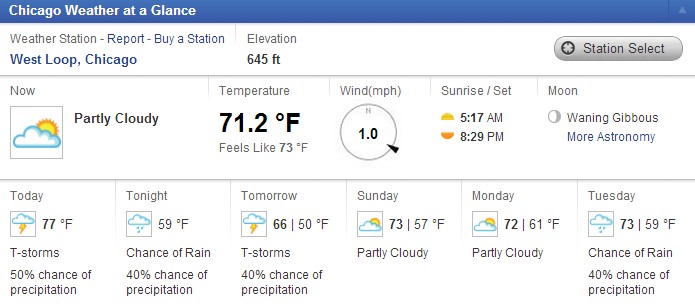
Climate experts say that CO2 is the cause of all weather events.
Tornadoes have been at a record low for the last two years, and US hurricanes are close to a record low. This has greatly reduced disaster costs.
Given the huge savings in disaster costs due to CO2 generation, it is only fair that the government pays dividends to all CO2 polluters.
The vast majority of gun crime in US is committed in neighborhoods which are 90+% Democratic party affiliated

Interactive map: Homicides in the District of Columbia – The Washington Post