Data and Station Information for FUNAFUTI B
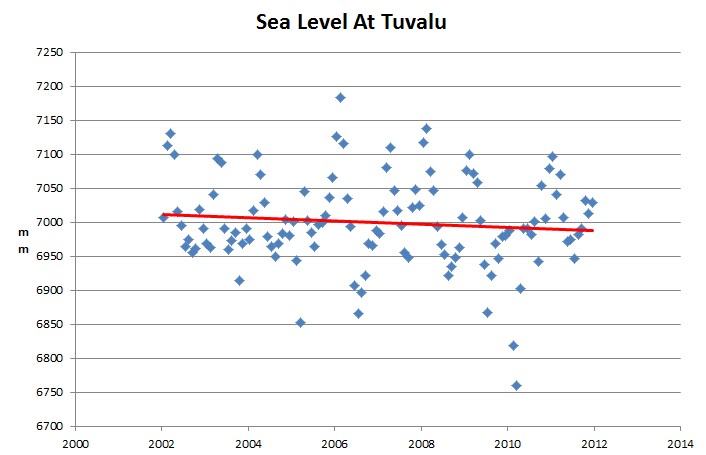
Sea level has been falling for the past decade in Tuvalu, but experts tell us that Tuvalu is going to drown soon – and it is because you leave your lights on and drive your SUV.
My uneasiness is stoked by dire pronouncements that Tuvalu’s leaders have been making for more than a decade. The planet’s fourth-smallest nation, they say, faces extinction because of climate change. Rising seas and deadly storms have reportedly started to swamp the islands, and fears are growing that Tuvalu will be uninhabitable or may vanish entirely within a few decades. Prime Minister Saufatu Sapo’aga told the United Nations last year that the global-warming threat is no different from “a slow and insidious form of terrorism against us.” Independent scientists also offer a grim forecast. “Because of its location and physical nature, Tuvalu is particularly susceptible to the adverse impacts of climate change and in particular rising sea level,” concludes a 1996 scientific study coauthored by the South Pacific Regional Environment Programme and the government of Japan.
Unlike other current or predicted environmental catastrophes, Tuvalu’s problem is one that people worldwide are believed to create by burning fossil fuels that release carbon dioxide into the atmosphere, contributing to global warming. In that sense, my habit of leaving lights on around my house, in Washington, D.C., a neighbor’s of constantly driving his large SUV to go just a few city blocks and another neighbor’s preference for a toasty house in winter would play a role in Tuvalu’s fate. In fact, Tuvalu threatened in 2002 to sue the United States and Australia for excessive carbon dioxide emissions. Meanwhile, some Tuvaluans are getting ready to abandon their homeland. “Islanders Consider Exodus as Sea Level Rises,” the British newspaper The Guardian reported last year.
Will Tuvalu Disappear Beneath the Sea?