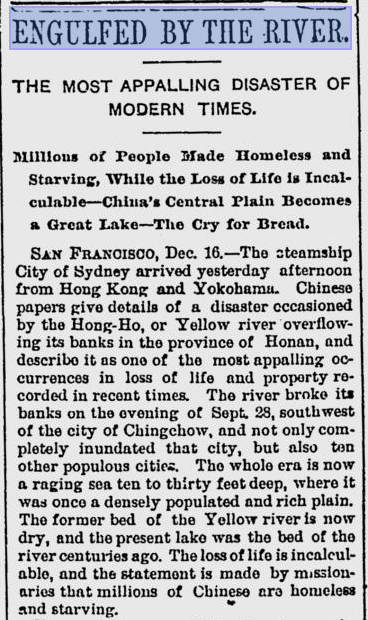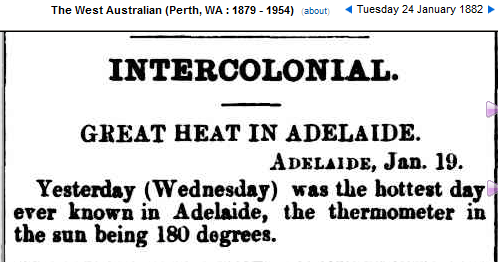
One year ago today, I reported on a takeover of Fort Collins by foxes. I rarely went two hours with out seeing one.
In 2012, I have not seen a single fox for the entire year. Must have something to do with global warming.
One year ago today, I reported on a takeover of Fort Collins by foxes. I rarely went two hours with out seeing one.
In 2012, I have not seen a single fox for the entire year. Must have something to do with global warming.
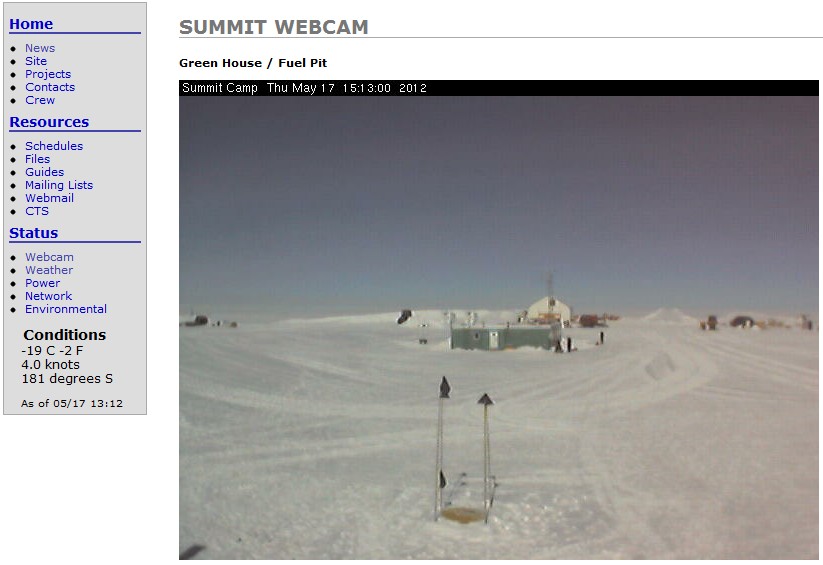
Temperatures have skyrocketed on the Greenland Ice Sheet up to -19C. looks like a big golfing weekend ahead. This a is a huge improvement from -42C last weekend.
According to Fortier, the Arctic has been possibly ice free since 2010. Zwally gives it possibly another twelve weeks and Maslowski possibly another year. Barber says it has been free of multi-year ice since 2010.
97% of the consensus of experts is 100% behind the fact that the Arctic is free of ice.
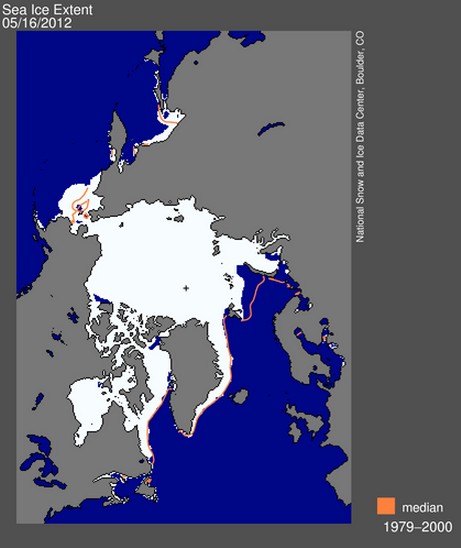
Did the endless winter finally get to Hendrik?
Hansen tells us that the climate was stable in the past, before man started tinkering with it. Jeff Masters tells us that the pleasant weather of spring 2012 was the most extreme weather the US has ever experienced.
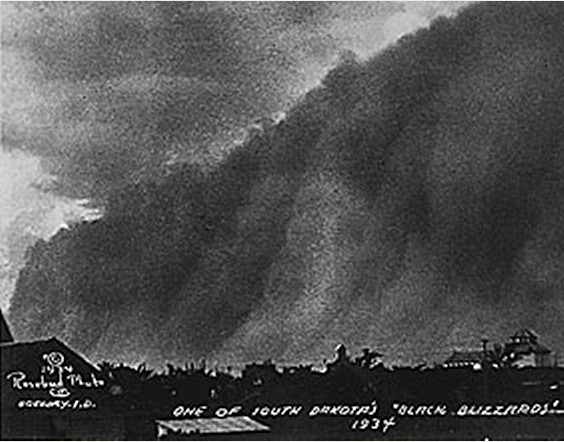
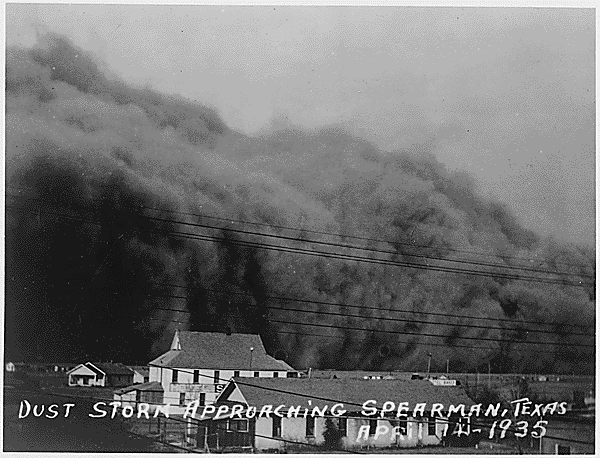
April 14, 1935 dawned as a beautiful spring Sunday across the Plains of Colorado and Kansas southward into Texas.
Residents of the Plains had been beleaguered for four years of dust storms as drought gripped the region. Farmers continued to plow their land, betting that the rains would return. They had settled on the Plains during a rainy cycle in the early 1900s. With plentiful rains and mechanized tractors, they had planted millions of acres of wheat, using techniques that had been successful in New England.
But the summer of 1931 was rainless and hot. The bountiful wheat crops that had set records in previous years suddenly withered to nothing. By 1934, farmers were losing everything.
On this Sunday morning, people were glad to have a day of blue skies. They went to church, hung our laundry and did other chores. By mid-afternoon, residents saw an ominous sight on the northwestern horizon. A low, black cloud sweeping across the Plains approaching quickly.
Many people did not have time to escape the onrushing dust cloud. Many were trapped in their automobiles as they struggled to drive with visibilities reduced to zero in the blinding dust. Daylight was turned to darkness as the black clouds thousands of feet high engulfed entire towns with millions of tons of black topsoil blown from the unprotected land.
There was no escaping the dust. It was everywhere. People hung wet sheets across their windows and doors to prevent the dust from entering their homes. Grit was in food. Thousands contracted pneumonia as they breathed in huge quantities of the choking dust. Many people thought it was the end of the world.
The “black blizzard” of April 14, 1935 was the worst dust storm of the Dust Bowl Era of the 1930s. The great quantities of black dust blew all the way to Washington, D.C., preventing politicians from ignoring the plight of the Plains’ farmers as gritty clouds hung over the Capitol City.
Joe D’Aleo sent this over. California had a dry winter, so Scripps declares permanent drought.
E. Calvin Beisner 11:01pm May 16
Rising temperatures could eliminate two-thirds of Calif. snowpack
Anne C. Mulkern, E&E reporter
Published: Wednesday, May 16, 2012″The snowpack that helps provide water for California cities and farms could shrink by two-thirds because of climate change, according to new research submitted to the state’s Energy Commission.Higher temperatures appear likely to wipe out a third of the Golden State’s snowpack by 2050 and two-thirds by the end of the century, the Scripps Institution of Oceanography found. …”
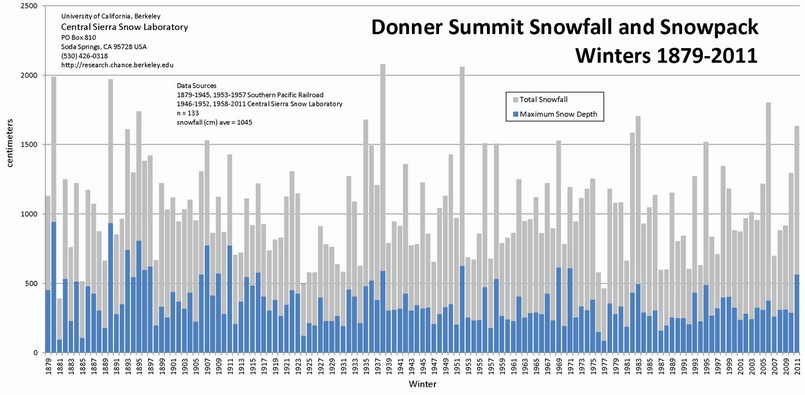
Long term records show no trend in California snowpack. Climate scientists normally just wait for a few weeks of supporting weather – and then declare future Armageddon and soon to be received funding.
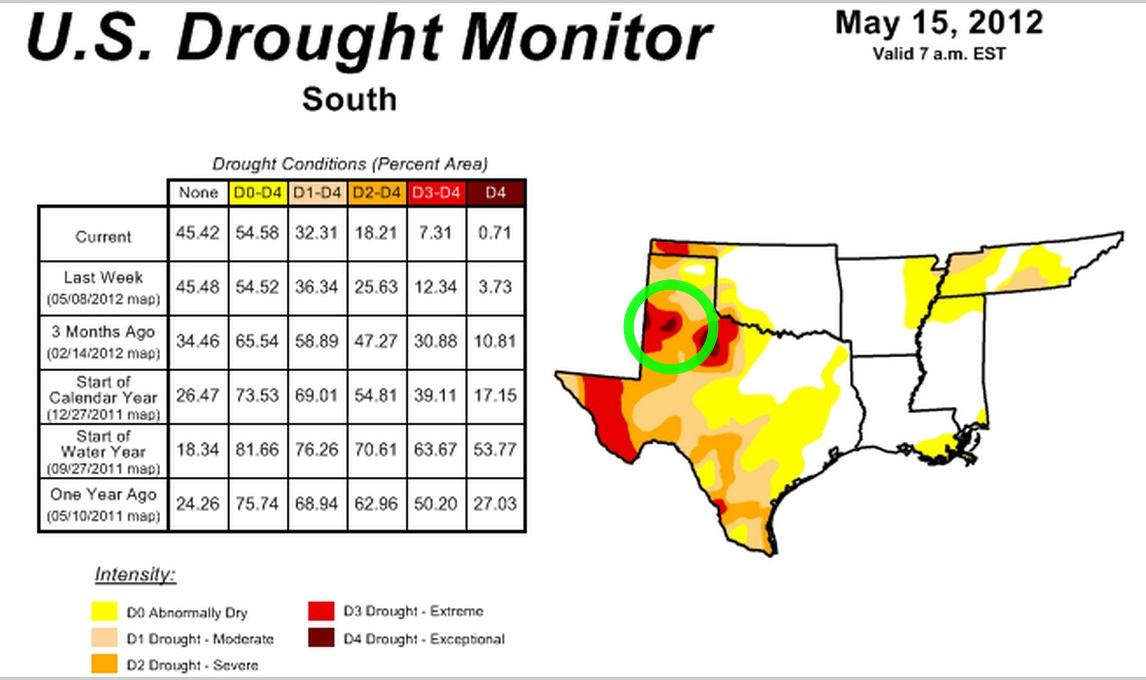
The rest of Texas has been pummeled with rain, but a tiny spot over Katherine’s office remains in exceptional drought, possibly reflecting the state of her science.
According to Phil Jones, the 1880s was a very cold decade with plummeting temperatures.
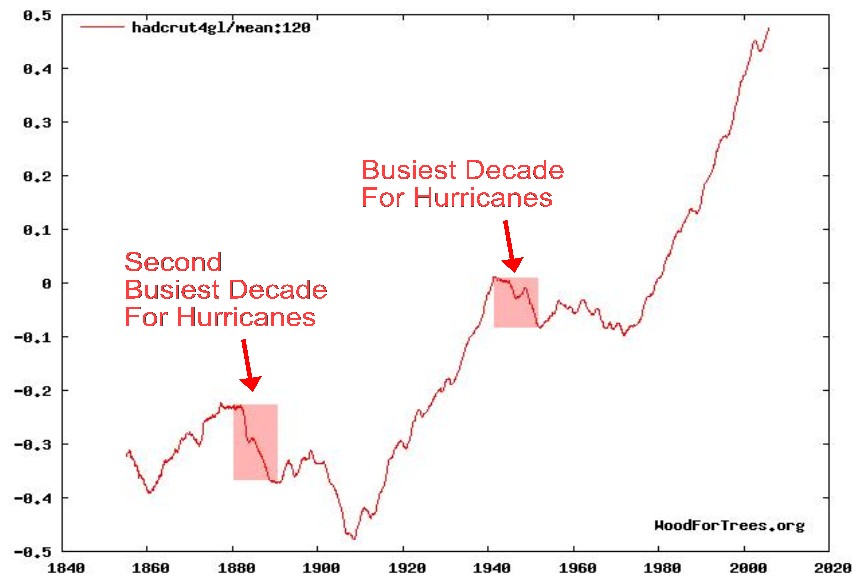
Wood for Trees: Interactive Graphs
U.S. Hurricane Strikes by Decade
The 1880s was also the second busiest decade for US hurricane strikes (22 hurricanes, five major hurricanes) topped only by the 1940s (24 hurricanes, 10 major hurricanes) yet both decades were supposedly very cool, with plummeting temperatures.
According to Hansen, the world has been gaining heat at a rate of 400,000 A-bombs per day due to global warming, and hurricanes are made more frequent and intense by warmer water.
Since the 1880s, Hansen has accumulated almost 19,000,000,000 A-bombs worth of global warming energy, yet global accumulated cyclone energy is at a record low, and the US is currently experiencing the longest major hurricane free period on record – seven years. During the supposedly cold 1940s, the US averaged one major hurricane per year.
So the question becomes, what are Hansen and Jones lying about?
The Arctic Ocean could be free of ice in the summer as soon as 2010 or 2015 – something that hasn’t happened for more than a million years, according to a leading polar researcher.
Louis Fortier, scientific director of ArcticNet, a Canadian research network, said the sea ice is melting faster than predicted by models created by international teams of scientists, such as the Intergovernmental Panel on Climate Change (IPCC).
May. 15, 2012 12:09 PM ET
April 2012 heats up as 5th warmest month globallyBy SETH BORENSTEIN, AP Science Writer
Temperatures that would have once been considered unusually hot and record breaking now aren’t even in the top two or three, said Michael Oppenheimer, a Princeton University climate scientist.
The last time the globe had a month that averaged below the 20th Century normal was February 1985. April makes it 326 months in a row. Nearly half the population of the world has never seen a month that was cooler than normal, according to United Nations data.
“A warmer world is the new normal,” Oppenheimer said. “To me, it’s startling to think that a generation has grown up with global warming defining their world.”
According to our top scientists, human beings are now defined by a claimed half degree rise in temperatures. i.e. we have severely mentally ill people teaching our children at universities.
Arctic Death Spiral: More Bad News about Sea Ice
Published: May 16th, 2012
PrintPermalinkRSSShareThis
By Michael D. LemonickThe sea ice that blankets the Arctic Ocean each winter peaked in early March this year, as usual, and is now in retreat, en route to its annual minimum extent in September. How low it will go is something scientists worry: ice reflects lots of sunlight back into space, and when the darker ocean underneath is exposed, more sunlight is absorbed to add to global warming.
That’s the simple version of the story, but things look even worse when you dig into the details. For one thing, all that open water does re-freeze each winter, but it freezes into a relatively thin layer known as seasonal, or first-year ice. Because it’s so thin, first-year ice tends to melt back quickly the following season, giving the ocean a chance to warm things up even more in what National Snow and Ice Data Center director Mark Serreze has called a “death spiral” that could lead to ice-free Arctic summers by 2030.
Arctic Death Spiral: More Bad News about Sea Ice | Climate Central
Complete bull. The peak came right at the end of March – one of the latest peaks on record.
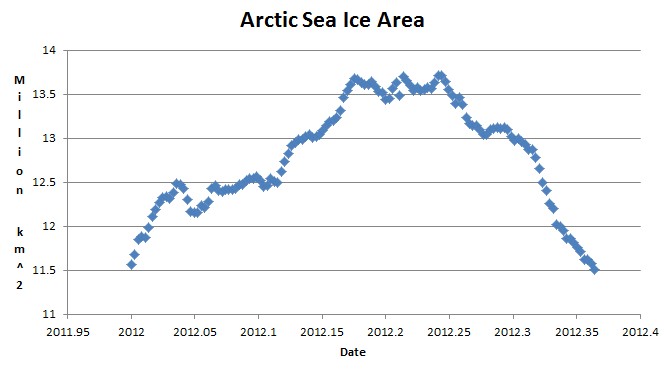
arctic.atmos.uiuc.edu/cryosphere/timeseries.anom.1979-2008
First year ice forms every winter, and has since water first appeared on the surface of the planet. The author is providing absolutely no useful or new information about the state of Arctic ice and is just cranking out another content free global warming fairy tale.
h/t to Marc Morano