
Last year, the world’s leading expert claimed that Greenland was darkening due to soot.
The world’s leading expert on the ice that covers the huge expanse of Greenland has told The Independent that he was “stunned” to see how much darker it has become in the past year – warning it could start a hugely damaging “cascading feedback loop” of the area becoming blacker as less and less light is reflected.
Greenland’s dark snow may start global warming ‘feedback loop’ – Environment – The Independent
I pointed out at the time that this claim is complete nonsense.
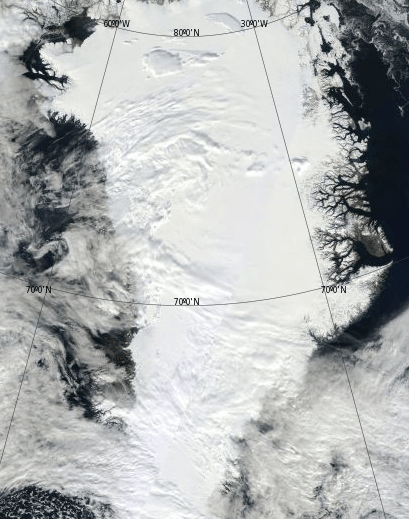
And now, the world’s leading expert gets debunked by his colleagues.
Arctic snow not darkening due to soot, dust, study finds
October 31, 2015
For millennia, Greenland’s ice sheet reflected sunlight back into space, but satellite measurements in recent years suggest the bright surface is darkening, causing solar heat to be absorbed and surface melting to accelerate. Some studies suggest this “dirty ice” or “dark snow” is caused by fallout from fossil fuel pollution and forest fires.
But a new Dartmouth-led study shows that degrading satellite sensors, not soot or dust, are responsible for the apparent decline in reflectivity of inland ice across northern Greenland. The study’s results suggest the ice sheet hasn’t lost as much reflectivity as previously thought, and that black carbon and dust concentrations haven’t increased significantly and are thus not responsible for darkening on the upper ice sheet.
h/t to Dave G


Alarm vs Sceptical science!
O/T, apologies, but important.
Political Theorist gets our “Inverted Totalitarianist Govts”
http://www.informationclearinghouse.info/article43306.htm
Excellent,
I just saw this ad displaced: http://securedcities.com/
It seems to fit right in with what that article is talking about.
What in Hades is a ‘secured city’ A UK type city with cameras on every corner to spy on citizens?
YUP! and much more
Here is the program:
http://securedcities.com/conference.php
Gail, apologies for tardy reply.
A combination of circumstances.
I cannot but feel that the Bankster NWO is faltering & failing, mainly thanks to Putin.
I cannot but feel also that the number of people willing to even disduss the important issues is vanishingly tiny.
It remains to be seen if the Bankster elite will push their failing agenda to the bitter eugenicist end.
http://www.savethemales.ca/000447.html
Best,
John Doran.
Uh, wouldn’t degrading sensors have shown a darkening of everything?
Assuming that the deposition of soot is a constant, then it would be reasonable to think that in years of above average surface melt, there will be more soot left on the surface, which will make it darker and increase the melt. New snowfall will cover that surface, and in years with average or below average melt, there will be less soot on the surface.
Steven, if this study turns out to be correct, then AGW is worse than we thought. The Greenland ice sheet is melting, and we had thought that part of that melting was caused by the accumulating soot. This study says that’s not so, which means the melting is caused by the increasing temperature.
What melting?
Greenland Blowing Away All Records For Ice Gain
http://realclimatescience.com/wp-content/uploads/2015/10/2015-10-29-05-51-27.png
https://stevengoddard.wordpress.com/2015/10/29/greenland-blowing-away-all-records-for-ice-gain/
Greenland ice sheet is NOT melting. The temperature is NOT increasing.
Now that the AMO has switched Greenland is responding with massive growth rates this year.
Again, your refusal to accept basic REAL DATA shows that you are an ignorant, moronic low-level troll.
You have NOTHING to offer but Parroting of the Norwegian Blue type.
The ignorance is certainly getting out of hand! Take a look at this POS: http://www.newsweek.com/smith-island-sinking-chesapeake-bay-thanks-climate-change-389131
If soot levels are causing the ice loss, why wasn’t it there from the higher levels in the 1860’s.
“C”ing Arctic Climate with Black Ice Richard B. Alley
They obtained highly accurate, well-dated chemical histories—including black carbon concentrations—from 1788 to 2002, with a time resolution of less than a year. For the first 60 years of the record, black carbon concentrations remained relatively stable, but the period from 1850 to 1951 showed highly elevated soot concentrations, especially during winter, when peak values were 10 times higher than the baseline. Lower values (although still higher than before 1850) mark the last 50 years of the record. Comparison to selected sections of a second core, collected 350 km to the south, shows close agreement, demonstrating the regional coherence of the signal.
also – http://news.bbc.co.uk/2/hi/6939633.stm
Why didn’t they also look at photosynthesising microalgae and cyanobacteria?
Abstract
Darkening of parts of the Greenland ice sheet surface during the summer months leads to reduced albedo and increased melting. Here we show that heavily pigmented, actively photosynthesising microalgae and cyanobacteria are present on the bare ice. We demonstrate the widespread abundance of green algae in the Zygnematophyceae on the ice sheet surface in Southwest Greenland. Photophysiological measurements (variable chlorophyll fluorescence) indicate that the ice algae likely use screening mechanisms to downregulate photosynthesis when exposed to high intensities of visible and ultraviolet radiation, rather than non-photochemical quenching or cell movement. Using imaging microspectrophotometry, we demonstrate that intact cells and filaments absorb light with characteristic spectral profiles across ultraviolet and visible wavelengths, whereas inorganic dust particles typical for these areas display little absorption. Our results indicate that the phototrophic community growing directly on the bare ice, through their photophysiology, most likely have an important role in changing albedo, and subsequently may impact melt rates on the ice sheet.
http://www.ncbi.nlm.nih.gov/pubmed/23018772
By the way, soot levels in the ice cores are measured in pica grams per ml with values like 612 pgmL?1. Not a lot there.
http://www.clim-past.net/10/1905/2014/cp-10-1905-2014.pdf
And most of the dirt levels on top of the glaicers comes from rock slides not soot. Not a lot of mountains sticking out of the middle of the icecap.
http://www.nationalparkstraveler.com/sites/default/files/styles/panopoly_image_half/public/legacy_files/storyphotos/GLBA-Johns%20Hopkins%20Landslide%20NPS.jpg?itok=KvIArmEb
A massive landslide, one of the biggest ever seen in North America and which registered on seismographs in Canada and the United States, has covered a more than 5-mile run of the Johns Hopkins Glacier in Glacier Bay National Park and Preserve like chocolate frosting on cake.
Greenland ice levels are deepening, Antarttic ice sheets are expanding, yet the climate warming folks just can’t let go of their god of one world control through planet saving endeavors. I worry more for the planet regarding the coming cooling. Much more dangerous than warming. Europe and Eastern U.S. will suffer tremendously. Sub Sahara Africa will become the the worlds breadbasket. Stay tuned. Oh, Russia and China will not fare well either.