So here is the joke – 1896 was at the start of a global cooling panic.
Global Cooling: 1895-1932
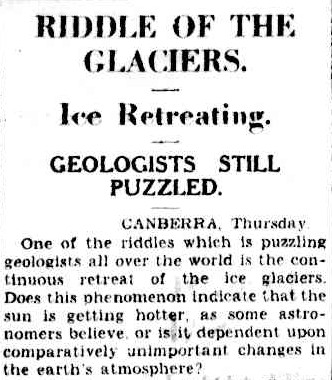
The world knew all about cold weather in the 1800s. America and Europe had escaped a 500-year period of cooling, called the Little Ice Age, around 1850. So when the Times warned of new cooling in 1895, it was a serious prediction.
On Feb. 24, 1895, the Times announced ‘Geologists Think the World May Be Frozen Up Again.’ The article debated ‘whether recent and long-continued observations do not point to the advent of a second glacial period.’ Those concerns were brought on by increases in northern glaciers and in the severity of Scandinavia’s climate.
Fear spread through the print media over the next three decades. A few months after the sinking of the Titanic, on Oct. 7, 1912, page one of the Times reported, ‘Prof. Schmidt Warns Us of an Encroaching Ice Age.’
Scientists knew of four ice ages in the past, leading Professor Nathaniel Schmidt of Cornell University to conclude that one day we will need scientific knowledge ‘to combat the perils’ of the next one.
The same day the Los Angeles Times ran an article about Schmidt as well, entitled ‘Fifth ice age is on the way.’ It was subtitled ‘Human race will have to fight for its existence against cold.’
That end-of-the-world tone wasn’t unusual. ‘Scientist says Arctic ice will wipe out Canada,’ declared a front-page Chicago Tribune headline on Aug. 9, 1923. ‘Professor Gregory’ of Yale University stated that ‘another world ice-epoch is due.’ He was the American representative to the Pan-Pacific Science Congress and warned that North America would disappear as far south as the Great Lakes, and huge parts of Asia and Europe would be ‘wiped out.’
Gregory’s predictions went on and on. Switzerland would be ‘entirely obliterated,’ and parts of South America would be ‘overrun.’ The good news – ‘Australia has nothing to fear.’ The Washington Post picked up on the story the following day, announcing ‘Ice Age Coming Here.’
Talk of the ice age threat even reached France. In a New York Times article from Sept. 20, 1922, a penguin found in France was viewed as an ‘ice-age harbinger.’
Even though the penguin probably escaped from the Antarctic explorer Sir Ernest Shackleton’s ship, it ’caused considerable consternation in the country.’
Some of the sound of the Roaring ’20s was the noise of a coming ice age – prominently covered by The New York Times. Capt. Donald MacMillan began his Arctic expeditions in 1908 with Robert Peary. He was going to Greenland to test the ‘Menace of a new ice age,’ as the Times reported on June 10, 1923.
The menace was coming from ‘indications in Arctic that have caused some apprehension.’ Two weeks later the Times reported that MacMillan would get data to help determine ‘whether there is any foundation for the theory which has been advanced in some quarters that another ice age is impending.’
On July 4, 1923, the paper announced that the ‘Explorer Hopes to Determine Whether new ‘Ice Age’ is Coming.’
The Atlanta Constitution also had commented on the impending ice age on July 21, 1923. MacMillan found the ‘biggest glacier’ and reported on the great increase of glaciers in the Arctic as compared to earlier measures.
Even allowing for ‘the provisional nature of the earlier surveys,’ glacial activity had greatly augmented, ‘according to the men of science.’ Not only was ‘the world of science’ following MacMillan, so too were the ‘radio fans.’
The Christian Science Monitor reported on the potential ice age as well, on July 3, 1923. ‘Captain MacMillan left Wicasset, Me., two weeks ago for Sydney, the jumping-off point for the north seas, announcing that one of the purposes of his cruise was to determine whether there is beginning another ‘ice age,’ as the advance of glaciers in the last 70 years would seem to indicate.’
Then on Sept. 18, 1924, The New York Times declared the threat was real, saying ‘MacMillan Reports Signs of New Ice Age.’
Fire and Ice | Media Research Center