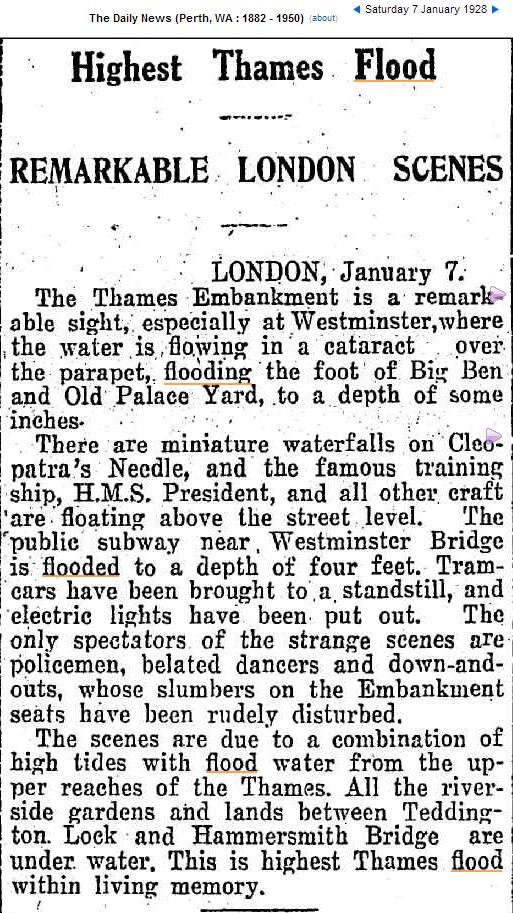
In 1923 it was warmer in Svalbard than it is now.
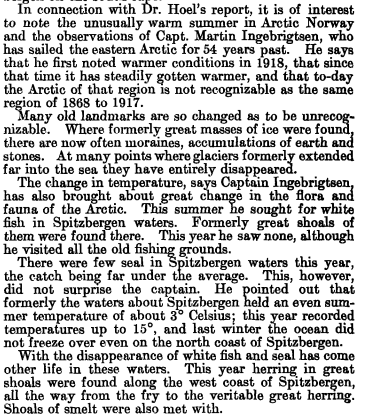
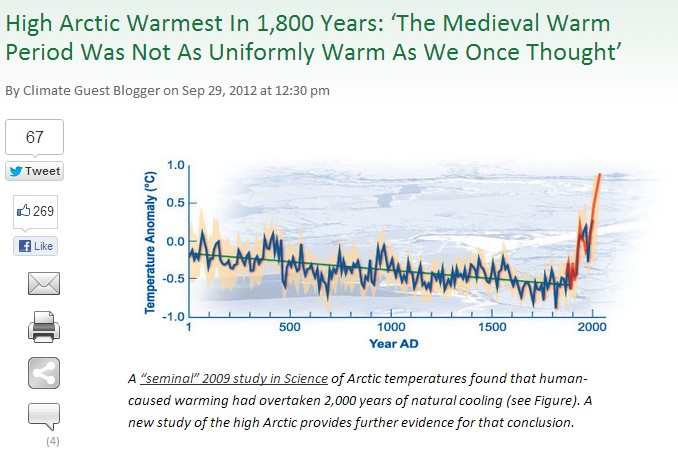
Romm says that current temperatures in Svalbard are the highest in 1,800 years, so we can deduce that 1923 was more than 1,800 years ago.
h/t to Marc Morano
In 1923 it was warmer in Svalbard than it is now.
Romm says that current temperatures in Svalbard are the highest in 1,800 years, so we can deduce that 1923 was more than 1,800 years ago.
h/t to Marc Morano
Wildfires are getting longer, fiercer, and more costly to contain. Wildfires have burned an average of 7 million U.S. acres every year since 2000. That’s equal to burning all of Yellowstone National Park three times over each year. But from 1960 to 1999, wildfires consumed half that amount – an average 3.5 million acres a year. U.S. wildfire seasons now last an average 76 days longer than in the 1970s and 1980s. Before 1986, a wildfire was contained on average in less than eight days. Since then, the average wildfire has burned for 37 days.
Face the Facts USA: Wildfires are burning longer – San Jose Mercury News
The five largest fires in US history all occurred more than a century ago.
- 1871 Peshtigo Fire – 3.8 million acres
- 1825 Maine Fire – 3 million acres
- 1898 South Carolina – 3 million acres
- 1910 Idaho – 3 million acres
- 1881 Michigan – 2.5 million acres
By cherry picking the ice age scare of the 1960s and 1970s to compare against, there is no limit to how much climate BS can be generated.
h/t to Marc Morano

Clint Dempsey scores the winning goal for Spurs. The last time Spurs won at the trashbin was before Hansen drowned Manhattan.
The Earth’s changing climate is costing the global economy $1.2 trillion a year and killing 1,000 children a day, according to a new study—and the U.N. warns the summer’s record heat and drought could trigger a catastrophe.
Climate Change Kills 400,000 a Year, New Report Reveals – The Daily Beast
I’m not exactly sure how massively upwards adjusted US temperatures kill children in Africa, but the UN has it figured out.
He is even worse this week than he was last week.
The UK’s top scientist told us a few years ago that Antarctica would soon be the world’s only inhabitable continent. Springtime has arrived, and it is time to start planning your future retirement home.
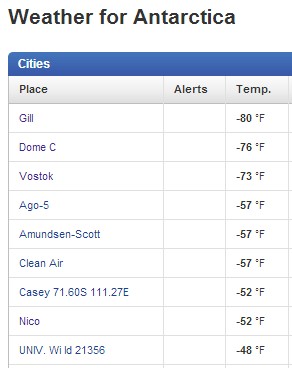
Weather Forecast – Antarctica, AA – Local & Long Range | Weather Underground
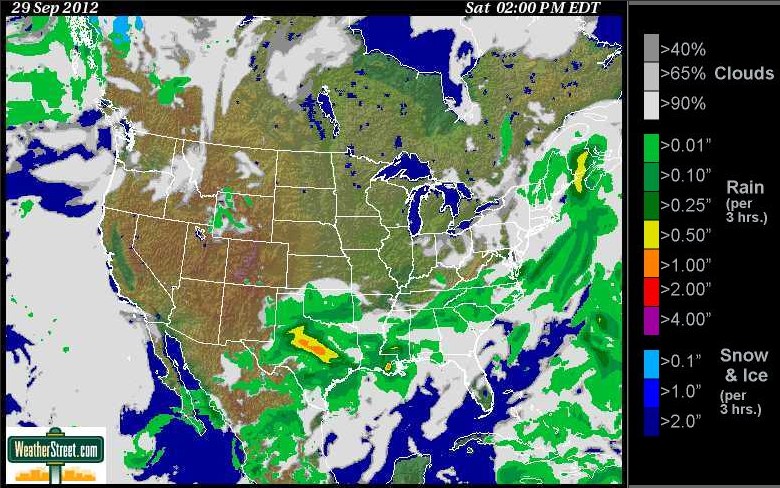
Weather Street:Clouds and Precipitation Forecast Movie
Last year, leading Texas A&M climate expert Andrew Dessler ridiculed Rick Perry for saying “the rains will return, they always do”
Dessler himself issued this brilliant forecast for Texas
Get used to it. The weather of the 21st century will be very much like the hot and dry weather of 2011. Giving extra credibility to this forecast is the fact that the weather extremes that we are presently experiencing were predicted in the first edition in 1995.
Global warming continues to pose a real threat that should not be ignored – a claim reinforced in a new study by scientists, reported in a supplement of the August issue of the Bulletin of the American Meteorological Society. This is despite very small global temperature rises over the last 10 years.
the Met Office’s decadal forecast predicts renewed warming after 2010 with about half of the years to 2015 likely to be warmer globally than the current warmest year on record.
So far, the Met Office has been wrong on 93% of the days since 2010, with only 20 days warmer than the same day in 2010, and 635 days cooler than 2010.
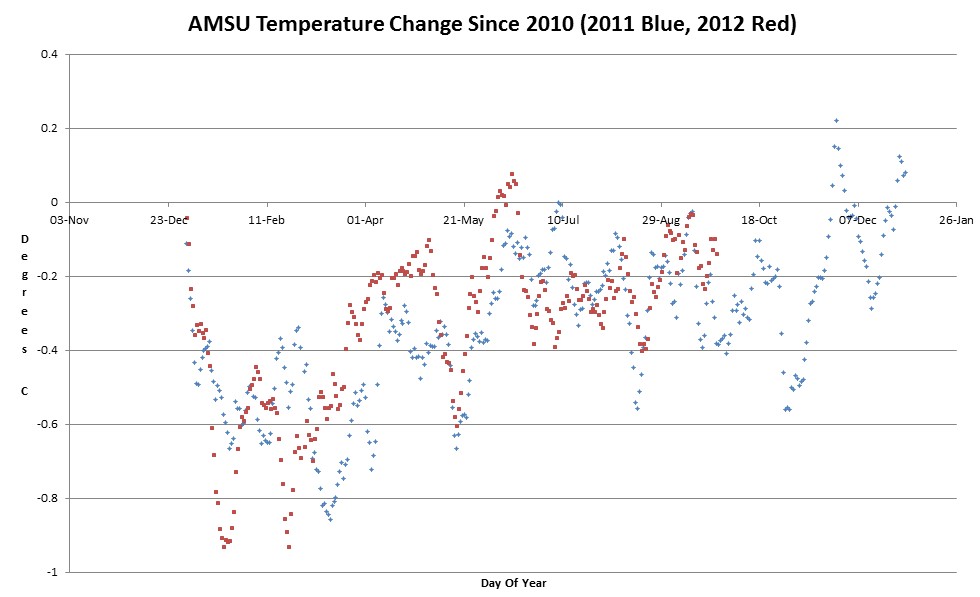
discover.itsc.uah.edu/amsutemps/data/amsu_daily_85N85S_ch05.r002.txt
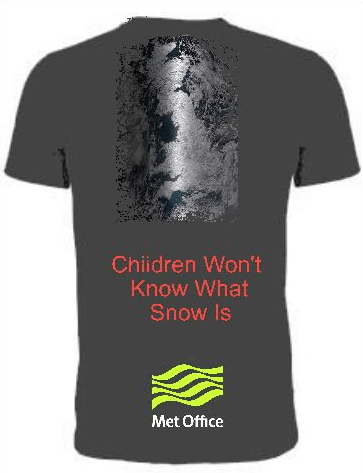
Global warming means t-shirt weather year round in England
24 March 2010
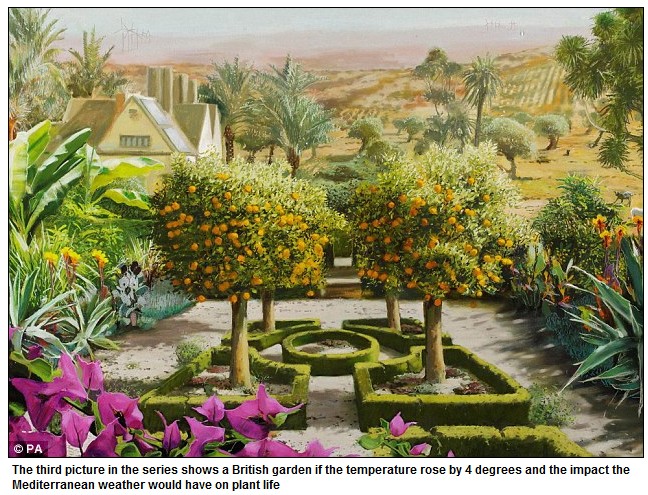
Mike Calnan, the National Trust’s head of gardens and parks, said thepredictions were based on computer models generated by the Met Office Hadley Centre.
‘We looked at gardens in southern France and southern Portugal and, bearing in mind what we can grow in this country in mild locations, we came up with a list of probably things we could grow in the future,’ he said
He added: ‘The Met Office are saying that despite the recent concerns about the science, they are very sure about the underlying science.