
Climate experts tell us that heavy rain is due to global warming, which is why the world record rainfall came during the coldest year ever.
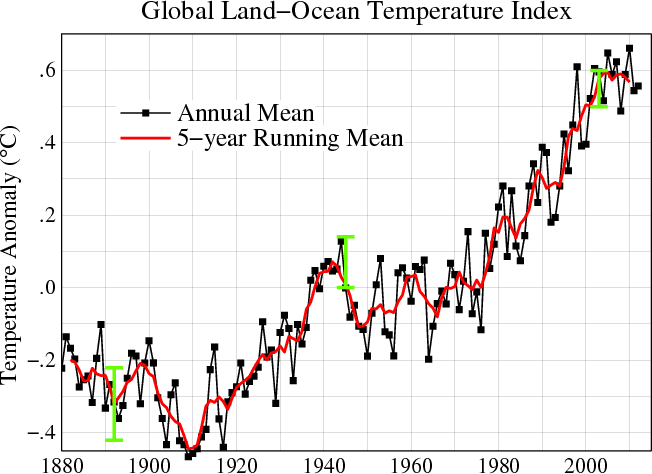

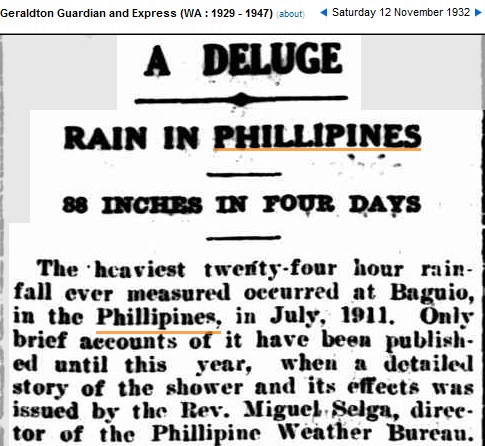
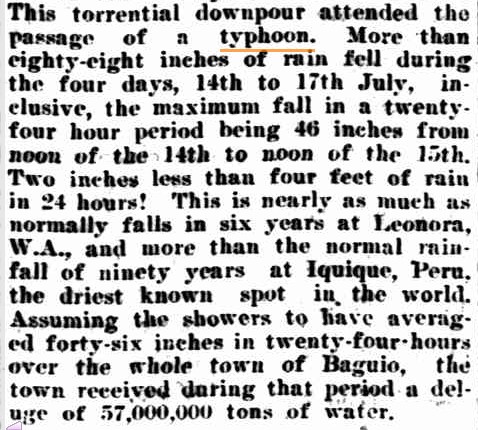
Climate experts tell us that heavy rain is due to global warming, which is why the world record rainfall came during the coldest year ever.


According to http://wmo.asu.edu/, this Phillipine event doesn’t rank on the rainfall records list. More rain fell in a 3 day period in 2007, But 6 of 8 rainfall records occurred in or before 1966 , 47 years ago. 154.7″ fell in 3 days and 191.7″ fell in 4 days in the 2007 rainfall event in Cratère Commerson, La Réunion. Not sure if this is correct or not, but there it is, in an effort for accuracy.
Well, here’s what Wikipedia currently reckons:
Most in one minute: 38 mm (1.5 in); Barst, Guadeloupe, 26 November 1970.
Most in one hour: 305 mm (12.0 in) in 42 minutes. Holt, Missouri, United States, 22 June 1947.
Most in 12 hours: 1,144 mm (45.0 in); Foc-Foc, Réunion, 8 January 1966, during tropical cyclone Denise.
Most in 24 hours: 1,825 mm (71.9 in); Foc-Foc, Réunion, 7–8 January 1966, during tropical cyclone Denise.
Most in 48 hours: 2,467 mm (97.1 in); Aurère, Réunion, 8–10 January 1958.
Most in 72 hours: 3,929 mm (154.7 in); Commerson, Réunion, 24–26 February 2007.
Most in 96 hours: 4,869 mm (191.7 in); Commerson, Réunion, 24–27 February 2007.
Most in one year: 26,470 mm (1,042 in); Cherrapunji, India, 1860–1861.
Highest average annual total: 11,872 mm (467.4 in); Mawsynram, India.
Is there a global precipitation data set available somewhere?
I am sure Jimmy or Phil will be happy to fabricate one for you. Maybe Dessler can find one in his book if fairy tales! It is a travesty that one is not handy for Kevin! 😉 °c