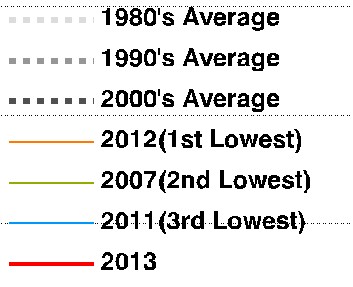
The animation below shows the changes from JAXA V1 to V2. Note how the 1980s minimum hardly changed at all, but more recent minimums have been increasingly reduced over time, particularly the last four years where they have made large reductions in ice extent. Hansen must be proud.

Disrupting the Borg is expensive and time consuming!
Google Search
-
Recent Posts
- El Nino To The Rescue?
- Worst March Drought On Record
- ChartGL Process Control Demo
- The Biggest Money Laundering Scam
- Drought In The Headwaters Of Lake Powell
- Unrealistic Expectations Of Water Availability
- Did Bill Gates Do This?
- Worst March Drought On Record In The US
- The Real Hockey Stick Graph
- Analyzing The Western Water Crisis
- Gaslighting 1924
- “Why Do You Resist?”
- Climate Attribution Model
- Fact Checking NASA
- Fact Checking Grok
- Fact Checking The New York Times
- New Visitech Features
- Ice-Free Arctic By 2014
- Debt-Free US Treasury Forecast
- Analyzing Big City Crime (Part 2)
- Analyzing Big City Crime
- UK Migration Caused By Global Warming
- Climate Attribution In Greece
- “Brown: ’50 days to save world'”
- The Catastrophic Influence of Bovine Methane Emissions on Extraterrestrial Climate Patterns
Recent Comments
- Bob G on El Nino To The Rescue?
- conrad ziefle on El Nino To The Rescue?
- Bob G on El Nino To The Rescue?
- arn on El Nino To The Rescue?
- BenV on El Nino To The Rescue?
- Bob G on El Nino To The Rescue?
- Peter Carroll on Worst March Drought On Record
- GW on El Nino To The Rescue?
- conrad ziefle on El Nino To The Rescue?


At least they didn’t monkey around with the predictable endpoint of 2013, which tracks the 2008 “recovery” (not shown) with precision, and for the same (non-CO2 related & affected) reason!!!
new and improved….to show less ice
When they initiated the coastal algorithm, of course it’s going to show less ice…
They must have “adjusted” the past again to show that.
…so they lied again
The 1980s average max change is the big problem.
The article “North American moose dying at alarming rates” says “Winters have grown substantially shorter across much of the moose’s range”, “a longer fall with less snow”, and “when the temperature rises above 23 degrees Fahrenheit in winter, as has happened more often in recent years”. The link is: http://www.lasvegassun.com/news/2013/oct/24/north-american-moose-dying-alarming-rates-biologis/
Reblogged this on Edonurwayup's Blog.