We can’t say for certain that Andrew Freedman wouldn’t be clueless without his CO2 paranoia, but it almost certainly has made his condition worse. He rants about Sandy without checking his facts.
Scientists cannot yet answer the specific question of whether climate change made Hurricane Sandy more likely to occur, since such studies, known as detection and attribution research, take many months to complete. What is already clear, however, is that climate change very likely made Sandy’s impacts worse than they otherwise would have been.
There are three different ways climate change might have influenced Sandy: through the effects of sea level rise; through abnormally warm sea surface temperatures; and possibly through an unusual weather pattern that some scientists think bore the fingerprint of rapidly disappearing Arctic sea ice.
The most damaging aspect of the storm was the massive storm surge that struck the coastline from Massachusetts to Maryland. Global warming-related sea level rise gave the surge a higher launching pad than it would have had a century ago, making it more damaging than it otherwise would have been. This is only going to get worse as sea level rise continues as a result of warming ocean waters and melting polar ice caps and glaciers.
The storm surge at The Battery in Lower Manhattan was the highest ever recorded at that location. It surpassed even the most pessimistic forecasts, with the maximum water level reaching 13.88 feet above the average of the daily lowest low tide of the month, known as Mean Lower Low Water, including a storm surge component of 9.23 feet. That broke the official record of 10.5 feet above Mean Lower Low Water set in 1960 during Hurricane Donna, as well as a record set during a hurricane in 1821.
How Global Warming Made Hurricane Sandy Worse | Climate Central
Manhattan has been steadily subsiding for thousands of years due to post glacial rebound. Tide gauge records show no global warming footprint.
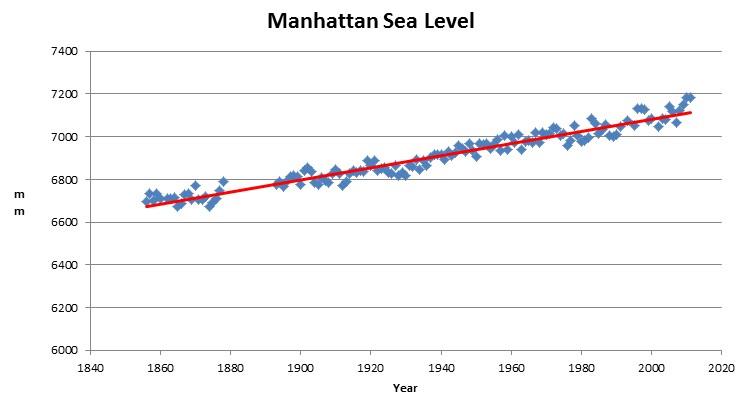 Data and Station Information for NEW YORK ( THE BATTERY)
The 1821 storm which he casually mentions was nearly identical to Sandy, and actually split Manhattan into two islands – despite the fact that the island was nearly two feet higher in 1821 as it is now. It came from a category four hurricane.
Sandy’s storm surge was largely driven by the fact that it was a full moon high tide, which raised tides almost a foot higher than the date of the 1821 storm.
As far as sea surface temperatures go, there is no indication that global warming had anything to do with it. Sandy hit an anomalously warm spot, but sea surface temperatures over much of the globe are anomalously cold. Freedman is using water temperature off New Jersey as a proxy for the planet, putting him on a par with one-tree Briffa for scientific malfeasance.

sst_anom.gif (800×600)
Sandy was largely powered by unusually cold inland temperatures. There is absolutely no reason to believe that global warming either caused or exacerbated Sandy’s storm surge.
Freedman has no idea what he is talking about.