RIVER RUNNERS: THE LATEST VICTIMS OF CLIMATE CHANGE
For the contiguous United States, the first nine months of 2012 were the warmest on record, according to the National Oceanic and Atmospheric Administration. As of October 2, 64 percent of the United States was in the middle of a drought. Wyoming and Colorado experienced the warmest summer on record, while Wyoming and Nevada saw the driest summer on record. In western and central regions of the country, wildfires burned a record-breaking 3.6 million acres in August.
In other words, it was a cruel summer. It stressed wildlife and depleted water reserves, but it also made life difficult for river runners in the Mountain West, whose business success is dictated largely by the health of the rivers they run. This followed very big water during the summer of 2011, thanks to major snowfall during the 2010-2011 season.
“We’re usually kayaking in March, April, May, and usually into June,” said Peter Van De Carr, who operates Backdoor Sports in Steamboat Springs and runs the Yampa River. “But last summer, we were done [kayaking] at the end of March. “As of June 20, the river was 40 cubic feet per second and going down. A year before, June 20, 2011, it was 4,000cfs and going up.”
“Some would say it’s not climate change, but climate strange, with one of the wettest years on record followed by one of the driest,” said Soren Jespersen, northwest Colorado wildlands coordinator for the Wilderness Society. “I think all the businesses that depend somewhat on consistent weather patterns are having a hard time adjusting to these shifts, whether it be ski resorts or river guides.”
River Runners: The Latest Victims of Climate Change | Science | OutsideOnline.com
Any business person who has such a poor understanding of the fundamentals of their own business, deserves to go under.
Snowfall is extremely variable from year to year. At Crested Butte, Colorado the standard deviation is 67 inches. Snow peaked there in 1978, one year after the second driest winter on record.
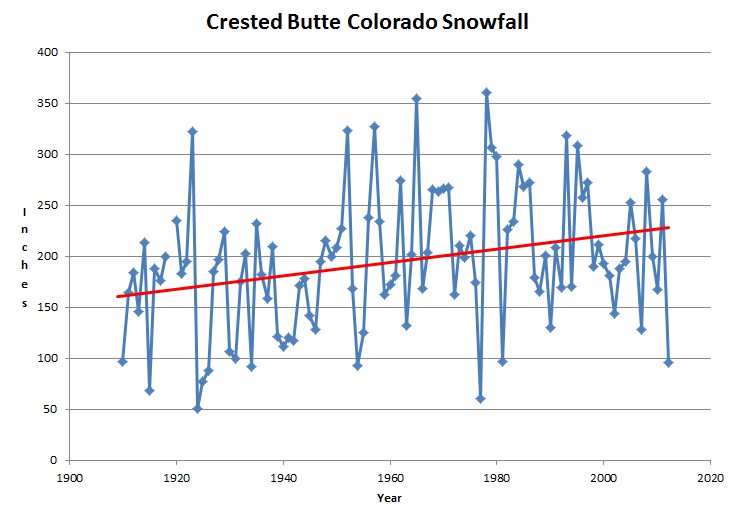
CRESTED BUTTE, COLORADO – Climate Summary