Russell Cook sent this over :

11. COOK: The program proclaimed the sea level rise won’t be stopped by some Carolina committee’s ignorance of it — but sea level rise will also not rise at the request of the IPCC’s prediction models, and according to a U. of Colorado study, “over the next 88 years, sea level would be expected to rise five inches in North Carolina” in direct contradiction to the Carolina committee’s report.
FL RESPONSE: We contacted the Univ. of Colorado, which denied this claim made on a blog. Steven Neerem, professor at the Colorado Center for Astrodynamics Research, told us: “I have never made a statement or provided a quote about sea level rise in North Carolina.” And also “What Mr. Goddard appears to have done is to linearly extrapolate the last 20 years of satellite data from our website, which would indeed result in only 5″ of sea level rise by 2100. However, no reputable scientist would linearly extrapolate 20 years of sea level data (a very short data record) to predict sea level rise 88 years later. Even longer tide gauge records would not give the complete picture, because they do not consider many factors including the acceleration of sea level rise that is expected from rising greenhouse gases. Regional predictions of future sea level rise must factor in the increasing heat content of the oceans and the locations of these changes, the melting of ice around the world and regional variations in sea level rise that result, as well as changes in ocean circulation due to all these factors including the addition of freshwater to the ocean. In addition, our satellite measurements do not include the contribution to relative sea level rise in North Carolina due to land subsidence.”
PBS | Ombudsman | The Mailbag: A Climate Change Exchange
CU sea level data shows no acceleration – quite the opposite.
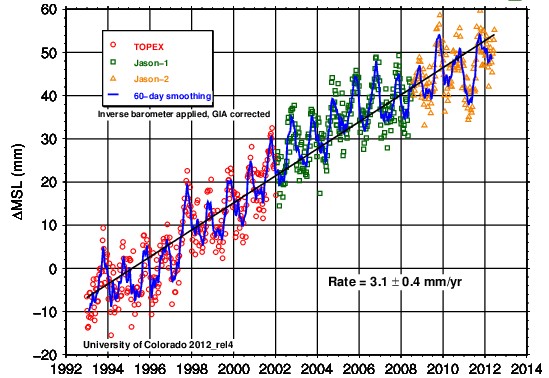
2012_rel4: Global Mean Sea Level Time Series
Their whole scary story is based on Hansen’s wildly irrational WAIS collapse theory towards the end of the century. The IPCC estimates only 18-59 cm of sea level rise this century. Apparently CU and PBS do not consider the IPCC to be reputable scientists.
The statement which I called into question was this.
Sea levels are rising faster than expected from global warming, and University of Colorado geologist Bill Hay has a good idea why. The last official IPCC report in 2007 projected a global sea level rise between 0.2 and 0.5 meters by the year 2100. But current sea-level rise measurements meet or exceed the high end of that range and suggest a rise of one meter or more by the end of the century.
Global warming: Sea level rising faster than expected « Summit County Citizens Voice
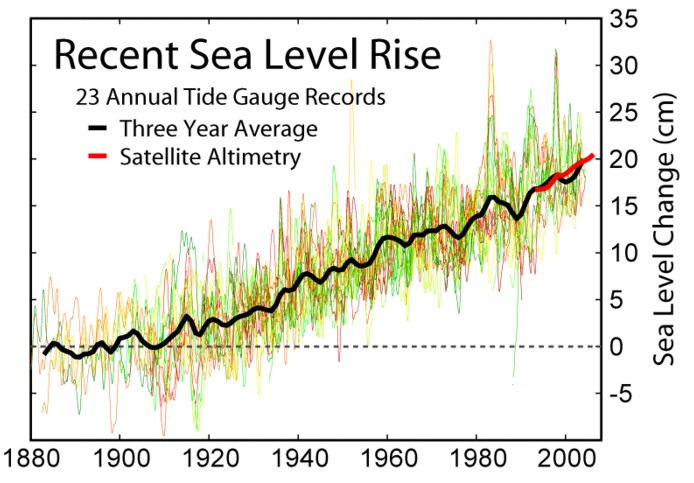
The PBS article acknowledges that the numbers claimed by Bill Hay are not accurate. Current sea level rise measurements are near the low end of the IPCC range, and are certainly not exceeding the high end.
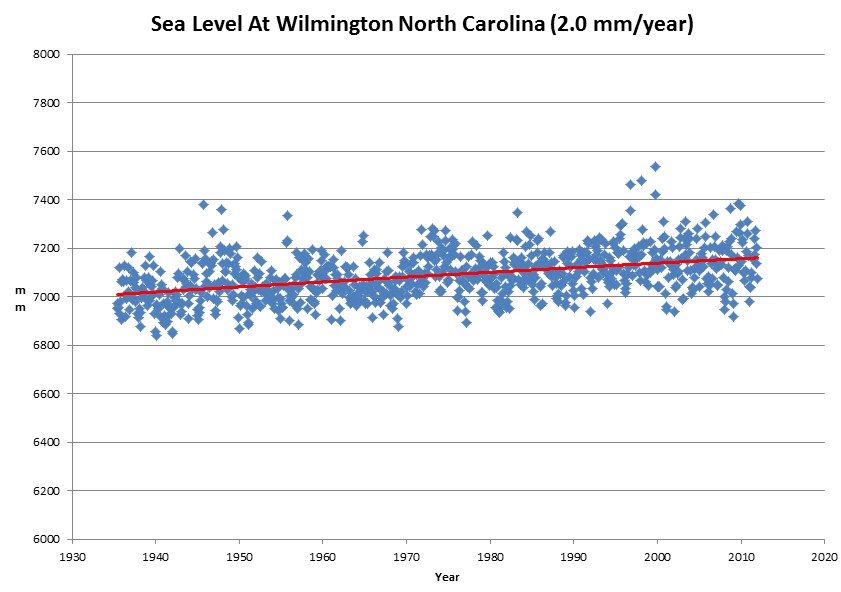
The only long term tide gauge in North Carolina shows even less sea level rise – 2.0 mm/year, and decelerating. There is no evidence that sea level rise is either accelerating or is a serious threat.
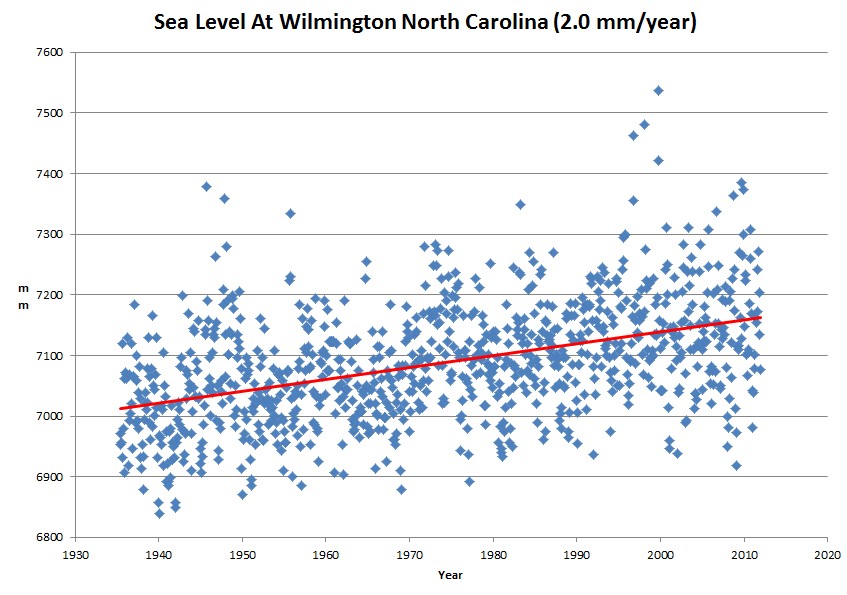
Since 1990 below – only 0.5 mm per year:

Data and Station Information for WILMINGTON